Twelve Nepali women, 1,700 kilometres: walking the Great Himalayan Trail
The Great Himalayan Trail runs the length of Nepal’s mountains, from Taplejung in the east to Darchula in the far west. Around 1,700 kilometres, across seventeen mountain districts. It is one of the longest and hardest walks anywhere.
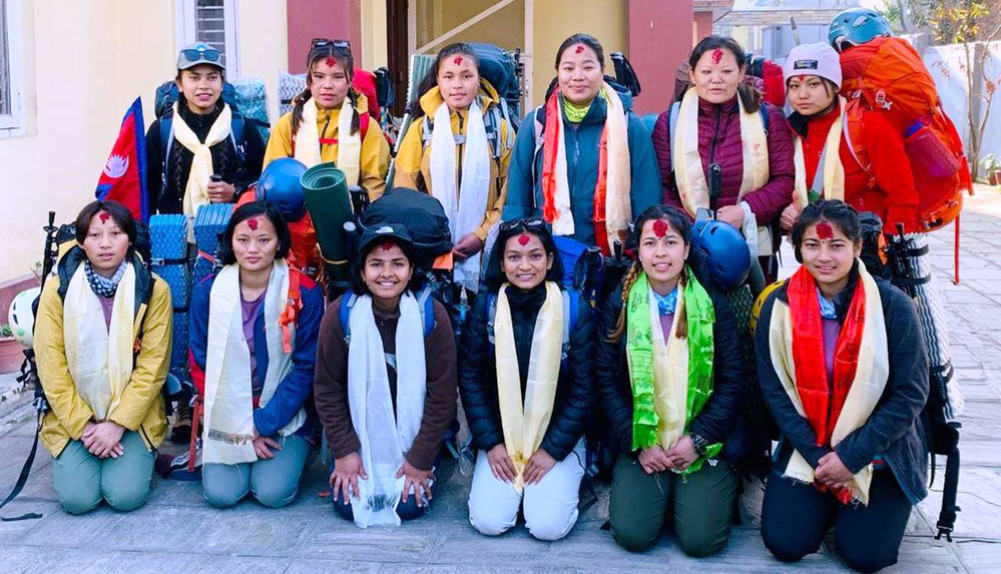
In March 2025, a team of twelve Nepali women and one man set out to do the whole thing in roughly a hundred days, led by Maya Gurung.
Who went
Alongside Maya Gurung: Shanti Thing Tamang, Sangita Vishwakarma, Dipa Lamichhane, Ranjita Lama, Varsha Bik, Saraswati Tamang, Shrishti Tamang, Anisha Shrestha, Sangeeta Tamang, Pramita Sapkota and Manmaya Tamang.
Several are from Sindhupalchowk, the district hit hardest by the 2015 earthquake.
Read the names again and notice the surnames. Tamang, Vishwakarma, Lama, Bik, Shrestha, Gurung, Sapkota, Lamichhane. That spread is not accidental, and it is the same principle the 2008 Everest expedition was built on. Who gets to represent Nepal in the mountains has never been evenly distributed, and the answer to that is not a statement, it is a team list.
What a hundred days on the GHT actually involves
This is not a long trek. It is a different category of thing.
The high route crosses passes above 5,000 m repeatedly, drops into valleys where the nearest road is days away, and passes through districts where lodges simply do not exist and you carry or arrange everything. Resupply is a logistics problem, not an errand. Weather windows on the passes do not care about your schedule. Doing it in one continuous push, west-bound or east-bound, means being fit in April and still fit in June.
The team started on 17 March 2025, timed around International Women’s Day.
Why this is the more useful story
Summits get the coverage. Everest gets the coverage most of all. But a summit is a day, and the skills that make a trekking guide employable are not summit-day skills. They are route knowledge, pacing a group, reading weather, knowing which lodge in which village, knowing what the trail does in the rain.
Walking 1,700 kilometres of Nepal end to end builds exactly that, at a scale almost nobody has. A woman who has done the full GHT knows the country’s mountain trails better than most working guides, and that knowledge is the thing that converts into a career rather than a headline.
Which is the point. Nepal’s trekking industry has never had a shortage of capable women. It has had a shortage of women with the visible, verifiable experience that gets you hired to lead.
Kantipur’s report: 12 Nepalese women on the Great Himalayan Trail.