Trip Facts
Country:
Annapurna Region, Nepal
Duration:
9 Days
Max Altitude:
3,210 m / 10,531 ft (Poon Hill viewpoint)
Activities:
Trekking
Region:
Annapurna Conservation Area, Gandaki
Grade:
Easy to Moderate
Group Size:
1–12 people
Accomodation:
3-star hotels in Kathmandu and Pokhara (3 nights), teahouse lodges on trek (5 nights)
Trips Overview
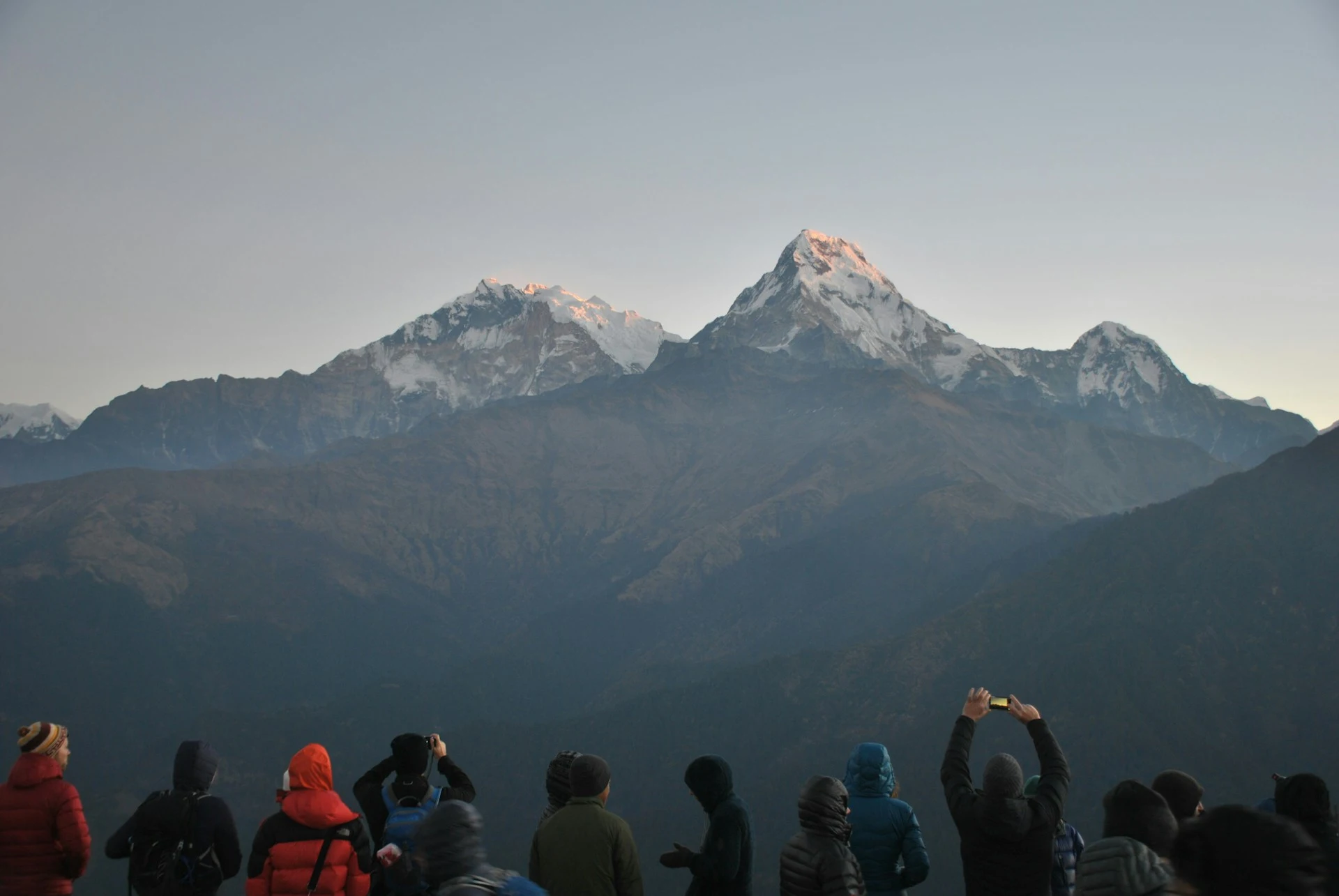
Poon Hill is a viewpoint, not a base camp. That single sentence explains most of what people get wrong about this trek. You do not walk up to the foot of Annapurna. You climb a 3,210 m grassy hill on the far side of a deep valley and look across at Dhaulagiri, Annapurna South, Hiunchuli, Nilgiri and Machhapuchhre standing in a row about 25 to 30 km away. The scale is enormous. The distance is real.
Understood that way, it is the best first Himalayan trek in Nepal, and we say that after running longer and higher routes for years. Five walking days. A maximum sleeping altitude of 2,860 m at Ghorepani, which is below the height at which altitude illness becomes a serious concern. A trail that is stone-paved for most of its length, with a village and a lodge every hour or two. You are never more than half a day from a road.
The hard part is not the altitude
It is the staircase above Tikhedhunga. Roughly 3,300 stone steps climb to Ulleri in a single relentless sequence. Nobody has counted them properly and estimates run from 3,200 to 3,700, which tells you something about how much anyone wants to repeat the exercise. It gains about 420 m. On a warm afternoon in October it takes most people two hours and it is the thing they talk about afterwards, not the view.
Then there is the descent from Ghandruk, which drops 720 m on stone in three to four hours. If your knees are going to complain on this trek, that is where. Trekking poles are not optional here in the way they are optional elsewhere.
Poon Hill at sunrise is crowded
We would rather you heard it from us. In the second half of October you can expect 200 to 400 people on that hilltop between 5:30am and 6:30am, and the viewing tower has a queue. It is not a solitary Himalayan dawn. It is a shared one, with headtorches strung out on the path below you and a tea stall doing very good business at the top.
Two things make it better, and we build both in. We leave Ghorepani before most lodges have finished their breakfast bell, which puts us on the hill early enough to choose where to stand. And we stay on top for an hour after sunrise rather than twenty minutes, because the crowd drains away fast and the light on Dhaulagiri at 7am is better than it was at 6.
Who this trek is right for
First-time trekkers. Families. Anyone with nine days who wants Himalayan mountains without a fortnight of leave and without the altitude risk that comes with going above 4,000 m. We have run this route with a nine-year-old and with trekkers in their late seventies, which is not something we would say about most of our itineraries.
It is also the right trek if you want to find out how you cope with consecutive walking days before committing to something longer. Plenty of people do this one, then come back for Annapurna Base Camp or Everest Base Camp knowing what they are signing up for.
Who it is not right for
If you have already trekked in Nepal, or you want solitude, or you want to be surrounded by mountains rather than facing them, look at Mardi Himal or Khopra Danda instead. Both are covered in the FAQs below with honest comparisons rather than a nudge towards whichever we would prefer to sell.
Trips Highlights
- Watch sunrise from Poon Hill at 3,210 m, with Dhaulagiri, Annapurna South, Hiunchuli, Nilgiri and Machhapuchhre in one line across the valley
- Sleep no higher than 2,860 m, which keeps this trek below the altitude where mountain sickness becomes a real risk
- Climb the Ulleri staircase, roughly 3,300 stone steps, the section everyone remembers long after the sunrise
- Walk a loop rather than an out-and-back, coming down the Modi Khola valley instead of retracing the Bhurungdi
- Spend an afternoon in Ghandruk, a slate-roofed Gurung village of about 1,000 households with Annapurna South directly overhead
- Cross rhododendron forest between Ulleri and Ghorepani, in flower from late March to early May
- Five walking days of 4 to 7 hours, on stone-paved trail with a village and a lodge every hour or two
- No domestic flight anywhere in the itinerary, so no weather cancellations and no spare days needed at the end
- Suitable for children from about nine and for trekkers well into their seventies, which is rare for a Himalayan route
- An extra hour on the viewpoint after sunrise, once the crowd has gone and the light on Dhaulagiri has improved
Trips Itinerary
You are met at Tribhuvan International Airport and driven to your hotel in Thamel. Nothing else is scheduled. Sleep, then walk around the neighbourhood in the late afternoon if you have the energy.
Your guide runs the briefing in the evening. We check your kit against the list, confirm your insurance covers trekking, take passport details for the permits, and hand over your duffel and map. If you are missing trekking poles, this is where you buy them. The gear shops are a five-minute walk and your guide will come with you and stop you overpaying.
Duration:
Transfer 30 to 45 min
Accomodation:
3-star hotel, Kathmandu
A long day on the Prithvi Highway, following the Trishuli river west. It used to take six hours. Road widening between Mugling and Pokhara has pushed it to seven or nine depending on traffic, and we would rather tell you that now than have you discover it on the bus.
The scenery from the window is genuinely good for the first half, all river gorge and rice terraces, and there are two food stops. Bring a book and download something to watch.
You arrive in Pokhara in the late afternoon. The lakeside is a pleasant place to eat and the hotel is a short walk from it. If you would rather fly, the 30-minute flight costs about USD 130 per person each way and we can arrange it. Roughly one trekker in five on this route takes that option.
Duration:
7 to 9 hrs drive, 205 km
Accomodation:
3-star hotel, Pokhara
A short drive north from Pokhara to the trailhead at Birethanti, where your ACAP permit is checked at the conservation area post. Then you start walking, up the Bhurungdi Khola through Hile and Tikhedhunga.
The first two hours are easy and pretty: terraced fields, buffalo, schoolchildren going the other way, water buffalo on the path. Then you cross the suspension bridge above Tikhedhunga at 1,540 m and the staircase starts.
Roughly 3,300 stone steps climb 420 m to Ulleri. Nobody has counted them properly and the estimates run from 3,200 to 3,700. It takes most people about two hours and there is no way to make it shorter or cleverer. Go slowly, stop at the tea stalls, use your poles, and accept that your calves will inform you about it tomorrow. Total ascent for the day is around 935 m, which is why we stop here rather than pushing on.
Ulleri is a Magar village on a shelf of hillside. Annapurna South appears above the roofs in clear weather, and it is the first time on this trip that the mountains look close.
Duration:
1 to 1.5 hrs drive, 4 to 5 hrs trek, 10 km
Accomodation:
Teahouse lodge, Ulleri
The best walking of the whole trek, and almost nobody expects it. The trail climbs 900 m through old rhododendron forest, past Banthanti and Nangethanti, on stone paths under a closed canopy with water running down beside you most of the way.
From late March into early May the rhododendrons are in flower and the forest goes red and pink overhead for hours at a time. In October the leaves are dark and the moss is thick and it feels like somewhere much further north than Nepal.
The climbing is steady rather than brutal, spread over five or six hours instead of concentrated the way yesterday was. Most people find today easier than Day 3 despite gaining more height.
Ghorepani sits on a saddle at 2,860 m, a cluster of blue-roofed lodges facing Dhaulagiri. It gets cold quickly once the sun drops behind the ridge, usually around 4:30pm. The dining room stove is lit in the evening and everyone in the village ends up around one.
Duration:
5 to 6 hrs trek, 9 km
Accomodation:
Teahouse lodge, Ghorepani
Up at 4:30am with a headtorch. The climb to Poon Hill is 1.6 km and 350 m of ascent on a good path, and takes 45 to 60 minutes. It is the coldest hour of the trip. Wear the down jacket, take gloves, and put a hat on before you start rather than halfway up.
Be honest with yourself about what is up there. In the second half of October there can be 200 to 400 people on that hilltop, and the viewing tower has a queue. We leave earlier than most lodges do specifically so we can pick our spot on the eastern edge before it fills.
What you see, when it is clear, is worth the alarm. Dhaulagiri at 8,167 m sits alone to the west with nothing in front of it. Then Tukuche, Nilgiri, Annapurna I at 8,091 m, Annapurna South, Hiunchuli, and Machhapuchhre off to the east with its fishtail summit catching light last. They are 25 to 30 km away across the Kali Gandaki and the Modi Khola. You are looking at them, not standing among them, and the distance is part of the scale.
We stay up for an hour after sunrise. Most groups leave within twenty minutes and the hilltop empties fast, the light on Dhaulagiri keeps improving, and the photographs people are happiest with are almost always the ones taken at 7am to an empty summit.
Back to Ghorepani for a proper breakfast, then east along the ridge through Deurali at about 3,090 m, then a long forest descent to Banthanti and on to Tadapani. The afternoon is downhill and knees start to talk. Poles out.
Duration:
1.5 hrs to Poon Hill and back, 5 to 6 hrs trek, 12 km
Accomodation:
Teahouse lodge, Tadapani
A short day, mostly down, dropping about 690 m through rhododendron and oak. There is a good chance of langur monkeys in the trees on this section and the forest is quieter than anything on the Ghorepani side because the Annapurna Base Camp crowds are on a different trail.
Ghandruk is the reason to walk this loop rather than turn around at Poon Hill. It is a large Gurung village of slate roofs and stone paving built up a hillside, with Annapurna South and Hiunchuli standing above it much closer than anything you saw at sunrise. Roughly 1,000 households, a working village rather than a trekking one.
You arrive early enough to spend the afternoon there. The Gurung Museum is small and worth thirty minutes. Beyond that the best thing to do is walk up through the upper village in the late light and sit somewhere.
Duration:
4 to 5 hrs trek, 8 km
Accomodation:
Teahouse lodge, Ghandruk
The last walking day, and the one that catches people out. It is 720 m of descent on stone steps to the Modi Khola, and stone stairs down are harder on the knees than any climb. Take it slowly, use both poles, and shorten your stride. Three to four hours, though people who race the first hour usually take four.
From the river the trail flattens into an easy walk along the water to Syauli Bazaar, where the road reaches. A jeep takes you back to Pokhara in two to three hours.
You are in Pokhara by mid afternoon, which leaves time for a shower and a proper meal by the lake. If you want to stay on for a couple of days, this is the natural place to do it and we can extend your hotel.
Duration:
3 to 4 hrs trek, 6 km, then 2 to 3 hrs drive
Accomodation:
3-star hotel, Pokhara
The same highway in reverse. A long day, but an easy one, and nobody minds it much with the walking finished.
You are back in Thamel by early evening. We hold the farewell dinner at a Nepali restaurant and hand out trip completion certificates. This is also when tips are given, pooled by the group, to the guide and porters together.
If you would rather fly back and use the day in Kathmandu instead, say so at booking. The flight is about USD 130 and we will restructure the day around it.
Duration:
7 to 9 hrs drive, 205 km
Accomodation:
3-star hotel, Kathmandu
Transfer to Tribhuvan International Airport about three hours before your flight.
Because this trek has no domestic flight in it, there is no realistic chance of a delay pushing your departure. That is the practical reason we recommend it to people travelling on fixed dates.
If you have time before you fly, or you want to extend, we can arrange a Kathmandu valley day around Boudhanath, Pashupatinath and Bhaktapur, or onward travel to Chitwan.
Duration:
Transfer 30 to 45 min
Accomodation:
Departure day
Trips Include
Everything below is inside the trek price. We give quantities and permit costs in rupees, because vague inclusion lists are where trekking budgets quietly break.
- Airport transfers on arrival and departure in Kathmandu, in a private vehicle
- 2 nights in a 3-star Kathmandu hotel on twin-share with breakfast (single supplement available)
- 1 night in a 3-star Pokhara hotel on twin-share with breakfast, on lakeside
- 5 nights in teahouse lodges on twin-share, with attached bathrooms at Ulleri, Ghorepani and Ghandruk
- All meals on trek: 5 breakfasts, 5 lunches and 5 dinners, with tea or coffee at every meal
- Fresh seasonal fruit after dinner each evening on the trail
- Farewell dinner in Kathmandu at a Nepali restaurant on your return
- Purified drinking water throughout the trek, so you never need to buy bottled water
- Tourist bus Kathmandu to Pokhara and back, in the reclining-seat class with air conditioning
- Private vehicle Pokhara to Birethanti trailhead, and jeep from Syauli Bazaar back to Pokhara
- Licensed, English-speaking trekking guide, with a second guide on departures of 7 or more
- One porter per two trekkers, carrying up to 12 kg each
- All guide and porter wages, meals, accommodation, equipment, insurance and medical cover
- Annapurna Conservation Area Permit (ACAP), NPR 3,000 per foreign national
- TIMS card, NPR 2,000, issued through our registered agency so you are covered whichever way a checkpoint is being run that week
- First aid kit carried by your guide, including a pulse oximeter
- Everest Women Treks duffel bag, trekking map, sun hat and buff, yours to keep
- Trip completion certificate
- All government taxes, VAT and company administrative costs
Guide and porter wages, insurance, equipment, food and lodging are ours to pay and already sit inside the price. Nobody on the trail will ask you to contribute to staff costs.
Trips Exclude
These sit outside the package. For nine days, budget roughly USD 150 to 300 on top of the trek price. That is less than most Nepal treks need, because this one is short, low and has no domestic flight in it.
- International flights to and from Kathmandu, and airport departure tax
- Nepal entry visa: USD 30 for 15 days, USD 50 for 30 days, available on arrival at Kathmandu airport
- Lunch and dinner in Kathmandu and Pokhara, other than the included farewell dinner
- Travel insurance, which must cover trekking and helicopter evacuation to at least 4,000 m
- Kathmandu to Pokhara flights if you prefer them to the bus, about USD 130 each way per person
- Bottled or boiled water, soft drinks, alcohol and hot chocolate on the trail
- Lodge charges for hot showers (USD 4 to 8), device charging (USD 2 to 4) and wifi (USD 2 to 5 per day)
- Dining room heating charge at Ghorepani in winter, typically USD 1 to 3 per person per evening
- Personal trekking clothing and equipment, including trekking poles
- Sleeping bag and down jacket if you rent rather than bring your own, about USD 25 each for the trek
- Tips for your guide, porters and drivers, customarily 10 to 15% of the trip cost, pooled by the group
- Extra nights or activities in Pokhara if you extend at the end
- Emergency evacuation costs, which your insurer reimburses
- Anything not listed under what is included
Travel insurance covering helicopter evacuation is required. Cover to 4,000 m is more than enough for this itinerary, and it is far cheaper and easier to buy than the 5,600 m cover the Everest and Annapurna Base Camp treks need. Read the altitude limit in the policy wording. Do not assume a standard travel policy includes trekking.
Packaging Lists
The three things that actually matter here
Trekking poles. On most treks they are useful. On this one they are the difference between arriving in Pokhara comfortable and arriving unable to go down stairs. The Ulleri ascent and the Ghandruk descent are both long stone staircases. Two poles, adjustable, used properly.
Broken-in boots with a stiff sole. Soft trail runners are punished by uneven stone. Walk at least 50 km in whatever you bring before you fly.
A light rain shell, in every season. Ghorepani sits where cloud piles up. It rains here in months when it is dry elsewhere in Nepal, and the rhododendron forest drips even when it is not raining.
Upper body
2 base layers in merino or synthetic, 1 fleece, 1 waterproof windproof shell, 1 light down jacket for the Ghorepani evening and the Poon Hill dawn. That dawn is the coldest hour of the trip and people underpack for it.
Lower body
2 pairs trekking trousers, 1 pair thermal leggings, waterproof over-trousers, 4 pairs underwear, 4 pairs of trekking socks.
Head, hands and feet
Sun hat, warm beanie, buff, category 3 sunglasses, light gloves, boots, and camp shoes or sandals for the evenings. A headtorch is essential rather than optional: you walk up Poon Hill in the dark.
For women
Bring enough menstrual supplies for the whole trek plus a few spare days, since what is sold in trail shops is limited and unpredictable. Sealable opaque bags for used products, which you carry out to Pokhara.
Sleeping
A bag rated to 0C comfort is enough for Ghorepani in the main seasons, and minus 5C if you are going in December or January. This is a much lighter bag than the high treks need. Lodges provide blankets and most will give you a second one if you ask.
Health and documents
Blister plasters and tape, ibuprofen for the knees, rehydration salts, prescription medicines in original packaging, SPF 50 sunscreen and lip balm, passport, two passport photographs, insurance certificate, and rupees in small notes.
Bags
One duffel of up to 12 kg carried by your porter (we provide it), plus a 25 to 35 litre daypack for water, a layer, camera and documents. There is no flight weight limit on this trek, which is a relief compared with Lukla.
Trips Altitude
Trips FAQs
The questions we get asked about this trek, including the awkward ones about crowds, knees and whether a different Annapurna route would suit you better.
Yes, with your expectations set correctly. In mid to late October there are commonly 200 to 400 people on the summit at sunrise and the viewing tower has a queue. In April it is busy but noticeably less so. In December, February and June you may have twenty people up there.
The crowd does not block the view. Poon Hill is an open grassy dome, not a narrow ledge, and there is room to spread out if you arrive early enough to choose. What the crowd does is change the feeling of the morning from solitary to communal. Some people mind that a lot. Most do not.
Two things we do about it: we leave Ghorepani before the lodges have finished serving breakfast, and we stay an hour after sunrise rather than heading straight down. The hill empties within twenty minutes of the sun clearing the ridge and the light on Dhaulagiri gets better, not worse, for the next hour.
If solitude is genuinely what you are after, do Khopra Danda or Mardi Himal instead. We would rather send you there than have you disappointed here.
Easy to moderate, with two specific hard sections that have nothing to do with altitude.
The first is the Ulleri staircase on Day 3: roughly 3,300 stone steps gaining 420 m, usually about two hours, at the end of a day that has already gained 500 m. It is the single hardest hour of the trip and it comes early.
The second is the descent from Ghandruk on Day 7: 720 m down on stone steps in three to four hours. Descending stairs loads your quads and knees far more than climbing them. People who found the ascent fine sometimes struggle here.
Everything else is 4 to 6 hours of walking a day on a well-made path with tea stalls throughout. If you can walk for five hours on consecutive days and manage a long flight of stairs without stopping, you can do this trek. You do not need to be fit in any athletic sense.
Train on stairs, not flat ground. Six weeks of stair work beats six weeks of level walking for this route specifically.
The honest comparison, since these four get confused constantly.
Poon Hill (3,210 m, 5 walking days). Lowest, shortest, easiest, busiest. Best first Himalayan trek and the only one of the four that works well with children or with trekkers in their seventies. You view the mountains from a distance of 25 to 30 km.
Mardi Himal (4,500 m at high camp, 5 to 6 walking days). Similar length, much higher, far quieter, and the ridge walk puts you facing Machhapuchhre at close range. Harder, colder, and you are above 4,000 m, so altitude genuinely matters. Choose this if you have trekked before and want fewer people.
Khopra Danda (3,660 m, 6 to 7 walking days). The quiet one. Community-run lodges, very few trekkers, and arguably a better Dhaulagiri view than Poon Hill. Longer days and more sustained climbing. Choose this if solitude is the priority.
Annapurna Base Camp (4,130 m, 7 to 10 walking days). The only one of the four that takes you inside the mountains rather than looking at them. You end up in a glacial amphitheatre with peaks on every side. Needs more time, more fitness and proper altitude care. Choose this if you want to be among the mountains, not opposite them.
A lot of people do Poon Hill first, then come back for Annapurna Base Camp knowing how their body handles multi-day walking. That is a sensible order.
Very unlikely, and this is the clearest safety advantage this trek has.
The rule of thumb that matters is this: above 3,000 m, you should not increase your sleeping altitude by more than about 500 m per night. On this trek the highest you ever sleep is Ghorepani at 2,860 m. The rule does not apply, because you never sleep above 3,000 m at all. You touch 3,210 m for about an hour at sunrise and come straight back down 350 m to breakfast.
Mild effects still occur. Some people sleep badly at Ghorepani, some get a headache on the climb from Ulleri, and shortness of breath on the steps is normal for everyone. These usually settle overnight. Your guide carries a pulse oximeter and will check anyone who is not feeling right.
What actually causes trouble on this route is not altitude. It is dehydration, sunburn and knee strain. Drink 3 litres a day, wear SPF 50 including on cloudy days, and use poles on the descents.
Yes to both, and this is the trek we suggest for it. We have run this route with a nine-year-old and with trekkers at 78.
For children, roughly nine and up works if they are used to walking. Below that the Ulleri steps and the Ghandruk descent are a lot to ask. We can add a porter to carry a tired child’s daypack, and we plan shorter days on request by splitting Day 5 and stopping at Deurali or Banthanti.
For older trekkers the low maximum altitude removes most of the medical risk that rules out Everest and Annapurna Base Camp. The limiting factor is knees, not lungs. If descending stairs is already uncomfortable for you at home, tell us and we will discuss the route in detail before you book rather than after.
For any group with children we ask that a named adult is responsible for them, and we will walk you through daily distances honestly beforehand.
On a clear morning, west to east: Dhaulagiri I at 8,167 m, Tukuche Peak, Dhampus Peak, Nilgiri South, Annapurna I at 8,091 m, Annapurna South at 7,219 m, Hiunchuli, Gangapurna, and Machhapuchhre at 6,993 m off to the east.
Two 8,000 m peaks in one panorama, which is unusual for a viewpoint you can reach in three walking days.
The distances are worth stating plainly, because photographs flatten them. Dhaulagiri is roughly 30 km away, Annapurna South about 25 km. This is a wide panorama, not a close encounter. If you want mountains looming directly overhead, that happens at Ghandruk on Day 6, where Annapurna South and Hiunchuli sit right above the village.
Cloud is the real variable. October and November give the highest chance of a clear morning, roughly four days in five. In March and April haze from valley burning can soften the view, though the peaks stay visible.
Yes, and we will say so rather than talk you into the longer version.
Two of the nine days are full days on a bus between Kathmandu and Pokhara. If you start and finish in Pokhara, whether you fly or you are already there, this becomes a 6-day trip with no loss of trekking at all. That is a straightforward change and we price it accordingly.
You can also compress the trek itself. A 4-day version runs Nayapul to Tikhedhunga or Ulleri, up to Ghorepani, Poon Hill and straight out via Ghandruk, skipping Tadapani. It works, and it is what many people on very short trips do, but you lose the Deurali ridge and the quietest forest section, and Day 1 becomes a long climb with no warm-up.
Going the other way, adding two days lets you route through Ghandruk to Chhomrong and Jhinu Danda for the hot springs by the Modi Khola, which is a good finish.
Two, and both are included in your price.
The Annapurna Conservation Area Permit costs NPR 3,000 for foreign nationals and NPR 1,000 for SAARC nationals. It is compulsory, it is checked, and children under 10 do not need one. On this route it is inspected at Birethanti on the way in and again at Ghorepani.
The TIMS card costs NPR 2,000 and is issued through a registered trekking agency. Its status is where you will find contradictory information online, and we would rather explain that than pretend it is simple. Some checkpoints in the Annapurna region have been inspecting ACAP only since 2025, and several operators now tell people TIMS is finished. Others still issue it. The rules have changed more than once in three years.
Our position: we arrange both. TIMS costs about USD 15 and being turned back at a checkpoint on Day 3 costs a great deal more. This is not the case in the Everest region, where TIMS was genuinely replaced by the Khumbu Pasang Lhamu municipality permit and is no longer issued at all. Annapurna and Khumbu are not the same, and pages that treat them as the same are the ones to be careful with.
We need your passport and two passport photographs at the Kathmandu briefing.
Yes, and of everything we run it is the one we most often recommend for a first solo trip. The trail passes through villages all day, lodges are close together, and you are with a licensed guide from the trailhead to the road.
Twin-share rooms are allocated with someone of the same sex unless you ask for a single, which is available at most lodges on this route for a supplement. Solo travellers make up a large share of every departure.
Better than most Nepal treks, because you are low and the villages are permanent rather than seasonal.
Ulleri, Ghorepani and Ghandruk all have lodges with rooms that have attached bathrooms and western toilets. Tadapani is more basic, with shared facilities. Rooms are twin, with two beds, a mattress, pillow and blankets. Bedrooms are unheated everywhere.
Hot showers are gas-heated and generally work, at USD 4 to 8. At Ghorepani in winter the dining room stove costs USD 1 to 3 per person per evening, which some lodges charge and some do not.
Bring your own toilet paper and hand sanitiser. Walls are thin and few doors lock properly, so a sarong to change under is worth packing.
October and November give the clearest air of the year and the highest chance of a sharp sunrise. They are also the busiest, and late October is the single most crowded fortnight on Poon Hill.
Late March to early May is our favourite. The rhododendron forest between Ulleri and Ghorepani is in flower, temperatures are mild, and the trails are quieter than October. Some haze in the valley is the trade-off.
December to February works on this trek in a way it does not on the high routes. Ghorepani is cold, minus 5C at night is normal, and snow on the Poon Hill path happens. But the lodges stay open, the air is very clear, and you may have the viewpoint nearly to yourself. Bring a warmer bag.
June to September is monsoon. Cloud most mornings, leeches in the forest below Ulleri, slippery stone and often no view at all from the summit. We will run it if you ask and we will tell you the odds first.
No. It is the default because it keeps the trip affordable and it is what most people choose, but there are two alternatives.
Fly Kathmandu to Pokhara, 30 minutes, roughly USD 130 per person each way. Doing this in both directions turns two travel days into two useful days, and we will rebuild the itinerary around it.
Or start and finish in Pokhara yourself and book the 6-day version. If you are combining this with time in Pokhara anyway, that is the sensible structure.
What we would not do is pretend the bus is scenic all day. The first three hours along the Trishuli are good. The rest is a road.
This is the most common complaint we get on this trek, well ahead of altitude, blisters or fitness. Two long stone descents, 580 m into Tadapani and 720 m out of Ghandruk, are what does it.
What helps, in order of how much difference it makes: two trekking poles used properly on every descent, shortening your stride so you take more small steps rather than fewer big ones, a boot with a stiff sole so the stone edges do not flex through, and six weeks of leg strengthening before you fly. Squats and step-downs beat cardio for this.
If you have an existing knee problem, tell us at booking. We can add a day so Day 7 is split, and we can arrange a jeep from Ghandruk on the rough road down to Syauli Bazaar, which removes the worst descent altogether at extra cost.
Budget USD 150 to 300 for the nine days beyond the trek price. That is lower than most Nepal treks because there is no domestic flight and prices on this trail have not been carried up by porter and yak.
It covers Kathmandu and Pokhara lunches and dinners, hot showers at USD 4 to 8, charging, wifi, snacks, drinks and tips. Tipping is customary at 10 to 15% of the trip cost, pooled by the group and given at the farewell dinner.
Take Nepali rupees in small notes from Pokhara. There are ATMs in Pokhara and Birethanti, and one in Ghandruk that works sometimes. Nothing on the trail takes cards.
Good, and better value than the high-altitude routes because supplies come up by jeep and mule rather than being carried for three days.
Menus run to dal bhat, noodles, fried rice, momos, soups, pasta, potatoes, porridge, eggs and Tibetan bread. Dal bhat is the one to order most days: freshly cooked, generous, and refills are free everywhere.
Vegetarian and vegan are easy. Gluten-free is workable with notice, though the choice narrows to rice dishes. Tell us about allergies at booking so your guide can talk to lodge kitchens directly rather than relying on you doing it in the doorway.
Good to Know
The questions we get asked about this trek, including the awkward ones about crowds, knees and whether a different Annapurna route would suit you better.
The number that matters is not 3,210 m. It is 2,860 m, because that is the highest you sleep.
Acute mountain sickness becomes a genuine concern above roughly 3,000 m, and the standard guidance is to limit sleeping-altitude gain to about 500 m per night once you are above that line. On this itinerary you never cross it while sleeping. Ghorepani at 2,860 m is your ceiling for the night, and your time above 3,000 m totals about an hour on the Poon Hill summit before you descend 350 m for breakfast.
That is why we grade this trek on its stairs rather than its altitude, and why we do not build in an acclimatisation day. There is nothing to acclimatise to. Adding a rest day here would be padding, and some operators do exactly that.
Compare it with what we build into the high routes. On Everest Base Camp we run two active acclimatisation days and take daily oxygen saturation readings from Day 4 because you sleep at 5,164 m. None of that is needed here, and pretending otherwise would be selling you a problem you do not have.
What does affect people on this trail: dehydration on the Ulleri climb, sunburn at 2,800 m where the UV is much stronger than it feels, and cold on the pre-dawn summit walk. Drink 3 litres a day, wear SPF 50, and put the down jacket on before you leave the lodge at 4:30am, not when you start shivering.
Between the bridge above Tikhedhunga at 1,540 m and the village of Ulleri at 1,960 m, the trail is a continuous stone staircase. The commonly quoted figure is 3,300 steps. Other sources say 3,200 and one says 3,767. Nobody has counted them properly, and after climbing them you understand why.
It gains 420 m. It takes most trekkers about two hours with stops. The steps are irregular in height, which is what makes them tiring, since you cannot settle into a rhythm the way you can on a staircase at home. There are tea stalls roughly every twenty minutes and the correct strategy is to use them.
Then there is the other side of the same coin. The descent from Ghandruk on Day 7 drops 720 m on similar stone, and the descent into Tadapani on Day 5 drops about 580 m. Going down loads the front of your thighs and the front of your knees far harder than going up loads anything. Trekkers who found the Ulleri climb manageable are quite often the ones limping on Day 7.
Preparation that works: six weeks of stair repeats, step-downs off a box, and squats. Flat walking and running do very little for this. Equipment that works: two poles, adjusted so your elbow is at 90 degrees on level ground and lengthened for descents, plus a boot with a sole stiff enough that you do not feel every stone edge.
If you have had knee surgery or you already avoid stairs at home, tell us before you book. There is a jeep road to Ghandruk and taking it removes the hardest descent.
Alarm at 4:15am. Out of the lodge by 4:40 with a headtorch. It is dark, it is usually around freezing at Ghorepani in the main seasons, and the path is a steady climb of 350 m over 1.6 km that takes 45 to 60 minutes.
You will not be alone. There is a permit hut partway up charging a small local fee, and a line of headtorches ahead and behind you. In late October the summit holds 200 to 400 people. In April it is busy. In December it might be twenty.
The summit is a broad grassy dome with a metal viewing tower and a tea stall. The tower queues up. You do not need it: the ground gives you the same panorama and more room. We aim for the eastern edge, which gets Machhapuchhre and Annapurna South cleanly and is less contested than the western side where everyone points at Dhaulagiri.
Sunrise itself takes about twenty minutes to work through the peaks, west to east, and then most of the hill leaves at once. That is when it gets good. We stay a further hour. The light on Dhaulagiri improves, the crowd thins to a handful of people, and you can hear the valley instead of the shutter noise.
Bring: headtorch, down jacket, hat, gloves, and a flask of tea if your lodge will fill one. Leave the tripod unless you are serious about it, since there is no room for one before 6:30am.
Cloud is the one thing nobody controls. Roughly four mornings in five are clear in October and November. If yours is not, you can go up again the next morning at no extra cost, and your guide will tell you honestly at 4am whether it looks worth the climb.
Teahouses here are more comfortable than anything on the high trails. Ulleri, Ghorepani and Ghandruk have rooms with attached bathrooms and western toilets, and Ghorepani in particular has some genuinely good lodges because the village exists almost entirely to serve this trek. Tadapani is the basic night: shared toilets, thin walls, and worth knowing in advance.
Hot showers are gas-heated and mostly reliable, at USD 4 to 8. They are worth taking at Ghorepani and Ghandruk. Bedrooms are unheated everywhere, so the dining room stove is where the evening happens, and at Ghorepani in winter some lodges charge USD 1 to 3 per person to light it.
Bring your own toilet paper and hand sanitiser. Doors often do not lock. Walls are plywood. A sarong or light towel to change under solves most of the privacy problem, and single rooms are available at most lodges on this route for a supplement, which is not true higher up.
Drink properly even though it means a cold walk to the toilet at night. Cutting back on water to avoid that is how people end up with urinary tract infections on trek, and it is more common than altitude sickness on this route.
Women should bring enough menstrual supplies for the whole trek plus a few spare days. Trail shops stock little and unpredictably. There is no waste collection on the trail, so used products are carried out in sealable opaque bags to Pokhara. Worth mentioning to your guide, since cramps and fatigue are easy to mistake for something else and neither of you wants that confusion.
Every departure runs with a licensed, English-speaking trekking guide. On departures of seven or more we send a second guide, so the group can split when one person wants a slower morning on the Ulleri steps and someone else does not.
Porters carry up to 24 kg shared between two trekkers, which means a 12 kg duffel each. Anything above that we split further rather than overloading anyone. All our porters are insured, equipped with proper boots, jackets and eyewear, paid above the government minimum, and fed and accommodated at our cost.
Group sizes run 1 to 12 people. We run this trek for solo travellers regularly, and a solo booking gets the same guide and the same permits as a group of eight.
Guides on this route are briefed specifically on the two things that go wrong here: pacing the Ulleri staircase so nobody arrives at Ulleri wrecked, and managing the descents so knees survive Day 7. Both are more about instruction than rescue.
Carry Nepali rupees in small notes. Draw them in Pokhara, where the ATMs are reliable. There is an ATM in Birethanti and one in Ghandruk, and neither should be your plan.
Expect to pay for what is free in a city: hot showers USD 4 to 8, charging USD 2 to 4, wifi USD 2 to 5 per day, dining room heat USD 1 to 3 at Ghorepani in winter. A 10,000 mAh power bank covers a five-day trek and removes the charging cost entirely.
Mobile signal is good on this route by Nepali trekking standards. An Ncell or NTC SIM bought in Kathmandu or Pokhara works at Ulleri, Ghorepani and Ghandruk, and drops out in the forest between them. Most lodges sell wifi. Ghandruk has the best connection on the loop.
The whole trek is short enough that you never need cash for more than a day or two ahead. Roughly NPR 3,000 to 5,000 per day covers everything personal.
ACAP is Nepal’s largest protected area and it is managed by a trust rather than the government, with permit fees going back into the villages you walk through. That is worth knowing when you pay NPR 3,000 at Birethanti.
We include purified water throughout so nobody buys bottled. The Annapurna trails have a serious plastic problem and there is no recycling once it is up there. Carry out batteries and any sanitary waste.
Ask before photographing people, particularly in Ghandruk where the volume of visitors has made some households tired of cameras. Walk clockwise around mani walls and chortens, keeping them on your right. Mules have right of way and you step to the inside of the trail, against the hillside, never the drop side.
Where there is a choice we use locally owned lodges in Ulleri, Ghorepani and Ghandruk, and buy supplies in the villages rather than carrying them from Pokhara.
A 20% deposit confirms your place and the balance is due in Kathmandu before you travel to Pokhara. We can hold a provisional booking for seven days at no cost while you check flights.
Cancel more than 30 days out and the deposit is refunded less bank charges. Inside 30 days it is retained, but transferable to another departure within 12 months.
If we cancel, which we would only do for safety or if a group does not reach minimum numbers, you choose between a full refund and a transfer.
Because there is no domestic flight in this itinerary, the weather delay risk that affects every Everest trip does not apply here. A landslide on the Prithvi Highway can add hours to a road day in monsoon. It has never yet cost anyone their flight home.
Book four to six weeks ahead for October and April. Ghorepani has plenty of lodge beds but the good rooms go early, and in mid-October the village genuinely fills.
A 20% deposit holds your place and the balance is due in Kathmandu before you travel to Pokhara. We can hold a provisional booking for seven days at no cost while you sort flights.
Once you are booked, you get a pre-departure pack with a six-week training plan built around stairs rather than flat walking, a kit list to tick off, and notes on which insurance policies actually cover trekking to 4,000 m.
No domestic flight means no weather delay risk. This is the practical reason this trek suits people on tight schedules. Everything runs by road, so a nine-day trip stays nine days. You do not need spare days before your international flight the way you do on any Everest itinerary.
You can start and finish in Pokhara. If you are already there, or you fly rather than drive, the trek shortens to six days and we price and plan it that way. Just ask when you enquire. Two of the nine days on this itinerary are full days on a bus, and skipping them is a legitimate choice.
Add-ons that work well. Two nights in Pokhara at the end, a day on Phewa Lake, or paragliding from Sarangkot. Chitwan is a five-hour drive from Pokhara and pairs naturally with this trek.