Trip Facts
Country:
Everest Region, Nepal
Duration:
13 Days
Max Altitude:
5,357 m / 17,575 ft (Gokyo Ri)
Activities:
Trekking
Region:
Sagarmatha National Park, Khumbu
Grade:
Challenging
Group Size:
1–12 people
Accomodation:
3-star hotel in Kathmandu (2 nights), teahouse lodges on trek (10 nights)
Trips Overview
Everest Base Camp gets the traffic. Gokyo gets the view.
From the top of Gokyo Ri you can see Everest, Lhotse, Makalu and Cho Oyu at once. That is four of the world’s fourteen 8,000 m peaks in a single panorama, with the Ngozumpa Glacier below you and a chain of turquoise lakes running up the valley. There is no other viewpoint in Nepal that gives you all four.
The trek gets there in thirteen days, branching off the main Everest trail above Namche into the Dudh Koshi’s western arm. You pass through Dole and Machhermo, reach the third of the Gokyo Lakes at 4,790 m, and climb Gokyo Ri the following morning for sunrise.
Gokyo Ri or Kala Patthar?
This is the real question, and the honest answer is that they show you different things.
Kala Patthar puts you closer to Everest. You are looking up at the south-west face from the foot of the mountain, and it is enormous. But you see one giant, because Nuptse and Lhotse crowd the view, and you have to reach 5,545 m and sleep at 5,164 m to get it.
Gokyo Ri puts you further back, and that is the point. From 5,357 m you see the whole Khumbu skyline laid out: Everest, Lhotse, Makalu and Cho Oyu, plus the lakes and the glacier. Most people who have done both say Gokyo Ri is the better photograph and Kala Patthar the bigger moment.
Gokyo also keeps you lower. The highest you sleep is 4,790 m, against 5,164 m at Gorak Shep. That is a meaningful difference: you sleep better, eat better and are less likely to get altitude sick.
The quiet side of the Khumbu
Above Namche the crowds turn right towards Tengboche and Base Camp. You turn left. From Dole onwards the trail carries a fraction of the traffic, the lodges are smaller, and the valley is quieter in a way that is difficult to convey until you are standing in it.
The trade-off is honest: fewer lodges, more basic facilities above Dole, and no Base Camp to tell people about afterwards. If the achievement matters more than the scenery, do the Base Camp trek. If you want the mountains without the queue, this is the better trek.
About the acclimatisation
Most Gokyo itineraries sold online have a flaw. They stop at Phortse Thanga at 3,680 m and then climb to Machhermo at 4,470 m the next day, gaining nearly 800 m of sleeping altitude in one go, which is well past the 500 m guideline.
Ours goes Namche to Dole, Dole to Machhermo, Machhermo to Gokyo, and then spends a full day at Gokyo. It is the same thirteen days. It just puts them in a sensible order.
Trips Highlights
- See Everest, Lhotse, Makalu and Cho Oyu from Gokyo Ri, four 8,000 m peaks in one panorama
- Reach the Gokyo Lakes at 4,790 m, among the highest freshwater lake systems in the world and sacred to both Hindus and Buddhists
- Walk alongside the Ngozumpa Glacier, the longest glacier in Nepal
- Trek the quiet western arm of the Khumbu, where the Base Camp crowds do not go
- Sleep no higher than 4,790 m, well below the 5,164 m of the Base Camp trek, for better sleep and lower altitude risk
- Follow a corrected acclimatisation profile via Dole, not the 790 m jump most Gokyo itineraries build in
- Cross Mong La at 3,970 m with the classic view back to Ama Dablam
- Attend the free altitude talk at the Machhermo rescue post, run daily in season by volunteer doctors
- Return through Khumjung, the Sherpa village behind Namche, rather than retracing the outward trail
- Daily oxygen saturation and pulse checks from Day 4, recorded so trends are visible
Trips Itinerary
You are met at Tribhuvan International Airport and driven to your hotel in Thamel. Nothing is scheduled for the rest of the day. Most people arrive tired and the best use of the afternoon is sleep and a walk around the neighbourhood.
Your guide runs the pre-trek briefing in the evening. We check your kit against the list, confirm your insurance covers high-altitude evacuation, hand over your duffel bag and map, and answer questions. If anything is missing, the gear shops are five minutes away.
Duration:
Transfer 30 to 45 min
Accomodation:
3-star hotel, Kathmandu
An early start for the flight to Lukla. In peak season this departs from Manthali, four to five hours by road from Kathmandu, so the day begins around 1am. Outside peak season it is a 35-minute flight direct from Kathmandu. Either way the approach to Tenzing-Hillary Airport is memorable, on a single sloping runway cut into the hillside.
From Lukla the trail drops gently through Chaurikharka and Ghat, following the Dudh Koshi downstream. A deliberately short first afternoon that loses height rather than gaining it, which is what you want on the day you arrive at 2,840 m.
Duration:
3 to 4 hrs trek, 8 km
Accomodation:
Teahouse lodge, Phakding
The trail crosses the Dudh Koshi repeatedly on suspension bridges strung with prayer flags, climbing gradually through Monjo where you enter Sagarmatha National Park and your permits are checked.
After the high Hillary Bridge the day changes character. A sustained climb of roughly 600 m in two to three hours takes you up to Namche. It is the first genuinely hard section of the trek and most people find it humbling. Go slowly and drink more than you think you need.
Duration:
5 to 6 hrs trek, 12 km
Accomodation:
Teahouse lodge, Namche Bazaar
A rest day, but not a day in bed. We climb to the Syangboche ridge and the Hotel Everest View at 3,880 m, then come back down to sleep at 3,440 m. Climbing high and sleeping low is what actually drives acclimatisation.
This day matters more on the Gokyo route than on the Base Camp trail, because tomorrow is the biggest sleeping-altitude gain of the trek. Treat it as preparation rather than a rest.
The terrace at the hotel gives an open view of Everest, Lhotse and Ama Dablam. On the way back we can visit Khumjung village and its monastery, or the Sherpa Culture Museum above Namche.
Your guide takes the first oxygen saturation and resting pulse readings today and records them daily from here on. Namche is also the last place with reliable shops, so buy anything you are missing here.
Duration:
4 to 5 hrs hike, 7 km
Accomodation:
Teahouse lodge, Namche Bazaar
The day you leave the crowds. The trail climbs steadily out of Namche to the ridge at Mong La, 3,970 m, where a chorten sits on the crest with Ama Dablam, Thamserku and Kangtega behind you. It is the classic view back down the Khumbu.
From Mong La the trail drops sharply to the river at Phortse Thanga, losing about 300 m, then climbs again through rhododendron and juniper to Dole.
This is the biggest sleeping-altitude gain of the trek, and we walk it slowly and deliberately. Most itineraries you will see online stop at Phortse Thanga instead and then climb nearly 800 m to Machhermo the next day, which is a worse profile than this one.
Duration:
5 to 6 hrs trek, 11 km
Accomodation:
Teahouse lodge, Dole
A short, gentle day gaining only 270 m of sleeping altitude, which is exactly the point. The trail climbs steadily above the tree line through Lhabarma and Luza, with Cho Oyu appearing ahead and the valley opening out.
Machhermo sits in a wide bowl below Kangtega. We arrive early, which is deliberate.
At 3pm in season the rescue post here runs a free altitude talk, given by volunteer doctors. It covers how altitude sickness develops, what to watch for, and when to descend. We encourage everyone in the group to go. It is thirty minutes, it is genuinely good, and it means the conversation you have with your guide about symptoms afterwards is one you both understand in the same terms.
Duration:
4 to 5 hrs trek, 7 km
Accomodation:
Teahouse lodge, Machhermo
Another modest day, gaining 320 m. The trail climbs to Pangka, then turns up beside the terminal moraine of the Ngozumpa Glacier. The climb up the moraine wall is the steepest section of the day and the only real effort.
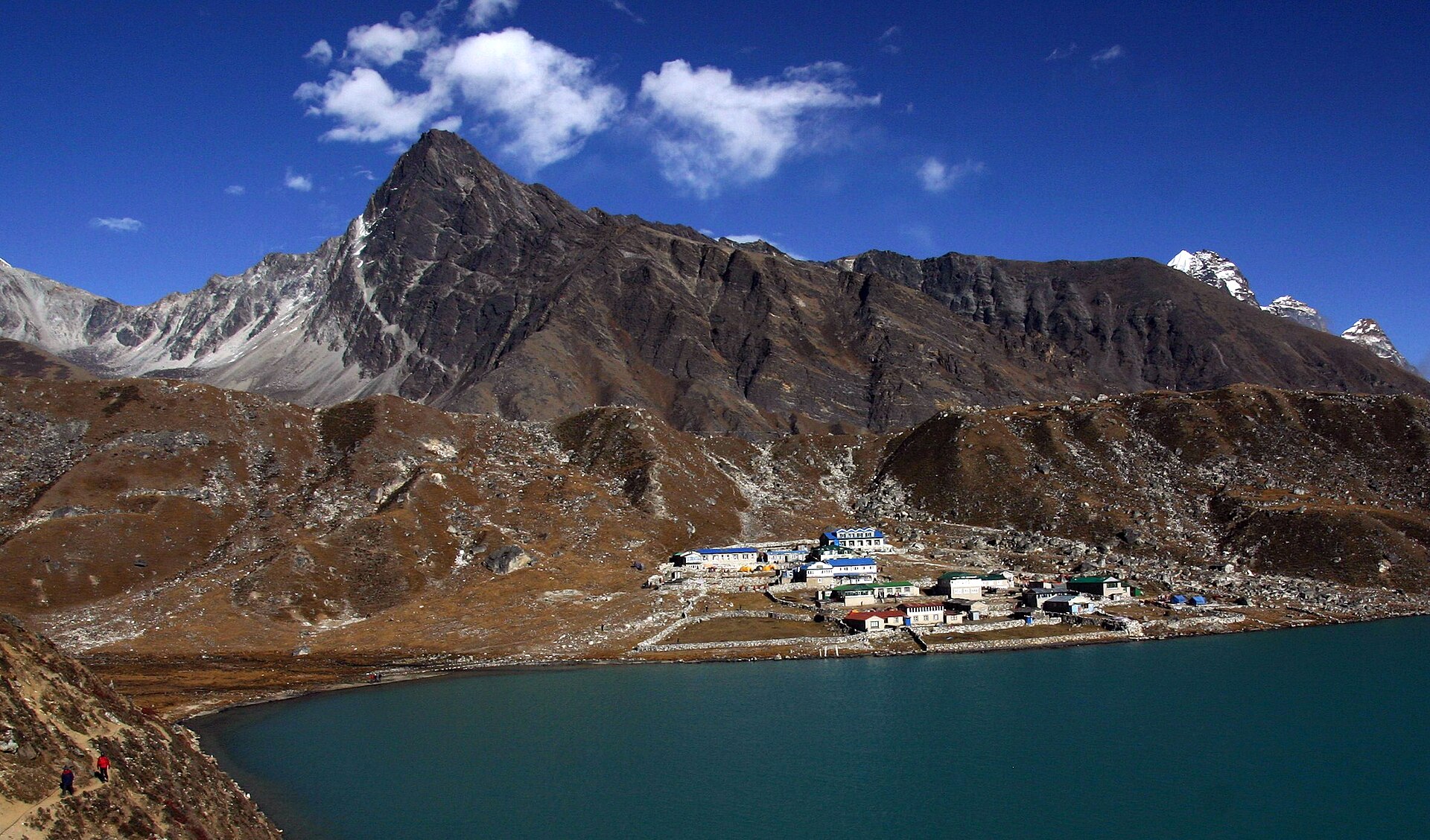
At the top the valley opens and the lakes begin. You pass Longpongo, the first, then Taboche Tsho, the second, both extraordinarily blue against the grey moraine. The lodges sit beside the third lake, Dudh Pokhari, with Gokyo Ri rising directly behind them.
Arriving in early afternoon leaves time to walk out along the third lake and look at what you are climbing tomorrow.
Duration:
4 to 5 hrs trek, 7 km
Accomodation:
Teahouse lodge, Gokyo
The day the trek is built around. We leave in the dark and climb the steep zigzag path directly above the lodges, gaining around 570 m. It takes most people two to three hours and it is hard work, but it is short and you are well acclimatised by now.
From the summit, at 5,357 m, the whole Khumbu is laid out. Everest, Lhotse, Makalu and Cho Oyu stand together, four 8,000 m peaks in one view, with the Ngozumpa Glacier running south below you and the chain of lakes strung up the valley. There is no other viewpoint in Nepal that gives you all four at once.
Back down for a late breakfast. The afternoon is free. Most people walk north along the glacier to the fourth and fifth lakes, which takes two to three hours and is beautiful and almost empty. Scoundrel’s Viewpoint above the fifth lake gives another angle on Everest. Or you sit by the third lake and do nothing at all, which is also a perfectly good use of the day.
Duration:
3 to 4 hrs climb, 5 km
Accomodation:
Teahouse lodge, Gokyo
Back down the valley the way you came, past the second and first lakes and down the moraine wall to Pangka, then on through Machhermo to Dole.
Descending 590 m makes an immediate difference. Appetite comes back, you sleep properly for the first time in days, and the walking feels easy. The valley also looks completely different in this direction, with Kangtega and Thamserku ahead of you all afternoon rather than behind.
Duration:
5 to 6 hrs trek, 13 km
Accomodation:
Teahouse lodge, Dole
Down to Phortse Thanga and back up towards Mong La, then instead of retracing the outward trail we take the high route around the hillside to Khumjung.
Khumjung is the largest Sherpa village in the Khumbu, sitting in a wide bowl below Khumbila with green-roofed houses and a monastery that keeps what it says is a yeti scalp. The Hillary School is here, founded in 1961 and still the main school in the region.
From Khumjung it is a short descent to Namche, where there are bakeries, coffee and hot showers that actually work.
Duration:
5 to 6 hrs trek, 12 km
Accomodation:
Teahouse lodge, Namche Bazaar
The last walking day. Down the steep section to the Hillary Bridge, then the long undulating trail along the Dudh Koshi through Monjo and Phakding, with a final climb back up to Lukla.
Longer than it looks on the map, but you are fit by now and the air is thick. The evening in Lukla is traditionally when the group and the crew eat together and the guides and porters are thanked properly.
Duration:
6 to 7 hrs trek, 19 km
Accomodation:
Teahouse lodge, Lukla
Morning flight back to Kathmandu or Manthali, weather permitting. Flights go early because the wind at Lukla builds through the day. The rest of the day is yours for a shower, a proper bed and any last shopping.
In the evening we hold the celebration dinner at a Nepali restaurant and hand out trip completion certificates.
If cloud closes Lukla, we wait. This is why we recommend keeping spare days before your international flight.
Duration:
35 min flight, or road transfer from Manthali
Accomodation:
3-star hotel, Kathmandu
Transfer to Tribhuvan International Airport about three hours before your flight.
If you have time before departing, or if you want to extend, we can arrange a Kathmandu valley day around Boudhanath, Pashupatinath and Bhaktapur, or onward travel to Pokhara or Chitwan.
Duration:
Transfer 30 to 45 min
Accomodation:
Departure day
Trips Include
Everything below is covered by the trek price. We are specific about quantities because vague inclusions are where trekking budgets quietly break.
- Airport transfers on arrival and departure in Kathmandu, in a private vehicle
- 2 nights in a 3-star Kathmandu hotel on twin-share, with breakfast (single supplement available)
- 10 nights in teahouse lodges on twin-share, with attached bathrooms where available at Lukla, Phakding and Namche
- All meals on trek: 10 breakfasts, 10 lunches and 10 dinners, plus tea or coffee with every meal
- Fresh seasonal fruit after dinner each evening on the trail
- Celebration dinner in Kathmandu at a Nepali restaurant on your return
- Purified drinking water throughout the trek, so you never need to buy bottled water
- Round-trip flight Kathmandu or Manthali to Lukla, including the road transfer to Manthali when the season requires it
- Licensed, English-speaking trekking guide trained in wilderness first aid, with a second guide for groups of 7 or more
- One porter per two trekkers, carrying up to 12 kg each
- All guide and porter wages, meals, accommodation, equipment, insurance and medical cover
- Sagarmatha National Park entry permit (NPR 3,000)
- Khumbu Pasang Lhamu Rural Municipality permit (NPR 3,000). This has replaced the TIMS card in the Everest region
- Comprehensive first aid kit carried by your guide, including a pulse oximeter used at daily altitude checks
- Everest Women Treks duffel bag, trekking map, sun hat and buff, yours to keep
- Trip completion certificate
- All government taxes, VAT and company administrative costs
Guide and porter wages, insurance, equipment and accommodation are paid by us and already sit inside the price. You are never asked to contribute to staff costs on the trail.
Trips Exclude
These costs sit outside the package. Budget roughly USD 250 to 450 beyond the trek price for thirteen days. Lodge charges in the Gokyo valley run slightly higher than on the Base Camp trail, because everything has to be carried further.
- International flights to and from Kathmandu
- Nepal entry visa: USD 30 for 15 days, USD 50 for 30 days, obtainable on arrival at Kathmandu airport
- Lunch and dinner in Kathmandu, other than the included celebration dinner
- Travel insurance, which must cover helicopter evacuation and medical treatment to at least 5,500 m
- Bottled or boiled water, soft drinks, alcohol and hot chocolate on the trail
- Lodge charges for hot showers, device charging, wifi and heating. Budget USD 3 to 8 per item per day, higher above Dole
- Personal trekking clothing and equipment
- Sleeping bag and down jacket if you rent rather than bring your own, about USD 35 each for the trek
- Tips for your guide and porters, customarily 10 to 15% of the trip cost, given as a group at the end
- Extra nights in Kathmandu if a Lukla flight delay extends your stay
- Emergency evacuation costs, which your insurer reimburses
- Anything not listed under what is included
Travel insurance covering helicopter evacuation and medical treatment to at least 5,500 m is required. The Gokyo valley is quieter than the Base Camp trail, which is its appeal, but it also means an evacuation takes longer to organise. Check the altitude limit in the policy wording rather than assuming.
Packaging Lists
The three things that actually matter
Broken-in boots. Mid-weight with ankle support, worn for at least 50 km before you fly. New boots on Day 3 to Namche is the most common preventable injury we see.
A layering system, not a thick coat. You will be too hot climbing and cold within minutes of stopping. Base layer, fleece or light down mid-layer, windproof shell, and a heavy down jacket for evenings and the Gokyo Ri morning.
A sleeping bag rated to minus 15C comfort. Lodge blankets are not enough above Dole, and Gokyo at 4,790 m is cold at night. Comfort rating, not extreme rating, because the extreme figure is a survival number rather than a sleeping number.
Worth adding for this trek specifically
Trekking poles for the descent from Mong La and the long drop back to Phortse Thanga. Category 3 or 4 sunglasses, because the glare off the Ngozumpa Glacier and the lakes is stronger than most people expect. Microspikes are not needed on this route, since Cho La is not included.
Upper body
2 merino or synthetic base layers, 1 fleece, 1 lightweight down or synthetic mid-layer, 1 waterproof windproof shell, 1 heavy down jacket (rentable in Kathmandu for about USD 35).
Lower body
2 pairs trekking trousers, 1 pair thermal leggings, waterproof over-trousers, 4 to 5 pairs underwear, 4 pairs trekking socks plus a thick sleeping pair.
Head, hands and feet
Sun hat, warm beanie, buff, category 3 or 4 sunglasses, inner gloves, insulated outer gloves, boots, camp shoes for the evenings.
For women
Enough menstrual supplies for the whole trek plus a few days spare, since nothing reliable is sold above Namche and altitude often shifts cycle timing. Sealable opaque bags for used products, which you carry out. A pee funnel if you plan to use one, practised at home rather than on a cold night at altitude.
Health and documents
Personal first aid kit, blister plasters, rehydration salts, prescription medication in original packaging, sunscreen SPF 50, SPF lip balm, headlamp with spare batteries, passport, four passport photographs, insurance certificate, and USD in small denominations.
Bags
One duffel of up to 12 kg carried by your porter (we provide the duffel), plus a 25 to 35 litre daypack you carry yourself. The Lukla flight allowance is 15 kg total including your daypack.
Trips Altitude
Trips FAQs
The questions we actually get asked about this trek, starting with the one everybody wants answered: how it compares with Everest Base Camp.
They give you different things, and neither is the lesser trek.
Gokyo gives the better view. From Gokyo Ri you see Everest, Lhotse, Makalu and Cho Oyu together, four 8,000 m peaks in one panorama, over the lakes and the Ngozumpa Glacier. It is quieter, it is two days shorter, and the highest you sleep is 4,790 m rather than 5,164 m, so most people feel considerably better on it.
Base Camp gives the bigger moment. Standing at the foot of Everest below the Khumbu Icefall means something that a viewpoint does not, and Kala Patthar puts you closer to the mountain than anywhere else you can walk to.
Practical version: if you want the photograph and the quiet, come to Gokyo. If you want to say you stood at Everest Base Camp, do that trek. If you want both, the Three Passes links them, though it is a considerably harder trip.
5,357 m, or 17,575 ft. You will see 5,360 m quoted almost as often, and the two are close enough that either is fine.
Be careful with figures above 5,400 m, which appear on some operator pages. They are wrong, and occasionally the same page contradicts itself between its facts box and its itinerary. If a company cannot get the altitude of its own high point right, it is worth wondering what else is approximate.
The climb from Gokyo is around 570 m of ascent, and takes most people two to three hours in the dark.
Challenging, and a step below Everest Base Camp rather than an easy option.
Walking days are four to six hours, shorter than the Base Camp trek, and there are no passes and no technical ground. What makes it demanding is altitude: you sleep six nights above 4,000 m and the climb to Gokyo Ri is steep.
The single hardest day is Day 5 from Namche to Dole, which gains the most sleeping altitude of the trek and includes a 300 m drop and re-climb in the middle. The Gokyo Ri morning is the hardest hour.
Ours is deliberately built to keep sleeping-altitude gain under about 500 m a day above Namche, and to put a full day at Gokyo before you go home.
Many Gokyo itineraries sold online do not. The common pattern is to stop at Phortse Thanga at 3,680 m on Day 5 and then climb to Machhermo at 4,470 m the next day. That is nearly 800 m of sleeping gain in one day, at an altitude where it matters, and it is the single most common flaw in Gokyo itineraries.
We go Namche to Dole (4,200 m), Dole to Machhermo (4,470 m), Machhermo to Gokyo (4,790 m). Same thirteen days, better order, and a much lower chance of you spending the Gokyo Ri morning in bed with a headache instead.
No, though it helps. Many of our trekkers on this route have never been above 3,000 m. What you need is the ability to walk five to six hours on consecutive days over uneven ground, and the patience to go slowly.
We recommend ten weeks of preparation: two or three hill or stair sessions a week, and one longer walk of four hours or more at weekends carrying the daypack you plan to use. Walking on back-to-back days at the weekend is far more useful than a single long walk.
Not on this trek. Cho La at 5,420 m has a boulder field and a glacier crossing, it needs microspikes, and it turns a challenging trek into a strenuous one.
If you want the pass, our Three Passes trek crosses Cho La along with Kongma La and Renjo La over twenty days, and takes in Everest Base Camp and Kala Patthar as well. That trek asks for previous high-altitude experience.
We do not offer a Gokyo trek with Cho La bolted on, because the combination puts a technical pass in an itinerary that has not built the acclimatisation for it.
Acute Mountain Sickness is your body reacting to reduced oxygen. Mild symptoms like headache, nausea, poor sleep and breathlessness affect most trekkers at some point.
Our controls: sleeping altitude rises no more than about 500 m per day above Namche, an active acclimatisation day at Namche before the biggest gain, deliberately short days from Dole onward, and daily oxygen saturation and pulse checks recorded by your guide from Day 4.
We also arrive at Machhermo early so the group can attend the free altitude talk at the rescue post, which is run by volunteer doctors and is genuinely worth the half hour.
If symptoms worsen the treatment is descent, and this valley descends quickly. From Gokyo you can be at Dole, 590 m lower, in half a day.
Busy as far as Namche, which everyone on every Everest trek shares. Above Namche the Base Camp traffic turns east and you turn west, and from Mong La onwards the difference is obvious.
In peak October you will still see other groups at Machhermo and Gokyo, because there are only so many lodges. But you will not be walking in a queue, and the fourth and fifth lakes on the afternoon of Day 8 are often empty.
The trade-off is fewer lodges. In peak season we book ahead, which is why we ask you to book three months out for October and April.
Comfortable to Namche, simpler above it.
Lukla, Phakding and Namche generally have rooms with attached bathrooms and reliable hot showers. Dole, Machhermo and Gokyo are more basic: a twin room with two beds, a mattress, a pillow and a blanket, an unheated bedroom, shared toilets, and a dining room with a stove lit in the evening.
Gokyo has improved a lot in recent years and several lodges now have decent food and reliable hot water. Machhermo and Dole are the most basic stops.
Bring your own toilet paper and hand sanitiser from Namche onwards, and a headlamp for night toilet trips.
March to May gives rhododendron in flower below Dole and mild days, though the lakes are often still partly frozen in March and early April, which is beautiful in a different way.
September to November gives the clearest air of the year and the lakes at their most vividly blue. October is the single best month for the Gokyo Ri view.
December to February is possible but cold, and several lodges above Dole close. The lakes freeze solid.
June to August is monsoon: cloud, no views from Gokyo Ri, and frequent Lukla flight cancellations. There is no point coming for this trek in the monsoon, because the view is the entire trek.
Two permits, both included in your price: the Sagarmatha National Park entry permit (NPR 3,000) and the Khumbu Pasang Lhamu Rural Municipality permit (NPR 3,000).
A TIMS card is not required for the Everest region. The Khumbu Pasang Lhamu permit replaced it, and the municipality fee rose from NPR 2,000 to NPR 3,000 in September 2024. Many operator websites still list a TIMS card for this trek. That information is out of date.
We arrange both permits. You need your passport and four passport photographs.
Budget USD 250 to 450 beyond the trek price for thirteen days. That covers Kathmandu lunches and dinners, hot showers and device charging on the trail, wifi, snacks and drinks, and tips.
Lodge charges in the Gokyo valley run a little higher than on the Base Camp trail, because supplies are carried further. Expect USD 4 to 8 for a hot shower at Gokyo.
Bring Nepali rupees in small notes from Kathmandu. There is an ATM in Namche but it is unreliable, and there are none in the Gokyo valley. Cards are not accepted on the trail.
Tipping is customary at 10 to 15% of the trip cost, pooled by the group and given on the last evening in Lukla.
A policy that explicitly covers trekking to at least 5,500 m and helicopter evacuation and medical repatriation. Most standard travel insurance caps altitude cover well below that, and many exclude helicopter rescue entirely.
Check the altitude limit in the policy wording rather than assuming, and send us the certificate before you travel. We will ask to see it before you fly to Lukla.
Yes. Solo travellers make up a large share of every departure we run, and you are with a licensed guide throughout.
Twin-share rooms are allocated with someone of the same sex unless you request and pay for a single, though single rooms are limited at Dole and Machhermo where there are only a few lodges.
The Gokyo valley is quieter than the Base Camp trail, which most people find is the appeal rather than a concern. Lodges are still every couple of hours, and you are never walking a section on your own unless you want to.
Good to Know
The questions we actually get asked about this trek, starting with the one everybody wants answered: how it compares with Everest Base Camp.
The summit gives you Everest, Lhotse, Makalu and Cho Oyu at once. Cho Oyu is the closest, filling the head of the valley to the north. Everest sits further back to the east, recognisable by its dark pyramid and the plume of snow usually blowing off the summit ridge. Makalu is the sharp one to the far right.
Below you the Ngozumpa Glacier runs south, grey and rubble-covered rather than white, which surprises people. The lakes are strung along its western edge.
Go at sunrise. Cloud builds through the morning almost every day and by 10am the Everest view has usually gone. We leave the lodges between 4.30am and 5am depending on the season.
It is cold at the top, well below freezing with wind. Down jacket, hat, gloves and a hot drink in a flask. Take spare camera batteries and keep them inside your jacket, because cold flattens them within minutes.
If it is cloudy, you can go again the next morning at no extra cost, provided the group agrees. We build enough slack into the schedule for one repeat attempt.
Machhermo has a small aid post staffed in season by volunteer doctors, set up specifically because this valley has a history of altitude illness among both trekkers and porters.
They run a free talk at 3pm daily in season, covering how AMS develops, the difference between mild symptoms and the two dangerous forms, and when descent is the only answer. It lasts about half an hour.
We time our arrival at Machhermo for early afternoon so the whole group can go, and we ask everyone to attend. It is genuinely good, and it changes the conversation afterwards: when your guide asks how your head is at Gokyo, you both know exactly what the question means.
They also sell a small amount of medication and will check anyone who is unwell. A donation is appreciated and goes towards treating porters, who are the people this post exists for.
You sleep six nights above 4,000 m and the highest is Gokyo at 4,790 m. That is meaningfully lower than the Base Camp trek, which puts you at 5,164 m for a night, and it is the main reason people find this trek more comfortable.
The risk point is Day 5, Namche to Dole, which is the biggest sleeping gain of the trek. Everything after it is deliberately gentle: 270 m to Machhermo, 320 m to Gokyo, then a full day at Gokyo.
What we ask from you: drink 3 to 4 litres of water a day, walk slower than feels natural, eat even when you do not want to, skip alcohol above Namche, and report symptoms early rather than proving you can push through. Your guide records oxygen saturation and pulse each evening from Day 4.
Descent is quick if you need it. Gokyo to Dole is 590 m down in half a day, and Dole to Namche another 760 m. That is a real advantage this valley has over the upper Khumbu.
Diamox (acetazolamide) helps some trekkers. Discuss it with your own doctor before you travel and trial it at home first.
Hot showers work reliably at Lukla, Phakding and Namche, usually for USD 3 to 6, and are available at Gokyo for USD 4 to 8. Dole and Machhermo are less dependable. Most people manage on unscented wet wipes and a quick-dry towel for the middle of the trek.
Bring your own toilet paper and hand sanitiser from Namche onwards. Lodge toilets above Dole are usually shared and often a squat toilet. A headlamp for night toilet trips matters more than it sounds when it is below freezing.
Rooms are twin-share, walls are thin and most doors have no lock. Bring a sarong or light towel to change under if you want privacy.
Drink fully even though it means getting up at night. Urinary tract infections are common on trek precisely because people cut back on water to avoid the cold walk to the toilet.
Women should bring enough menstrual supplies for the whole trek plus a few days spare. Altitude and sustained exertion often shift cycle timing, and nothing reliable is sold above Namche. There is no waste disposal on the trail, so used products are carried out in sealable opaque bags. Worth telling your guide, because cramps and fatigue overlap with early altitude sickness and you do not want either one misread as the other.
Every departure runs with a licensed, English-speaking guide trained in wilderness first aid, and groups of seven or more carry a second guide so the group can split if anyone needs to descend.
Porters carry up to 24 kg shared between two trekkers. All our staff are insured, equipped with proper boots, jackets and eyewear, paid above the government minimum, and accommodated and fed at our cost. We do not use load-sharing arrangements that push weight onto underpaid casual porters.
This matters particularly in the Gokyo valley, which has a long and unhappy history of porters being sent over the high ground without proper clothing. The Machhermo aid post was set up partly because of it.
Carry Nepali rupees in small denominations. The ATM in Namche is unreliable and there are none in the Gokyo valley, and cards are not accepted on the trail.
Expect to pay for what is free in Kathmandu: hot showers USD 3 to 8, device charging USD 2 to 6 per device, wifi USD 3 to 8 per day, all rising the further up the valley you go. A power bank of 20,000 mAh or more removes most charging costs, and cold drains batteries fast, so sleep with your phone and power bank inside your sleeping bag.
Charge everything at Gokyo the night before Gokyo Ri.
Mobile coverage is patchy above Namche and largely absent above Dole. Everest Link wifi cards work at Gokyo and most lodges. Neither is dependable, and telling people at home you may be offline for a few days saves worry.
We include purified water throughout precisely so nobody buys bottled water. Plastic bottles are a serious waste problem in the Khumbu, where nothing is recycled and much is burned.
The Gokyo Lakes are sacred to both Hindus and Buddhists, and there is a temple at the third lake. Do not swim in them, do not wash in them, and do not take anything from the shore. Trekkers swimming in the lakes causes real offence locally and is the single most common complaint we hear from Gokyo lodge owners.
Carry out what you carry in, including sanitary waste and used batteries. Ask before photographing people, particularly monks and elderly villagers. Walk clockwise around mani stones, chortens and prayer wheels, keeping them on your right.
Yaks have right of way. Always step to the inside of the trail, against the hillside, never the drop side.
Book three months ahead for October and April. Gokyo, Machhermo and Dole have far fewer lodges than Namche, and in peak season the good ones fill early.
A 20% deposit confirms your place, with the balance due in Kathmandu before you fly to Lukla. We can hold a provisional booking for seven days at no cost.
Cancel more than 30 days out and the deposit is refundable less bank charges. Inside 30 days the deposit is retained but transferable to another departure within 12 months.
If we cancel a departure, which we would only do for safety or if a group does not reach minimum numbers, you get a full refund or a transfer, your choice.
Weather delays are not cancellations. If Lukla closes, we wait and cover your accommodation at the same standard.
Book three months ahead for October and April. Gokyo has fewer lodges than Namche or Dingboche, and in peak season the good ones fill early.
A 20% deposit holds your place, with the balance due in Kathmandu before you fly to Lukla. We can hold a provisional booking for seven days at no cost while you check flights.
Once you are booked we send a pre-departure pack with a training plan for the ten weeks before the trek, a kit list you can tick off, and a short guide to insurance policies that genuinely cover high-altitude helicopter evacuation.
Keep two spare days before your international flight. Lukla flights are weather-dependent and delays of a day or two happen in every season. If your international flight leaves the morning after you are due back in Kathmandu, a normal Lukla delay becomes a missed flight.
Which airport you fly from depends on the season. In March, April, May, September, October and November, Lukla flights usually operate from Manthali, four to five hours by road from Kathmandu with a very early start. In the quieter months they generally run direct from Kathmandu. We confirm which applies to your dates when you book, and the road transfer is included either way.