Trip Facts
Country:
Annapurna Region, Nepal
Duration:
12 Days
Max Altitude:
4,660 m / 15,289 ft (Khayer Lake, optional). 3,660 m at Khopra Danda
Activities:
Trekking
Region:
Annapurna Conservation Area, Myagdi and Kaski
Grade:
Moderate to Challenging
Group Size:
1–12 people
Accomodation:
3-star hotels in Kathmandu and Pokhara (4 nights), community lodges and teahouses on trek (7 nights)
Trips Overview
Poon Hill has a queue. Khopra has a ridge.
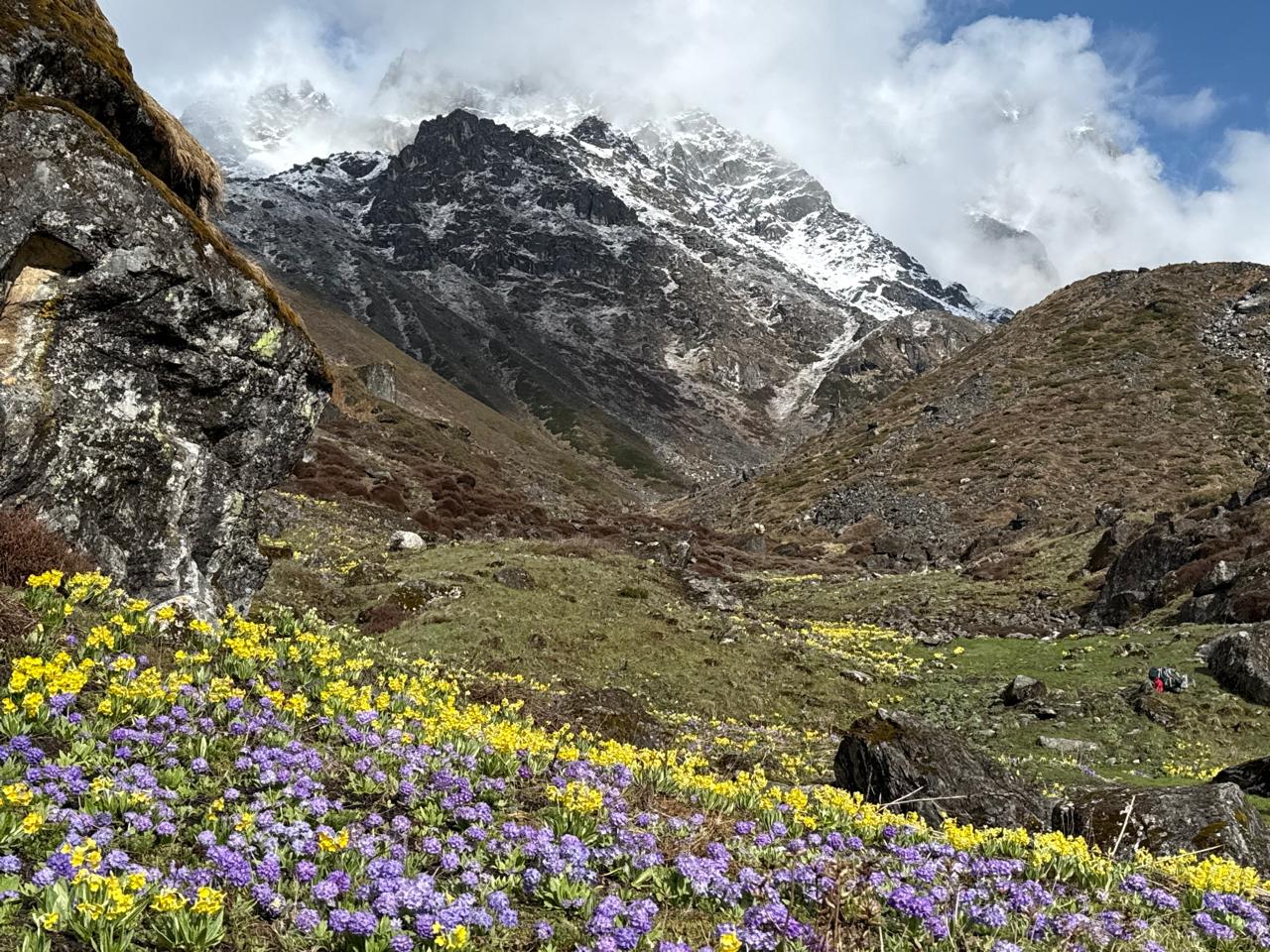
Khopra Danda sits at 3,660 m on a grass and rock spine above the Kali Gandaki. Step out of the lodge door and the Annapurna south face is directly in front of you, close enough that you can follow individual gullies up it. Turn ninety degrees and Dhaulagiri stands across the valley, with Nilgiri and Tukuche filling the gap. Poon Hill, at 3,210 m, gives you a wide postcard from a long way back. Khopra puts you inside the amphitheatre.
The count is the other difference. In peak October, several hundred people stand on Poon Hill for sunrise. Khopra Danda has around thirty beds. Do the arithmetic.
The lodges belong to the villages
This is the part most trip pages skip, and it is the best thing about the route.
The lodges at Khopra Danda, Chistibang and Swanta are not private businesses. They were built and are run by community committees from the villages below, principally Swanta and Paudwar, under a scheme set up with support from Annapurna Conservation Area staff and Nepali development partners. The profit does not leave the valley. It goes into the village school, the trail, the water supply and a fund the committee votes on.
What that means for you in practice is mixed, and we would rather say so. The staff rotate, so service is less polished than a family-run lodge on the Poon Hill circuit. Menus are shorter. At Khopra you may well be in a dormitory bunk rather than a twin room. In exchange, the money you spend on a bed and a plate of dal bhat stays with the people whose ridge you are standing on. Very few treks in Nepal can say that as cleanly.
Khayer Lake, honestly
Khayer Lake at 4,660 m is the optional day from Khopra, and it is the hardest day of the trek by a wide margin. One thousand metres of ascent and the same back down, eight to ten hours, no lodge and no shelter on the way, on ground that holds snow well into May and again from late October.
Roughly half our groups get up there. The other half wake to cloud or wind and spend the day on the ridge instead, which is not a bad day at all. Anybody selling you Khayer Lake as a guaranteed item on a fixed itinerary is selling you weather they do not control.
Who this trek suits
You need to walk five to six hours a day for a week over ground that is properly steep in places, and you need to be relaxed about basic lodges. You do not need previous altitude experience. If you want hot showers every night, wide menus and a bakery, do Ghorepani and Poon Hill instead. If you want the view without the crowd and you are happy in a bunk room, this is the better week.
Trips Highlights
- Stand on Khopra Danda at 3,660 m, looking straight into the Annapurna south face with Dhaulagiri across the Kali Gandaki behind you
- Sleep in community-owned lodges at Khopra, Chistibang and Swanta, where the profit funds the village school, trail and water supply rather than a private owner
- Around thirty beds at Khopra Danda against several hundred people on Poon Hill at sunrise, on the same week of the same month
- Optional day to Khayer Lake at 4,660 m, a sacred glacial lake below Annapurna South, offered honestly as weather-dependent rather than sold as a certainty
- Muldai viewpoint at 3,637 m before dawn on Day 5, then sleep 400 m lower at Chistibang, which is proper climb-high sleep-low acclimatisation
- Compare Khopra and Poon Hill directly, since this itinerary includes both viewpoints rather than making you choose
- Walk two days of forest above Tadapani where you may not pass another group all morning
- Visit the yak cheese factory at Swanta, run by the same village committee that owns the lodges
- Daily oxygen saturation and pulse checks from Day 4, recorded so your guide can see a trend rather than a single reading
- No mountain flight anywhere in the itinerary, so no Lukla-style weather gamble at either end of your holiday
Trips Itinerary
You are met at Tribhuvan International Airport and driven to your hotel in Thamel. Nothing is scheduled after that. Most people land tired and the best use of the afternoon is sleep.
Your guide runs the briefing in the evening. We check your kit against the list, confirm your insurance covers helicopter evacuation, take your passport details for the permits, and hand over the duffel and map. If something is missing, the gear shops are five minutes away and cheaper than Pokhara.
Duration:
Transfer 30 to 45 min
Accomodation:
3-star hotel, Kathmandu
Tourist bus west along the Trishuli river. It is a long sit and the road surface varies, but the valley is worth watching and there are stops for tea and lunch.
If you would rather fly, the plane takes 25 minutes and costs about USD 110. Tell us at booking and we will arrange it. Some groups fly one way and take the bus the other.
Pokhara sits on a lake at 820 m with Machhapuchhre standing behind it. The afternoon is free. This is your last chance to rent a down jacket or sleeping bag, buy anything you forgot, and leave your city clothes in the hotel store.
Duration:
6 to 7 hrs by road, 200 km
Accomodation:
3-star hotel, Pokhara
Early drive up the Modi Khola road to Kimche, then the stone staircase to Ghandruk, one of the largest Gurung villages in Nepal, with slate roofs stacked up the hillside and Annapurna South filling the head of the valley.
From Ghandruk the trail climbs into rhododendron and oak forest to Tadapani, gaining about 690 m. Steep in sections but shaded most of the way.
This is the busy day. You share the trail with Annapurna Base Camp and Poon Hill traffic, and in October it is genuinely crowded. From tomorrow morning that stops. Tadapani means far water, and the sunrise view of Annapurna South and Machhapuchhre from just above the lodges is the first proper one of the trek.
Duration:
1.5 hr drive, 5 to 6 hrs trek, 9 km
Accomodation:
Teahouse lodge, Tadapani
The turn north, and the day the trek changes. Within twenty minutes of leaving Tadapani the Base Camp trail branches away and the forest closes in. Moss on every branch, water running under the path, and often nobody else on it.
The climb is steady and long: about 790 m to a small cluster of three lodges on a shoulder at 3,420 m. Dobato is not a village. It is a handful of buildings on a ridge with a water tank, and in bad weather it feels remote in a way the Poon Hill circuit never does.
Your guide takes the first oxygen saturation and resting pulse readings this evening and records them daily from here. This is the largest sleeping gain of the trek. The 500 m guideline applies above 3,000 m, and you start the day at 2,630 m, so the profile is defensible, but we walk it slowly and we watch people.
Duration:
5 to 6 hrs trek, 8 km
Accomodation:
Teahouse lodge, Dobato
Up in the dark for the 45-minute climb to Muldai at 3,637 m. It is short, steep and cold, and the reward is a 360-degree turn: Annapurna South, Hiunchuli, Machhapuchhre, Annapurna II and III to the east, Dhaulagiri away to the west. Almost nobody is up there. Poon Hill, 400 m lower and half a day south, will have a few hundred people on it at the same moment.
Back to Dobato for breakfast, then west along the ridge and down through rhododendron to Chistibang at 3,026 m.
Sleeping altitude drops nearly 400 m on the day you first go above 3,600 m. That is deliberate. Climbing high and sleeping low is what actually drives acclimatisation, and it is why you will feel fine at Khopra tomorrow and at Khayer Lake the day after.
Chistibang is the first of the community lodges. Simple, warm enough in the dining room, and the dal bhat is better than it has any right to be at that altitude.
Duration:
5 to 6 hrs total, 7 km
Accomodation:
Community lodge, Chistibang
A short morning, and short on purpose. The trail leaves the last of the rhododendron within an hour and climbs onto open grass ridge, gaining about 630 m. As you come over the shoulder the Annapurna wall opens on your right and stays there for the rest of the walk.
You arrive at the Khopra Danda community lodge in time for lunch. The lodge sits on the crest at 3,660 m with nothing between it and the mountains. Annapurna South and Hiunchuli are directly in front, close enough to trace individual gullies. Behind you the ground falls away into the Kali Gandaki and Dhaulagiri stands on the far side, with Nilgiri and Tukuche between.
The afternoon is free, and that is the best part of the day. Light on the south face changes hour by hour and the walk out along the ridge above the lodge takes twenty minutes for a view most people never bother with.
Practical notes. Accommodation here is mostly dormitory bunks, around thirty beds in total. There is no hot shower. Solar power runs the lights and a limited charging point. Nights are cold and the dining room stove is the only warm place. Nobody comes here for comfort.
Duration:
3 to 4 hrs trek, 5 km
Accomodation:
Community lodge, Khopra Danda
The hard day, and the honest version of it.
Khayer Lake sits at 4,660 m in a basin below Annapurna South, with a small Hindu shrine on the shore. Getting there from Khopra means 1,000 m of ascent and the same descent, eight to ten hours of walking, with no lodge, no shelter and no water source you should drink from along the way. The route follows open ridge and then a long grinding traverse over ground that holds snow well into May and again from late October.
Roughly half our groups make it. The other half wake to cloud, wind or fresh snow and do not go. That is not a failure of planning. The ridge above 4,000 m makes its own weather and it decides at about 4am.
Your guide makes the call at breakfast and it is not negotiable. Turning around at 4,300 m in blowing snow with six hours of descent still to come is how people get hurt on this route.
If we go: a 4am start with head torches, warm layers you can shed, and the flask filled at the lodge. If we do not: the ridge day is genuinely good. Most people walk the crest, sleep, read, watch the face, and are quietly relieved.
Tell us at booking if the lake is the reason you are coming. We can add a spare day at Khopra so you get two attempts instead of one, which roughly doubles your odds.
Duration:
8 to 10 hrs round trip, 16 km, weather permitting
Accomodation:
Community lodge, Khopra Danda
A long descent, 1,390 m of it, off the ridge and into the Swanta valley. Steep and loose in the upper section, then grassland, then terraced fields and buckwheat.
Some operators run Khopra straight down to Tatopani in one day, losing about 2,450 m. It is legal and it saves a night. It also wrecks knees and gives you nothing to look at. We stop at Swanta instead.
Swanta is a working Magar and Gurung farming village with a community lodge and a small yak cheese factory, both run by the same committee that owns the lodges at Khopra and Chistibang. You can visit the cheese room, and you should. It is a fifteen-minute walk and the cheese is good.
After three nights above 3,000 m, the first warm evening at 2,270 m with green fields around you is a noticeable pleasure.
Duration:
5 to 6 hrs trek, 11 km
Accomodation:
Community lodge, Swanta
Out of the valley and up through Chitre to join the main Poon Hill circuit at Ghorepani, gaining about 590 m.
The change is abrupt and worth noticing. Within an hour of Chitre you are back on wide stone-paved trail with mule trains, German bakeries and lodges with wifi and hot showers. After Khopra it feels like a small town.
Ghorepani sits in a saddle at 2,860 m surrounded by rhododendron forest, which in late March and April is red and pink for miles. Rooms here have attached bathrooms and the showers work, which after four days you will care about more than you expect.
Duration:
4 to 5 hrs trek, 9 km
Accomodation:
Teahouse lodge, Ghorepani
Up at 4.30am for the 45-minute climb to Poon Hill. You will not be alone. In peak October there can be several hundred people on the platform, which is exactly why we sent you to Khopra and Muldai first. Judge it for yourself.
The view is genuinely wide: Dhaulagiri, Tukuche, Nilgiri, Annapurna South, Hiunchuli, Machhapuchhre and Annapurna II across roughly 180 degrees. It is a better panorama than Khopra. It is a worse experience. Both things are true and most people leave preferring the ridge.
Back for breakfast, then the long way down: Ulleri and its 3,200-odd stone steps, then Tikhedhunga and the river to Birethanti at 1,050 m. That is 1,800 m of descent in a day and it is the single hardest thing this trek does to your legs. Poles matter here.
A vehicle meets you at Birethanti for the drive to Pokhara, and the lake, and a shower with no queue.
Duration:
6 to 7 hrs trek, 17 km, then 1.5 hr drive
Accomodation:
3-star hotel, Pokhara
Tourist bus back to Kathmandu, or the 25-minute flight if you have upgraded. Either way the afternoon is free for Thamel and any last shopping.
In the evening we hold the farewell dinner at a Nepali restaurant and hand out trip completion certificates. This is also where tips are given, pooled by the group.
Duration:
6 to 7 hrs by road, or 25 min by air
Accomodation:
3-star hotel, Kathmandu
Transfer to Tribhuvan International Airport about three hours before your flight.
If you have time, or want to extend, we can arrange a Kathmandu valley day around Boudhanath, Pashupatinath and Bhaktapur, or onward travel to Chitwan. Several people every season go back to Pokhara instead and paraglide.
Duration:
Transfer 30 to 45 min
Accomodation:
Departure day
Trips Include
Everything below is covered by the trek price. We give quantities because vague inclusions are where trekking budgets quietly break.
- Airport transfers on arrival and departure in Kathmandu, in a private vehicle
- 2 nights in a 3-star Kathmandu hotel on twin-share, with breakfast (single supplement available)
- 2 nights in a 3-star Pokhara hotel on twin-share, with breakfast, lakeside
- Return tourist bus Kathmandu to Pokhara, with air-conditioning and a reserved seat (flight upgrade quoted on request)
- Private vehicle Pokhara to Kimche at the start, and Birethanti to Pokhara at the finish
- 7 nights in community lodges and teahouses on trek, twin-share where rooms allow and dormitory at Khopra Danda where they do not
- All meals on trek: 7 breakfasts, 8 lunches and 7 dinners, plus one hot drink with every meal
- Farewell dinner in Kathmandu at a Nepali restaurant on your return
- Purified drinking water throughout the trek, so you never need to buy a plastic bottle
- Licensed, English-speaking trekking guide trained in wilderness first aid, with a second guide for groups of 7 or more
- One porter per two trekkers, carrying up to 12 kg each
- All guide and porter wages, meals, accommodation, equipment, insurance and medical cover
- Annapurna Conservation Area Permit (ACAP), NPR 3,000 per person
- TIMS card, NPR 1,000 per person at the group rate through our registered agency. Whether TIMS is still being checked in the Annapurna region is disputed, so we obtain it anyway rather than gamble on the checkpoint
- Comprehensive first aid kit carried by your guide, including a pulse oximeter used at daily altitude checks from Day 4
- Free luggage storage at the Pokhara hotel for anything you do not want on the trail
- Everest Women Treks duffel bag, trekking map, sun hat and buff, yours to keep
- Trip completion certificate
- All government taxes, VAT and company administrative costs
Guide and porter wages, insurance, equipment and accommodation are paid by us and already sit inside the price. You are never asked to top up staff costs on the trail. Bed and meal money at the community lodges is paid to the village committees at the posted local rate, not to a middleman.
Trips Exclude
These costs sit outside the package. Budget roughly USD 200 to 350 beyond the trek price for twelve days. Lodge charges above Tadapani run higher than on the Poon Hill circuit, because everything up there is carried in by mule and porter.
- International flights to and from Kathmandu
- Nepal entry visa: USD 30 for 15 days, USD 50 for 30 days, obtainable on arrival at Kathmandu airport
- Lunch and dinner in Kathmandu and Pokhara, other than the included farewell dinner
- Travel insurance, which must cover helicopter evacuation and medical treatment to at least 5,000 m
- Flight upgrade Kathmandu to Pokhara, about USD 110 each way, if you would rather not take the bus
- Bottled or boiled water, soft drinks, alcohol and hot chocolate on the trail
- Lodge charges for hot showers, device charging, wifi and heating. Budget USD 3 to 6 per item per day, and expect no shower at all at Khopra Danda
- Personal trekking clothing and equipment
- Sleeping bag and down jacket if you rent rather than bring your own, about USD 2 per item per day in Pokhara
- Microspikes for the Khayer Lake day if snow conditions call for them, about USD 15 to hire in Pokhara
- Tips for your guide, porters and drivers, customarily 10 to 15% of the trip cost, pooled by the group at the end
- Extra nights in Kathmandu or Pokhara if you arrive early or stay on
- Emergency evacuation costs, which your insurer reimburses
- Anything not listed under what is included
Travel insurance covering helicopter evacuation and medical treatment to at least 5,000 m is required, because the optional Khayer Lake day takes you to 4,660 m. Check the altitude limit in the policy wording rather than assuming. Helicopters can reach Khopra in reasonable weather, but the ridge closes in fast and an evacuation from the Khayer Lake side may mean walking down first.
Packaging Lists
The three things that actually matter
Broken-in boots with real grip. The Ghorepani and Ulleri staircases are wet stone for hours and the Khopra ridge is loose scree in places. Worn for at least 50 km before you fly.
A layering system, not a thick coat. You will be too hot on the climb to Dobato and cold within five minutes of stopping on the ridge. Base layer, fleece, windproof shell, and a down jacket for the Khopra evenings.
A sleeping bag rated to minus 10C comfort. The community lodges give you a mattress, a pillow and one blanket, and the Khopra dormitory is unheated. Comfort rating, not extreme rating: the extreme number is a survival figure, not a sleeping figure.
Worth adding for this trek specifically
Trekking poles, more useful here than on most Annapurna routes because of the 1,800 m descent on Day 10. A head torch you trust, since the community lodges run on solar and the lights go out when the batteries do. Microspikes if you are going for Khayer Lake in March, April, late November or December, and your guide will tell you honestly whether they are needed for your dates. A one litre insulated flask, because there is nowhere to buy anything between Khopra and the lake.
Upper body
2 merino or synthetic base layers, 1 fleece, 1 lightweight down or synthetic mid-layer, 1 waterproof windproof shell, 1 warm down jacket (rentable in Pokhara for about USD 2 a day).
Lower body
2 pairs trekking trousers, 1 pair thermal leggings, waterproof over-trousers, 4 pairs underwear, 4 pairs trekking socks plus a thick sleeping pair.
Head, hands and feet
Sun hat, warm beanie, buff, category 3 sunglasses, inner gloves, insulated outer gloves, boots, camp shoes for the evenings.
For women
Enough menstrual supplies for the whole trek plus a few days spare, since nothing reliable is sold above Ghandruk and altitude often shifts cycle timing. Sealable opaque bags for used products, which you carry out. A pee funnel if you plan to use one, practised at home rather than on a cold night in a dormitory.
Health and documents
Personal first aid kit, blister plasters, rehydration salts, prescription medication in original packaging, sunscreen SPF 50, SPF lip balm, headlamp with spare batteries, passport, four passport photographs, insurance certificate, and Nepali rupees in small notes.
Bags
One duffel of up to 12 kg carried by your porter (we provide the duffel), plus a 25 to 35 litre daypack you carry yourself. Anything you do not need on trek stays in the Pokhara hotel store at no charge.
Trips Altitude
Trips FAQs
The questions we actually get asked about this trek, starting with the two that decide it for most people: how it compares with Poon Hill and Mardi Himal, and whether Khayer Lake is realistic.
If you have five days and want an easy, comfortable, well-serviced walk with a famous view, do Poon Hill. Lodges are good, showers work, the trail is paved and you are never more than two hours from a bakery.
If you have twelve days and the crowd is what puts you off, come here.
The specifics. Poon Hill is 3,210 m and you look at the range from the south, across a wide valley, with a few hundred other people on the platform in October. Khopra Danda is 3,660 m and you look at the Annapurna south face from directly beneath it, with about thirty beds on the whole ridge. Poon Hill has the wider panorama. Khopra has the closer one, and the silence.
This itinerary gives you both, in that order, so the comparison is yours to make rather than ours to assert.
The closest comparison, and it is a genuinely difficult call.
Mardi Himal puts you on a narrow ridge under Machhapuchhre with High Camp at 3,580 m and the Upper Viewpoint at 4,500 m. The mountain is right on top of you. It has become popular fast, so High Camp is now busy in season and the lodges are private and increasingly commercial.
Khopra is quieter, the lodges are community-owned, and the view is wider: you get the Annapurna wall on one side and Dhaulagiri across the Kali Gandaki on the other, which Mardi does not offer. The trade-off is that Mardi is more dramatic and Khopra is more spacious.
Practical tiebreaker: if you want the single most in-your-face mountain, go to Mardi. If you want a week where the money you spend stays in the villages and the ridge is largely yours, come here.
3,660 m, or 12,008 ft. This is the figure used by the community lodge committee and by the ACAP signage on the ridge.
You will see 3,640 m and occasionally 3,700 m quoted on operator sites. The difference is trivial in practice, but check what a page means when it says maximum altitude, because several list 4,660 m as the trek high point without making clear that this is Khayer Lake and that Khayer Lake is optional, weather-dependent, and a 1,000 m climb from where you slept.
If a company cannot separate the ridge you sleep on from the lake you might not reach, be careful with the rest of its numbers.
Yes. The lodges at Khopra Danda, Chistibang and Swanta are owned and run by village committees from Swanta and Paudwar, set up with support from Annapurna Conservation Area staff and Nepali development partners. Profits go into a village fund: the school, the trail, the water supply and small loans.
What it means for you, honestly, is that service is less polished than a family-run lodge. Staff rotate on a roster rather than living there, so the person cooking your dinner may not have been there last month. Menus are shorter. Maintenance can lag.
What you get in exchange is that your bed money stays on the ridge instead of going to an owner in Pokhara. If that matters to you, this route is one of the few in Nepal where it is structurally true rather than a marketing line.
We pay the committees at the posted local rate. No commission, no side deal.
It is not guaranteed and any page that implies otherwise is not being straight with you.
From Khopra it is 1,000 m up and 1,000 m back down, eight to ten hours, roughly 16 km round trip, on open ground with no shelter and no lodge. The final section holds snow into May and again from late October, and the ridge builds its own cloud most afternoons.
Roughly half our groups get there. Your guide makes the call at breakfast based on the sky and the group, and it is not a vote.
What improves your odds: coming in late April, October or early November; being genuinely fit; and booking the optional spare day at Khopra so a bad morning does not end it. What does not improve your odds: wanting it very much.
If the weather is against you, the day on the ridge at Khopra is not a consolation prize. Several people a season decide it was the best day of the trek.
Moderate to challenging. Harder than Poon Hill, easier than Annapurna Base Camp on altitude and about the same on legs.
Walking days are four to six hours with two longer ones. There is no technical ground and no pass. What makes it demanding is three things: the 790 m climb to Dobato on Day 4, the optional 1,000 m Khayer Lake day, and the 1,800 m descent to Birethanti on Day 10.
That last one catches people out. It is all downhill, it is mostly stone steps, and quads that have been fine all week complain loudly about it. Trekking poles are not optional on that day as far as we are concerned.
The highest you sleep is 3,660 m, which is low enough that serious altitude problems are uncommon.
No to both. Most people on this route have never slept above 3,000 m before.
What you need is the ability to walk five to six hours on consecutive days on steep, uneven ground. Eight weeks of preparation is enough for most people: two or three hill or stair sessions a week, plus one longer walk of four hours at weekends carrying the daypack you plan to use.
Back-to-back walking at weekends is far more useful than one long walk. Day 4 is fine. Day 4 after Day 3 is the thing to train for.
Three tiers, and it is worth knowing which is which before you book.
Tadapani, Ghorepani: normal Annapurna teahouses. Twin rooms, often attached bathrooms, hot showers that work, wide menus, wifi.
Dobato, Chistibang, Swanta: basic. Twin rooms with a mattress, a pillow and a blanket, shared toilets, unheated bedrooms, a stove in the dining room in the evening. Hot water is a bucket.
Khopra Danda: the most basic and the best located. Mostly dormitory bunks, around thirty beds, no shower, solar lighting and limited charging. It is cold at night and there is no way around that.
Bring your own toilet paper and hand sanitiser from Tadapani onwards, plus a headlamp. Your sleeping bag matters most at Khopra.
In Kathmandu and Pokhara, yes, for a single supplement. On the trail it depends where.
Tadapani, Ghorepani, Swanta and Chistibang can usually manage a single room in the shoulder seasons and sometimes not in October. Khopra Danda is mostly dormitory and we cannot promise a private room there at all. If sharing a bunk room with strangers is a problem for you, this is the trek to know that about in advance.
Twin-share rooms are allocated with someone of the same sex unless you ask otherwise.
October and November give the clearest air of the year and the best odds on Khayer Lake. Also the busiest, though busy on this route still means quiet.
March to April gives rhododendron in flower right through the Ghorepani and Tadapani forest, which is the single best thing about spring here. Khayer Lake often still has snow on it in March.
December to February is cold and clear. Khopra can be snowed in and some community lodges close. Khayer Lake is usually off the table. We run it, but only for people who want the empty version and are equipped for it.
June to August is monsoon. Cloud, leeches in the forest below Tadapani, and no view from the ridge, which is the entire point of the trek. We do not recommend it.
The Annapurna Conservation Area Permit (ACAP, NPR 3,000 for foreign nationals) is compulsory and is checked. There are permit posts at Birethanti and Ghandruk and they do look.
The TIMS card is the disputed one. It has not been formally abolished in Annapurna the way it was in the Everest region, but reports since 2025 are that checkpoints have been inspecting ACAP only. Guidance from different offices has not been consistent.
We obtain both anyway. The TIMS group rate is NPR 1,000 and both are included in your price. Being turned back at a checkpoint halfway through a trek costs vastly more than the card does, and we are not interested in that gamble on your holiday.
We need your passport and four passport photographs. Nepal also requires trekkers in this region to use a licensed guide, which you have.
Less of a concern than on the Everest treks, but not zero. Mild symptoms such as headache, poor sleep and breathlessness start for some people around 3,000 m.
What the itinerary does about it: the biggest sleeping gain, 790 m to Dobato, happens on a day that starts at 2,630 m; you climb to Muldai at 3,637 m and then sleep 400 m lower at Chistibang; and your guide records oxygen saturation and resting pulse every evening from Day 4 so a downward trend is visible before you feel it.
The real exposure is the Khayer Lake day, which takes you to 4,660 m and back within a single day. Going high and coming straight down is a reasonable way to handle that, but it is why we do not schedule it before you have had two nights above 3,000 m.
If symptoms worsen the treatment is descent, and descent here is fast. From Khopra you can be at Swanta, 1,390 m lower, in five hours.
Diamox helps some people. Talk to your own doctor before you travel and trial it at home.
Budget USD 200 to 350 beyond the trek price for twelve days. That covers meals in Kathmandu and Pokhara, showers and charging on the trail, wifi, snacks, drinks and tips.
Bring Nepali rupees in small notes from Pokhara. There is no ATM anywhere on this trek after Pokhara and cards are not accepted on the trail. The community lodges in particular deal in cash only and cannot break large notes.
Expect USD 3 to 6 for a hot shower where one exists, USD 2 to 4 to charge a device, and USD 3 to 6 a day for wifi where it works. A 20,000 mAh power bank removes most of the charging cost. There is no shower at Khopra at any price.
Tipping is customary at 10 to 15% of the trip cost, pooled by the group and given at the farewell dinner.
Yes. Solo travellers make up a large share of every departure we run and you are with a licensed guide throughout.
Two things specific to this route are worth knowing in advance. Khopra Danda is mostly dormitory accommodation, so you may be sharing a bunk room, and the trail above Tadapani is quiet enough that you can go a couple of hours without seeing another group. Neither is a safety problem in our experience, but both are different from the Poon Hill circuit and some people would rather know first.
Twin-share rooms are allocated with someone of the same sex unless you request otherwise. Where a private room is possible we can arrange it, though not reliably at Khopra.
Good to Know
The questions we actually get asked about this trek, starting with the two that decide it for most people: how it compares with Poon Hill and Mardi Himal, and whether Khayer Lake is realistic.
The lodges at Khopra Danda, Chistibang and Swanta belong to village committees from Swanta and Paudwar, in Myagdi district. They were built in the 2010s with support from Annapurna Conservation Area staff and Nepali and international development partners, specifically to give villages on this side of the ridge an income from trekking that the Poon Hill circuit had never delivered to them.
The committee owns the buildings, sets the prices, staffs the lodges on a rotating roster and votes on what the surplus pays for. In recent years that has meant the school at Swanta, water pipe repairs, and maintenance on the trail you walk in on.
What this means at the dinner table. Cooking is decent but the menu is short, usually dal bhat, noodles, soup, eggs, potatoes and a couple of extras. Staff rotate, so consistency varies. Nobody is trying to upsell you a bakery item.
What it means for beds. Chistibang and Swanta have rooms. Khopra Danda is largely dormitory bunks, around thirty beds. In peak season it fills, and the next lodge in either direction is several hours away, which is why we book ahead and why we ask for six weeks notice in October and April.
We pay the posted committee rate. There is no commission arrangement and no separate operator lodge.
Face north from the lodge and the wall in front of you is Annapurna South at 7,219 m with Hiunchuli at 6,441 m to its left. You are close enough to trace individual gullies and to hear avalanches on a warm afternoon, which sound like distant traffic and take a second to place.
Turn left and the ground drops away into the Kali Gandaki, the deepest river gorge in the world measured between the Annapurna and Dhaulagiri massifs. Across it stands Dhaulagiri at 8,167 m, one of the fourteen 8,000 m peaks, with Tukuche and the Nilgiris filling the gap. Very few trekking viewpoints in Nepal give you an eight-thousander and a seven-thousander in opposite directions from the same spot.
Best light. First light hits Dhaulagiri before the sun clears the eastern ridge, so the classic shot is west, not east. Late afternoon puts the south face in warm light with the valley already in shadow. Sunrise is easier here than on Poon Hill because you walk fifty metres from the lodge door rather than climbing 350 m in the dark.
Cloud pattern. Clear mornings, cloud building from the valley by late morning, and often clearing again around 4pm. If you arrive at lunchtime to grey soup, do not despair. Wait.
It is cold on the ridge as soon as the sun goes. Down jacket, hat and gloves come out at about 4.30pm every day of the year.
Khayer Lake, also spelled Khayar or Khopra Lake, sits at 4,660 m in a basin under Annapurna South. There is a small shrine to Shiva and Barah on the shore, and a festival at Janai Purnima in August draws pilgrims from the villages below.
The day. Start 4am from Khopra. Ridge walking at first, then a long rising traverse, then a final climb into the basin. Around 1,000 m of ascent, 16 km round trip, eight to ten hours moving. No lodge, no shelter, no reliable water, no phone signal. You carry everything including lunch and a full flask.
Why it gets cancelled. Snow on the traverse from late October to May, wind on the exposed sections, and cloud that removes the point of going. Our guides call it at breakfast. About half of groups go in a normal season.
Snow gear. In March, April, late November and December, microspikes are often needed. Your guide advises on your dates and they hire in Pokhara for about USD 15.
The altitude. Sleeping at 3,660 m and touching 4,660 m for half an hour is a big single-day swing, but you come straight back down, which is the safest way to handle it. Anyone with a poor oxygen reading the previous evening does not go, and that is a medical decision rather than a discussion.
If you want the best odds, book the extra night at Khopra. Two mornings instead of one changes the arithmetic more than anything else you can do.
You sleep three nights at or above 3,000 m and the highest is 3,660 m at Khopra Danda. That is low by Himalayan trekking standards and serious altitude illness on this route is uncommon.
The profile does two useful things. The largest sleeping gain, 790 m to Dobato, happens on a day that begins at 2,630 m, below the altitude where the 500 m guideline bites. And on Day 5 you climb to Muldai at 3,637 m and then descend to sleep at 3,026 m, which is textbook climb-high sleep-low.
Daily checks. Your guide records oxygen saturation and resting pulse each evening from Day 4. One reading tells you little. Four in a row tell you a lot, which is why we write them down.
What we ask of you: three litres of water a day, walk slower than feels natural on Day 4, eat even without appetite, skip alcohol above Tadapani, and report a headache the first time rather than the third.
Descent is quick if it is needed. Khopra to Swanta is 1,390 m down in five hours and there is a road head reachable from the Swanta valley.
Diamox helps some trekkers. Discuss it with your own doctor and trial it at home first, not on the ridge.
Hot showers are reliable at Tadapani and Ghorepani and cost USD 3 to 6. Swanta and Chistibang can usually produce a bucket of hot water. Khopra Danda has no shower. Plan for three days on wet wipes and a quick-dry towel, and enjoy Ghorepani accordingly.
Bring your own toilet paper and hand sanitiser from Tadapani onwards. Toilets above there are shared and often squat. A headlamp for the night trip matters more than it sounds when the dormitory is unheated and the toilet is outside.
Rooms are twin-share or bunk, walls are thin and most doors have no lock. A sarong or light towel to change under is worth the space.
Drink properly even though it means getting up at night. Urinary tract infections are common on trek precisely because people cut fluids to avoid the cold walk.
Women should bring enough menstrual supplies for the whole trek plus a few days spare. Nothing reliable is sold above Ghandruk and altitude and hard exercise often shift cycle timing. There is no waste disposal on the ridge, so used products go out with you in sealable opaque bags. Worth mentioning to your guide, because cramps and fatigue read very similarly to early altitude symptoms and neither should be misfiled as the other.
Every departure runs with a licensed, English-speaking guide trained in wilderness first aid. Groups of seven or more carry a second guide, so if one person needs to turn back on the Khayer Lake day the rest of the group does not lose its day.
Porters carry up to 24 kg shared between two trekkers. All our staff are insured, equipped with proper boots, jackets and eyewear, paid above the government minimum, and fed and accommodated at our cost.
This route needs a guide more than Poon Hill does. The trail above Tadapani is less established, junctions in the forest below Dobato are easy to miss in cloud, and the Khayer Lake ground is unmarked once snow covers it. Nepal also requires trekkers in this region to use a licensed guide.
Where possible we recruit guides and porters from the Annapurna region, and on this route we use porters from the Swanta and Paudwar side when the schedule allows, which puts a second stream of trekking income into the same villages that own the lodges.
There is no ATM after Pokhara. Draw Nepali rupees there, in small notes, and bring more than you think. The community lodges take cash only and often cannot break a 1,000 rupee note early in the day.
Charging is solar above Chistibang and limited. Khopra has a small charging point that a full lodge overwhelms by 8pm. A 20,000 mAh power bank solves it. Cold flattens batteries fast, so sleep with your phone and power bank inside your sleeping bag and charge everything at Ghorepani.
Mobile coverage is patchy from Tadapani up and largely absent at Khopra, with occasional Ncell signal in one corner of the ridge that everybody in the lodge knows about by dinner. Wifi exists at Tadapani and Ghorepani for USD 3 to 6 a day and is slow.
Tell people at home you may be offline for three or four days. It saves a lot of worry over nothing.
Book six weeks ahead for October, November and April. Khopra Danda has around thirty beds and no overflow option, so when the ridge is full the itinerary does not work.
A 20% deposit confirms your place, with the balance due in Kathmandu or Pokhara before you start walking. We can hold a provisional booking for seven days at no cost.
Cancel more than 30 days out and the deposit is refundable less bank charges. Inside 30 days it is retained but transferable to another departure within 12 months.
If we cancel a departure, which we would only do for safety or if the group does not reach minimum numbers, you choose between a full refund and a transfer.
The Khayer Lake day being cancelled by weather is not a trip cancellation and is not refundable. It is a mountain, not a booking. This is why we offer the spare day at Khopra and why we would rather you knew the odds before you paid.
Book six weeks ahead for October, November and April. Khopra Danda has around thirty beds in total. When it is full, it is full, and the next lodge is four hours away.
A 20% deposit holds your place, with the balance due in Kathmandu or Pokhara before you start walking. We can hold a provisional booking for seven days at no cost while you check flights.
Once you are booked we send a pre-departure pack with an eight-week training plan, a kit list you can tick off, and a short guide to insurance policies that genuinely cover helicopter evacuation above 4,500 m.
No mountain flight to worry about. Unlike the Everest treks, this one runs entirely on roads and trails, so there is no Lukla-style weather gamble at either end. One spare day before your international flight is plenty.
Kathmandu to Pokhara: bus, flight or drive. The tourist bus takes six to seven hours and is included. A 25-minute flight costs about USD 110 each way and we are happy to book it. A private car costs around USD 130 for the vehicle and is worth splitting between three or four people.
Tell us early if Khayer Lake is the reason you are coming. March, April, October and November give the best odds. We can also build in a spare day at Khopra so you get two shots at it instead of one.