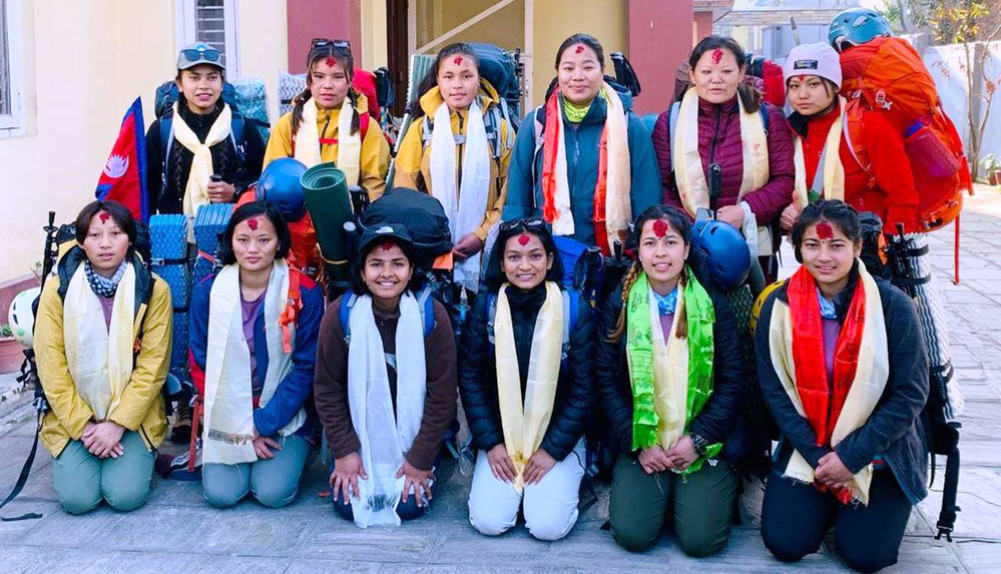
The Seven Summits Women Team: ten Nepali women and the climb that changed who gets to go
By 2008, more than four thousand people had stood on the summit of Everest. Seven of them were Nepali women.
That number is the reason the First Inclusive Women Sagarmatha Expedition existed. Ten women, picked deliberately from different ethnic groups and different parts of the country, set out to climb the mountain that half of them had grown up looking at without ever being told it was theirs to climb. They summited between 22 and 25 May 2008.
The word in the expedition’s name that mattered most was inclusive. Nepal is not one people, and mountaineering here has never drawn evenly from all of them. Putting a Gurung woman, a Sherpa woman, a Newar woman, a Dalit woman and others on the same rope was the point, not a detail.
What it cost to get there
Maya Gurung’s father arranged her marriage when she was fourteen. She took 150 rupees, about two dollars and thirty cents, and left. He performed her death rituals and had them filmed.
Chunu Shrestha’s father was ill when she went. People asked her why she was leaving him. Her brother asked why she wanted to die. “I didn’t want to die,” she said. “I wanted to do something big for women.”
Some of the guides on the mountain took bets on how many of them would not come back. Danuru Sherpa, who has summited Everest sixteen times, put it plainly to ESPN: “They were small. Some Sherpa guides made bets on how many would die.”
Maya Gurung is five foot three. Nimdoma Sherpa, who was seventeen on that climb and became the youngest woman to summit Everest, is four foot ten.
All ten came home.
Then they kept going
Asha Kumari Singh saw what would happen if they stopped. “If we stopped after Everest, we would be lost in history,” she said.
So they went after the Seven Summits, the highest peak on each continent. It took six more years:
- Kosciuszko, Australia, 2,228 m, 7 July 2010
- Elbrus, Russia, 5,642 m, 29 August 2010
- Kilimanjaro, Tanzania, 5,895 m, 5 March 2013
- Aconcagua, Argentina, 6,961 m, 23 February 2014
- Denali, United States, 6,190 m, 24 June 2014
- Vinson, Antarctica, 4,892 m, 23 December 2014
With Everest already behind them, Vinson completed the set. They were the first all-female team in the world to do it.
It is worth being accurate about what that means, because the shorthand version gets it wrong. This was a team achievement, and the team did not walk the same path. On Aconcagua, Shailee Basnet’s right thumb started to freeze halfway up, Maya Gurung took a bad cold injury across her chest and abdomen, and Pujan Acharya’s shoulder gave out. The three of them turned back. Four went on. On Denali, Maya arrived with pneumonia and spent the climb at base camp while the rest spent nineteen days on the mountain in chest-deep snow. Vinson cost roughly fifty thousand dollars per climber and only four could be funded, so the team chose who went.
Maya’s reaction to Aconcagua, quoted in ESPN’s piece, is the whole ethic in one line: “Four of our members got to the summit. As a team, we succeeded.”
The money was harder than the mountains
They needed to raise over a million dollars. Average household income in Nepal at the time was around seven hundred dollars a year. They took loans, maxed out credit, and ran fundraisers for years between climbs.
Shailee Basnet described the specific difficulty of it: “Nobody wants to give money to fund something that already happened.” Every summit made the next one harder to pay for, because sponsors want the future, not the receipt.
What they did afterwards
They did not retire into being famous. They started a trekking company. They taught English and outdoor skills. They built an outdoor curriculum for schools, and set up a programme that uses climbing and time outdoors in the recovery of trafficking survivors.
Then in April 2015 the earthquake hit. The villages that Maya and Nimdoma come from were among the worst affected, and many of them have no road access at all. Sixteen Sherpa men had already been killed in the Khumbu Icefall the year before, on 18 April 2014. Several were friends.
“We take it that it is our generation’s responsibility to bring the nation back,” Shailee said.
Why we keep pointing at this story
Shailee Basnet said something in the ESPN interview that we think about a lot: “There were no footsteps for us to follow, no blueprints laid out for us.”
There are now. That is the part that matters. A Nepali girl looking at the Himalaya today can name women who went, and can find them, and can be trained by them. Maya Gurung put it as a thing she overheard rather than a thing she achieved: “Men were telling their daughters to be like me.”
Read the full ESPN feature here: Group of women become some of the first female Nepali climbers to hike the Seven Summits.