Trip Facts
Country:
Annapurna Region, Nepal
Duration:
10 Days
Max Altitude:
4,500 m / 14,764 ft (Mardi Himal Base Camp)
Activities:
Trekking
Region:
Annapurna Conservation Area, Gandaki
Grade:
Moderate to strenuous
Group Size:
1–12 people
Accomodation:
3-star hotel in Kathmandu (2 nights) and Pokhara (2 nights), teahouse lodges on trek (5 nights)
Trips Overview
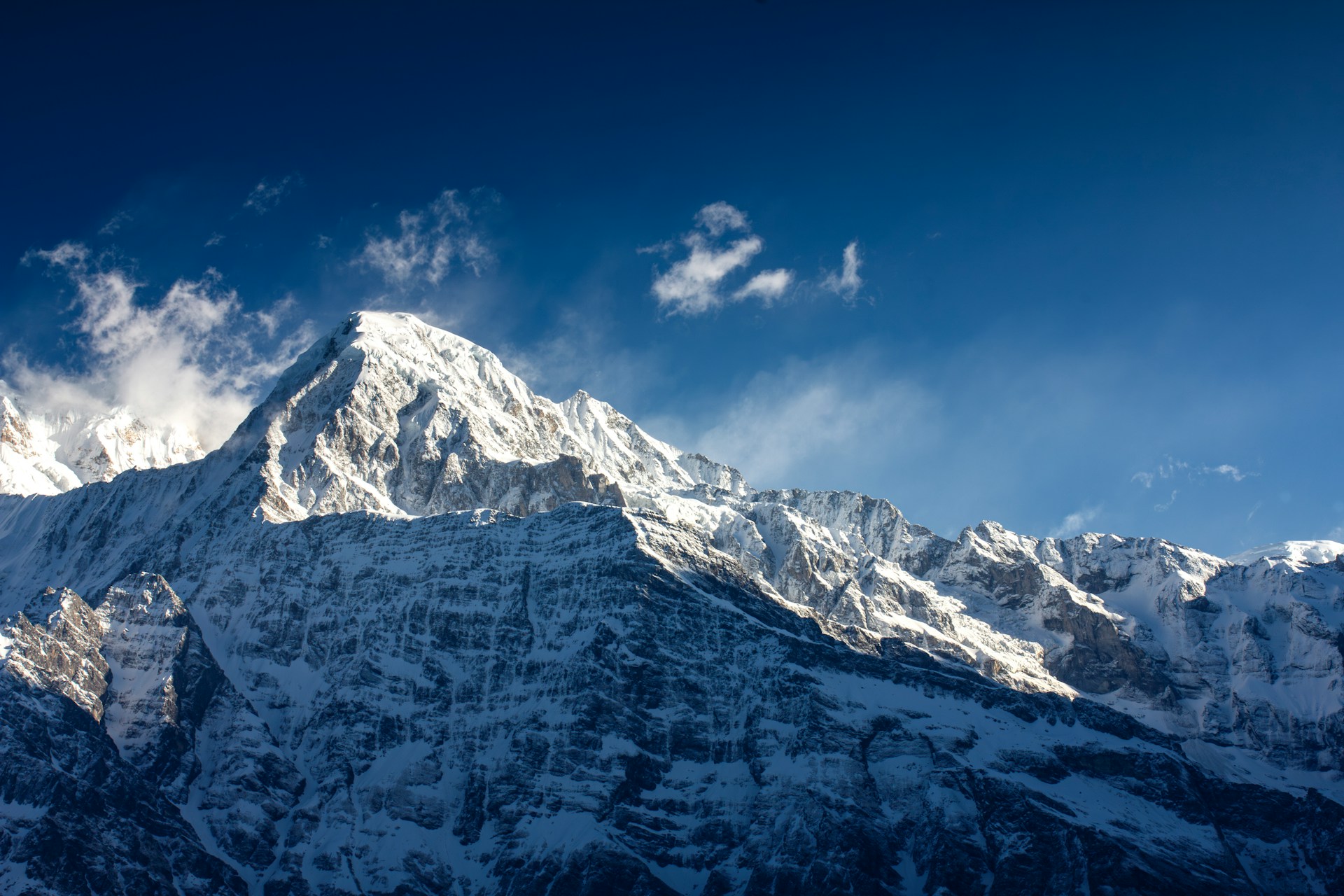
Almost every trek in the Annapurna region walks up a valley. Mardi Himal walks up a ridge, and that one difference changes what you see all day. From Low Camp onwards you are on the crest with the ground falling away on both sides, and once you break out of the rhododendron above 3,200 m there is nothing between you and Machhapuchhre. No intervening ridge, no foreshortening. The Fishtail is roughly 6 km away and 3,400 m above you, and it fills the sky in a way no other Annapurna trail manages.
That proximity is the entire reason to come here. Everything else about the trek follows from it.
Short, close to Pokhara, and newer than the rest
The trailhead at Kande is 90 minutes by road from Pokhara. You can be walking by mid-morning on the day you arrive. Five nights on the trail gets you to 4,500 m and back, which makes this the strongest short trek in the region and the reason we recommend it over Poon Hill to people who have a week rather than a fortnight.
It is also the newest of the Annapurna routes. The trail was only marked and lodged from about 2012, and it did not get busy until 2015 or so. Practically that means fewer lodges, smaller lodges, thinner menus, and stretches with no settlement at all above Low Camp. It also means a trail that has not been widened into a staircase by forty years of traffic.
The honest downsides
High Camp has a handful of lodges and they are basic: unheated plywood rooms, shared squat toilets, cold nights. In late October you want to be there before 2pm or you may be sleeping in the dining room.
There is no spring on the upper ridge. Water is carried or pumped up, so lodges charge for it, and the price climbs with the altitude. Budget accordingly and carry purification rather than buying bottles.
The final push from High Camp to View Point is exposed. It is a narrow ridge with drops on both sides, and in November, March and after any storm it holds ice. Microspikes are worth the 300 g.
And the ridge clouds over. From late morning the valley cloud rises and the mountains disappear, often for the rest of the day. This is a dawn trek. We start the summit day in the dark for that reason, not for effect.
Trekking with us
Groups are small and the pace is set by the slowest walker. Solo travellers make up a large share of every departure. A second guide comes on departures of seven or more, which matters here because the summit day splits: some people stop at View Point at 4,200 m and some carry on to Base Camp, and both groups need somebody with them.
You need to be able to walk five to seven hours on consecutive days on steep, rooty, uneven ground. You do not need previous altitude experience.
Trips Highlights
- Stand at Mardi Himal Base Camp, 4,500 m, with Machhapuchhre 6 km away and 3,400 m above you
- Walk a genuine ridge line rather than a valley floor, with open ground falling away on both sides from Low Camp upward
- Sleep at Low Camp, 2,970 m, an extra acclimatisation night that most 10-day itineraries skip entirely
- Watch sunrise from the Upper View Point at 4,200 m before the valley cloud rises and closes the ridge in
- Break above the tree line at Badal Danda, 3,210 m, where rhododendron gives way to open grass and juniper
- See Annapurna South (7,219 m), Hiunchuli (6,441 m), Mardi Himal (5,587 m) and Machhapuchhre (6,993 m) from one ridge
- Start walking within 90 minutes of leaving Pokhara, with no mountain flight to be delayed by weather
- Climb through old oak and rhododendron forest between Deurali and Low Camp, in flower through March and April
- Descend the quiet eastern side through Sidhing, a working Gurung village that most groups never reach
- Fit the whole trip into ten days, including both Kathmandu nights and two nights in Pokhara
Trips Itinerary
You are met at Tribhuvan International Airport and driven to your hotel in Thamel. Nothing else is scheduled. Sleep, then walk around the neighbourhood in the late afternoon.
Your guide runs the briefing that evening. We check your kit against the list, confirm your insurance covers 4,500 m, take your passport and photographs for the permits, and hand over your duffel and map. Anything missing can be bought or rented within five minutes of the hotel, and your guide will come with you.
Duration:
Transfer 30 to 45 min
Accomodation:
3-star hotel, Kathmandu
A long road day west along the Trishuli river. The Prithvi Highway has been under widening works for years, so plan for eight hours rather than the six the map suggests. We stop for lunch on the way. If you would rather fly, the 25-minute flight is around USD 130 and we can arrange it, but book it when you book the trek rather than on the morning.
Pokhara sits at 822 m beside Phewa Lake, and on a clear afternoon Machhapuchhre is visible from the lakeside without moving from your chair. This is the last night with a proper mattress, hot water and a menu worth reading.
Duration:
7 to 9 hrs drive, 200 km
Accomodation:
3-star hotel, Pokhara
A short drive up to Kande on the Baglung highway, then the trek starts with a stone staircase through Gurung farmland. It is about 290 m of climbing and takes two to three hours at a sensible pace.
Australian Camp is a grassy shoulder facing Annapurna South and Hiunchuli across the Modi valley. It is a deliberately gentle first day, partly because the drive eats the morning and partly because the two days that follow are long. If the sky is clear, the sunset from the meadow is the best of the first half of the trek.
Duration:
1.5 hrs drive, 2 to 3 hrs trek, 4 km
Accomodation:
Teahouse lodge, Australian Camp
Through Pothana at 1,950 m, then a junction at Deurali, 2,100 m, where the Annapurna Base Camp trail carries straight on down and the Mardi trail turns right onto the ridge. From here the character changes completely. No more villages, no more terraces, just oak and rhododendron closing overhead.
Forest Camp, marked as Kokar on some maps, sits at 2,550 m among the trees. Be honest with yourself about the view here: there is not one. This is a night in the woods with damp air, moss on everything and the sound of the forest, which some people find the best night of the trek and others find claustrophobic.
In March and April the rhododendron on this section is in flower and the walk is worth doing for that alone.
Duration:
5 to 6 hrs trek, 10 km
Accomodation:
Teahouse lodge, Forest Camp
A short day, and it is short on purpose. You gain 420 m and stop, which puts a proper acclimatisation night at 2,970 m into the itinerary. Plenty of operators run Forest Camp straight to High Camp instead, a sleeping gain of over 1,000 m in one day, and then wonder why half the group has a headache at 3,580 m.
The walk climbs steadily through thinning forest past Rest Camp at about 2,650 m. Somewhere above Low Camp the trees open and Machhapuchhre appears for the first time properly, straight up the ridge ahead of you.
You arrive by early afternoon. Use it: your guide will take you 200 m higher up the ridge and back before dinner, which does more for acclimatisation than the rest does.
Duration:
3 to 4 hrs trek, 5 km
Accomodation:
Teahouse lodge, Low Camp
610 m of climbing, and the best walking day of the trek. The trail leaves the last of the rhododendron behind at Badal Danda, 3,210 m, and after that you are on open ridge: grass, juniper, and a crest narrow enough that you can see down both sides at once.
Machhapuchhre is directly ahead the whole way and gets visibly larger every hour. Annapurna South and Hiunchuli sit off to your left. There is nothing in front of you, which is the thing that separates this trek from every other route in the Annapurna region.
High Camp is a cluster of a few basic lodges on a shelf at 3,580 m. Plywood rooms, no heating in them, shared squat toilets, and no shower worth the cold afterwards. Arrive early in October and November, because beds here run out. Your guide takes oxygen saturation and pulse readings this evening and again in the morning.
Eat early, get in your bag, and set an alarm for 4am.
Duration:
4 to 5 hrs trek, 5 km
Accomodation:
Teahouse lodge, High Camp
The long day. You leave High Camp in the dark, by headlamp, on a narrow ridge that climbs steeply for the first hour and then eases. From November to March, and after any storm in the shoulder months, the shaded side of this section holds ice. We carry microspikes for the group and you will be glad of them.
The Lower View Point comes at roughly 3,900 m, and the Upper View Point at 4,200 m usually takes two and a half to three hours from High Camp. For a lot of people this is the right place to stop. The view of Machhapuchhre from here is the one on every photograph of this trek, and stopping is not a failure.
From View Point the ridge broadens into a long shallow ramp of moraine and scree that runs another 90 minutes to Mardi Himal Base Camp at 4,500 m, sitting under the south face of Mardi Himal with Annapurna South filling the western sky. If the group splits here, the second guide stays with whoever turns back.
Then it all comes back down. Back to High Camp for a late breakfast, then off the ridge to Low Camp, sleeping 610 m lower than the night before, which is why nobody on this itinerary has a difficult night after the high day. It is a hard day and there is no way to make it a short one.
Duration:
8 to 10 hrs, 14 km
Accomodation:
Teahouse lodge, Low Camp
Rather than retracing the ridge, the trail drops east off the flank on a steep forest path to Sidhing. That is a 1,200 m descent in a morning and your knees will notice. Poles help more today than on any other day.
Sidhing is a working Gurung village rather than a trekking stop, with stone houses, buffalo and terraced millet, and it sees a small fraction of the traffic that the Poon Hill villages get. Lunch here, then a jeep down a rough road to the highway and on to Pokhara.
You are back at lakeside by late afternoon. Hot shower, clean clothes, and dinner somewhere with a proper menu.
Duration:
4 to 5 hrs trek, 9 km, then 2 to 3 hrs jeep
Accomodation:
3-star hotel, Pokhara
The road day again, in reverse. Morning departure, lunch on the highway, into Kathmandu by late afternoon. If you would rather fly back, tell us at booking.
In the evening we hold the farewell dinner at a Nepali restaurant and hand out trip completion certificates. This is also when tips are given to the guides and porters as a group.
Duration:
7 to 9 hrs drive, 200 km
Accomodation:
3-star hotel, Kathmandu
Transfer to the airport about three hours before your flight.
If you have days spare, this is an easy trek to extend. A Kathmandu valley day around Boudhanath, Pashupatinath and Bhaktapur works well, and so does going back to Pokhara for paragliding or continuing into Chitwan. Ask before you book and we will build it into one itinerary.
Duration:
Transfer 30 to 45 min
Accomodation:
Departure day
Trips Include
Everything listed is covered by the trek price. Quantities are stated because vague inclusions are where trekking budgets quietly break.
- Airport transfers on arrival and departure in Kathmandu, in a private vehicle
- 2 nights in a 3-star Kathmandu hotel on twin-share, with breakfast (single supplement available)
- 2 nights in a 3-star Pokhara hotel on twin-share, with breakfast, lakeside
- 5 nights in teahouse lodges on trek, twin-share where rooms allow it
- All meals on trek: 5 breakfasts, 6 lunches and 5 dinners, with tea or coffee at every meal
- Fresh seasonal fruit after dinner each evening on the trail
- Farewell dinner in Kathmandu at a Nepali restaurant on your return
- Purified drinking water throughout the trek, including the upper ridge where lodges charge USD 2 to 5 per litre
- Tourist coach Kathmandu to Pokhara and back, or a private vehicle for groups of 4 or more
- Private vehicle Pokhara to Kande at the start, and jeep from Sidhing to Pokhara at the end
- Licensed, English-speaking trekking guide, with a second guide for groups of 7 or more
- One porter per two trekkers, carrying up to 12 kg each
- All guide and porter wages, meals, accommodation, equipment, insurance and medical cover
- Annapurna Conservation Area Permit, NPR 3,000 per person
- TIMS card, NPR 1,000 per person when booked through a registered agency such as ours
- First aid kit carried by your guide, including a pulse oximeter used at the daily checks from Day 5
- Loan of microspikes for the ridge above High Camp between November and March
- Everest Women Treks duffel bag, trekking map, sun hat and buff, yours to keep
- Trip completion certificate
- All government taxes, VAT and company administrative costs
Guide and porter wages, insurance, equipment and accommodation are paid by us and already sit inside the price. You are never asked to contribute to staff costs on the trail.
Trips Exclude
These sit outside the package. Budget roughly USD 150 to 300 beyond the trek price for ten days. Water is the item people underestimate on this route, because the upper ridge has no spring and lodges charge for what they carry up.
- International flights to and from Kathmandu
- Nepal entry visa: USD 30 for 15 days, USD 50 for 30 days, obtainable on arrival at Kathmandu airport
- Lunch and dinner in Kathmandu and Pokhara, other than the included farewell dinner
- Optional Kathmandu to Pokhara flight, around USD 130 each way, if you would rather not spend 8 hours on the road
- Travel insurance, which must cover helicopter evacuation and medical treatment to at least 4,500 m
- Bottled or boiled water, soft drinks, alcohol and hot chocolate on the trail
- Lodge charges for hot showers, device charging and wifi. Budget USD 3 to 6 per item per day, and expect no shower at all at High Camp
- Personal trekking clothing and equipment
- Sleeping bag and down jacket if you rent rather than bring your own, about USD 20 to 35 each for the trek in Pokhara
- Tips for your guide and porters, customarily 10 to 15% of the trip cost, given as a group at the end
- Single room supplement in Kathmandu and Pokhara, and single rooms are not available at all at High Camp
- Extra nights or activities in Pokhara if you extend, including paragliding and boat hire
- Emergency evacuation costs, which your insurer reimburses
- Anything not listed under what is included
Travel insurance covering helicopter evacuation to at least 4,500 m is required. Check the altitude ceiling in the policy wording rather than assuming, because a 4,000 m policy does not cover the top two days of this trek.
Packaging Lists
What actually matters on this trek
Microspikes or light crampons. Between November and March, and after any storm in the shoulder months, the ridge above High Camp holds ice on the shaded side. They weigh about 300 g and they are the difference between turning around and getting to Base Camp. Rentable in Pokhara.
Broken-in boots with real ankle support. The forest section between Australian Camp and Low Camp is roots, rock steps and mud, and the descent to Sidhing drops 1,200 m in a morning.
Water treatment. A filter bottle or purification tablets. Lodge water on the upper ridge is expensive because it is carried up, and this is the one route where treating your own genuinely saves money.
A sleeping bag rated to minus 10C comfort. High Camp rooms are unheated plywood and the lodge blankets are thin. Comfort rating, not extreme rating.
Upper body
2 base layers in merino or synthetic, 1 fleece, 1 windproof waterproof shell, 1 down jacket for High Camp evenings and the dawn start (rentable in Pokhara for about USD 20).
Lower body
2 pairs trekking trousers, 1 pair thermal leggings, waterproof over-trousers, 4 pairs underwear, 4 pairs trekking socks plus a thick sleeping pair.
Head, hands and feet
Sun hat, warm beanie, buff, category 3 sunglasses, light inner gloves, warm outer gloves, boots, camp shoes, headlamp with spare batteries for the 4am start.
For women
Enough menstrual supplies for the whole trek plus a few days spare, since nothing reliable is sold above Australian Camp and altitude often shifts cycle timing. Sealable opaque bags for used products, which you carry out.
Health and documents
Small first aid kit, blister plasters, rehydration salts, prescription medication in original packaging, SPF 50 sunscreen, lip balm, passport, four passport photographs, insurance certificate, and rupees in small notes.
Bags
One duffel of up to 12 kg carried by your porter (we provide the duffel), plus a 30 to 40 litre daypack for water, layers, camera and spikes.
Trips Altitude
Trips FAQs
The questions we actually get asked about Mardi Himal, answered straight, including how it stacks up against Poon Hill, Khopra Danda and Annapurna Base Camp.
Different treks that get lumped together because they are both about a week.
Poon Hill tops out at 3,210 m, follows a stone staircase between large villages with good lodges, and gives you one wide sunrise panorama across the Annapurna and Dhaulagiri ranges. It is comfortable, it is busy, and in October you will share the viewpoint with a few hundred people.
Mardi Himal goes 1,290 m higher, sleeps in far more basic lodges, and gives you three days of walking a ridge with Machhapuchhre in your face rather than one morning of distant panorama. It is quieter above Low Camp and noticeably harder.
Pick Poon Hill if you want an easy first Himalayan walk, or you are bringing children or a parent. Pick Mardi Himal if you want the mountain close and you do not mind a cold night and a squat toilet.
Khopra Danda (3,660 m) is the closest thing to Mardi Himal in character: a ridge trek, quiet, community-run lodges, big views of Dhaulagiri and Annapurna South. It is a little easier, a little less dramatic, and it faces west rather than at Machhapuchhre. If you have done Mardi and want the same feel again, this is the one.
Annapurna Base Camp (4,130 m) is a valley trek that ends inside a glacial amphitheatre ringed by 7,000 m peaks. It needs eleven to thirteen days, it is more strenuous overall, and the sanctuary at the end is a genuinely different experience from a ridge. It also has an avalanche risk through the Modi gorge in winter and spring that Mardi does not have.
If you have seven or eight days of trekking, Mardi Himal is the better use of them. If you have twelve, do Annapurna Base Camp.
Moderate to strenuous. Harder than most operators grade it and easier than the altitude number suggests.
The walking is four to six hours most days on steep, rooty forest trail and then open ridge. There is no technical ground and no ropes. What makes it strenuous is Day 7: eight to ten hours, a 920 m climb from High Camp to Base Camp starting at 4am, and then 1,530 m of descent to Low Camp.
If you can walk for five hours over hilly ground on consecutive days, you can do this trek. If you have never done a multi-day walk, do six weeks of hill training first and it will be a pleasure instead of a slog.
They do, and some of them contradict themselves on the same page. Here is what we use, checked on the ground:
Kande 1,770 m. Australian Camp 2,060 m. Pothana 1,950 m. Deurali 2,100 m. Forest Camp 2,550 m. Low Camp 2,970 m. Badal Danda 3,210 m. High Camp 3,580 m. Lower View Point about 3,900 m. Upper View Point 4,200 m. Mardi Himal Base Camp 4,500 m. Sidhing 1,750 m.
The two that matter for your insurance and your training are High Camp at 3,580 m, where you sleep, and Base Camp at 4,500 m, the highest you stand. Watch out for itineraries that list Base Camp at 4,500 m in the trip facts and then say 4,120 m in the day-by-day. That is a copy and paste error, and it tells you something about how carefully the rest of the page was written.
Possible but manageable. You sleep at 3,580 m at the highest and stand at 4,500 m for perhaps twenty minutes, which is a much smaller exposure than any Everest route.
The risk on this trek is not the maximum altitude, it is the speed. The standard 10-day itinerary sold by most companies goes Forest Camp (2,550 m) to High Camp (3,580 m) in one day, a sleeping gain of over 1,000 m, when the accepted guidance above 2,500 m is around 500 m per night. We split it with a night at Low Camp, 2,970 m, so the two gains are 420 m and 610 m. That single extra night is the main reason our groups arrive at High Camp able to enjoy the evening.
Your guide records oxygen saturation and resting pulse from Day 5, so any trend is measured rather than guessed. Descent is fast on this route: you can lose 600 m in ninety minutes from High Camp, which is a real safety advantage.
Yes. The trail is well used in season, you are with a licensed guide throughout, and no stage is far from a lodge. Solo travellers make up a large share of every departure we run.
Twin-share rooms are allocated with someone of the same sex unless you request a single. The one caveat is High Camp: in peak season the lodges there sometimes put four or six people in a room, and a single room is not available at any price. Your guide will sort the allocation, and if the lodge is genuinely full we drop back down to Low Camp rather than take a bad arrangement.
They get more basic the higher you go, and the drop-off is sharper than on the Everest or Poon Hill trails because this route has only been lodged since about 2012.
Australian Camp and Forest Camp are fine: twin rooms, blankets, a dining room with a stove, hot showers for USD 3 to 5. Low Camp is similar but colder.
High Camp is a handful of lodges with unheated plywood-partitioned rooms, thin blankets, shared squat toilets outside, and no shower you would want to use. Charging is USD 3 to 5 per device and often from a small solar bank, so bring a power bank. Bring your own toilet paper from Low Camp onward. It is one night, and the sunrise the next morning is why you came.
Because the ridge clouds over. Warm air rises out of the Modi and Seti valleys through the morning and the cloud usually reaches ridge height between 10am and noon, earlier in spring than in autumn. Once it does, you are walking in white.
Leaving High Camp at 4.30am puts you at the Upper View Point for first light, with two or three clear hours after it. Groups that leave at 8am often reach 4,200 m and see nothing at all. This is not an operator adding drama to the itinerary. It is the only way the trek works.
Two, both included and both arranged by us before you leave Kathmandu.
The Annapurna Conservation Area Permit costs NPR 3,000 per foreign trekker and is checked at the ACAP post near the start of the trail. This is the one that matters and it is checked properly.
The TIMS card costs NPR 1,000 through a registered agency, or NPR 2,000 if you arrange it yourself as an individual. Enforcement of TIMS in the Annapurna region is currently disputed. It has never been formally abolished here the way it was in the Khumbu, but since 2025 checkpoints have reportedly been inspecting ACAP only. We obtain it anyway, because being turned back mid-trek costs far more than the fee. It was abolished in the Everest region, and a lot of pages confuse the two. Enforcement on the Mardi trail is inconsistent and some checkposts wave it through, but it is required and we carry it.
Bring your passport and four passport photographs. You cannot get either permit at the trailhead.
October and November are the clearest and the busiest. Post-monsoon air, stable weather, cold but dry nights at High Camp. Book ahead.
March to April gives rhododendron in flower through the forest section and slightly hazier air. Cloud arrives earlier in the day than in autumn.
December to February is cold and quiet. Nights at High Camp go to minus 10C or lower, some upper lodges close, and the ridge above High Camp holds snow and ice. It is doable with microspikes and a good bag, and the views are the sharpest of the year.
June to September is monsoon. Leeches in the forest, cloud on the ridge, and no view at the top. We do not run it.
Because there is no spring on the upper ridge. Every litre at High Camp has been carried up from below or pumped a long way, and the price reflects that: usually USD 2 to 3 at Low Camp and USD 4 to 5 at High Camp per litre.
We include purified water throughout, so this is not a cost you carry. Bring a filter bottle or purification tablets anyway as a backup. Do not plan to fill from streams above Low Camp, because there mostly are not any.
Six weeks of preparation is enough for most people. Two or three sessions a week of hill walking or stair climbing with a loaded daypack, building to a four-hour walk at the weekend, and a couple of runs or cycles for general endurance.
The specific things worth training are downhill and consecutive days. Day 7 involves 1,530 m of descent and Day 8 another 1,200 m, and it is the descents that wreck quads and knees on this trek, not the climbs. Walk downhill deliberately in training and use poles.
Budget USD 150 to 300 for the ten days. That covers meals in Kathmandu and Pokhara, hot showers and charging at USD 3 to 6 each, wifi, snacks, drinks and souvenirs.
Tips are separate and customarily 10 to 15% of the trip cost, pooled by the group and given to guides and porters at the farewell dinner.
Take rupees in small notes from Pokhara. There are no ATMs anywhere on the trail and no lodge takes a card.
Both, with conditions. We have taken trekkers from ten to seventy-one on this route.
For children the limiting factor is Day 7, not the altitude. Eight to ten hours with a 4am start is a lot for anyone under about twelve. A good option is for part of the group to stop at the Upper View Point at 4,200 m and turn back, which shortens the day by three hours and costs you very little in terms of the view.
For older trekkers the limiting factors are the descents and the High Camp lodge. If knees are an issue, we can run the trek with an extra night, descending High Camp to Low Camp to Sidhing over two days rather than one and a half. Ask and we will price it.
Good to Know
The questions we actually get asked about Mardi Himal, answered straight, including how it stacks up against Poon Hill, Khopra Danda and Annapurna Base Camp.
You sleep at 3,580 m at the highest and stand at 4,500 m for about twenty minutes. That is a modest total exposure, and serious altitude illness on this route is uncommon.
The problem is the profile, not the ceiling. The itinerary most companies publish runs Forest Camp at 2,550 m straight to High Camp at 3,580 m in a single day. That is a sleeping gain of 1,030 m, roughly double the 500 m per night that is the accepted guidance above 2,500 m. Groups on that schedule arrive at High Camp with headaches, sleep badly at the coldest lodge on the trail, and then start the hardest day of the trek at 4am already depleted.
We put a night at Low Camp, 2,970 m, into the middle of it. The gains become 420 m then 610 m. It costs one day and it changes the whole back half of the trek.
From Day 5 your guide records oxygen saturation and resting pulse each evening, so a change is measured rather than argued about. On the ridge, descent is quick and always available: 600 m in ninety minutes from High Camp, and a road at Sidhing within a day.
What we ask from you: 3 litres of water a day, walk slower than feels right on Day 6, no alcohol at High Camp, and speak up early rather than proving you can push through.
This is the practical detail that separates Mardi Himal from every other Annapurna trek. There is no spring above Low Camp. The ridge is a ridge, so water does not collect on it.
Everything sold at High Camp has been carried up on somebody’s back or pumped a very long way, and it is priced accordingly: around USD 4 to 5 a litre, against USD 1 to 2 at Australian Camp. Boiled water costs the same because the fuel came up the same way.
We include purified water for the whole trek, so this does not land on your budget, but it does affect how you walk. Fill up properly at Low Camp before the climb to High Camp and again at High Camp before the summit day. Do not plan to top up from streams above 3,000 m. There mostly are not any, and what there is may be a lodge’s drinking supply.
The section between High Camp and the Upper View Point is a narrow ridge with drops on both sides. It is a walk, not a climb, and it is entirely straightforward in dry conditions.
It is not always dry. From November through March the shaded eastern side holds hard snow and ice, and in the shoulder months a single storm can put ice there for a week. Frozen ground on a 4am start on an exposed ridge is where this trek stops being casual.
We carry microspikes for the group between November and March, and we carry them any time the conditions warrant it. They weigh about 300 g. If you own a pair, bring them, and bring poles regardless.
If the ridge is genuinely unsafe, we stop at the Lower View Point at around 3,900 m and come down. That decision belongs to the guide and it is not negotiable on the day. The mountain is in the same place next season.
Warm air rises out of the Modi and Seti valleys through the morning and forms cloud that reaches ridge height between about 10am and noon. In spring it happens earlier. Once it arrives, the mountains are gone, often until the following dawn.
This governs the whole itinerary. It is why Day 7 starts at 4.30am, why we recommend arriving at High Camp by early afternoon rather than at dusk, and why the sunset views on this trek are less reliable than the sunrises.
It also means a bad-luck day is possible. Roughly one departure in six loses the Base Camp morning to weather. If that happens, you will still have walked three days of open ridge with Machhapuchhre in front of you, which is more than most Annapurna treks give you on a good day.
The Mardi ridge was only marked and lodged from about 2012, and it did not get busy until 2015. Compared with Poon Hill, which has had lodges since the 1970s, that shows up in specific ways.
Fewer lodges, and smaller. High Camp has a handful and they fill up. Thinner menus: dal bhat, noodles, fried rice, eggs, and not a great deal else above Low Camp. No bakeries, no coffee machines, no ATMs anywhere on the route. Patchy mobile signal, good at Australian Camp and Low Camp, unreliable at High Camp. No health post above Pothana.
The upside is a trail that has not been paved into a staircase, villages on the descent that are not built around trekking, and stretches above Badal Danda where you can walk for an hour and see nobody in the off-peak months.
Practically: book ahead for October, November and April, carry snacks you actually want to eat, bring a power bank, and do not expect to buy anything you forgot.
Hot showers work at Australian Camp, Forest Camp and Low Camp for USD 3 to 5. At High Camp there is effectively no shower, and at 3,580 m in an unheated room you would not want one. Most people go two days on wet wipes and a quick-dry towel, which is fine.
Bring your own toilet paper and hand sanitiser from Low Camp onwards. Toilets above Forest Camp are shared, usually squat, and often outside the building. A headlamp matters more than it sounds when it is minus 5C at 2am.
Rooms are twin-share with thin partitions and most doors have no lock. In peak season High Camp may put four or more to a room. Bring a sarong or light towel to change under.
Drink fully even though it means getting up at night. Urinary tract infections are common on trek because people cut back on water to avoid the cold walk to the toilet. A wide-mouth bottle or a pee funnel solves that if you have practised at home.
Women should bring enough menstrual supplies for the whole trek plus a few days spare. Altitude and sustained exertion often shift cycle timing, and nothing reliable is sold above Australian Camp. There is no waste disposal on the ridge, so used products are carried out in sealable opaque bags. Worth mentioning to your guide, because cramps and fatigue overlap with early altitude symptoms and neither should be misread as the other.
Every departure runs with a licensed, English-speaking trekking guide. Groups of seven or more get a second guide, and on this route that is not a formality: the summit day splits, with some people stopping at the Upper View Point at 4,200 m and others carrying on to 4,500 m, and both groups need someone with them.
Porters carry up to 24 kg shared between two trekkers. All staff are insured, equipped with boots, jackets and eyewear, paid above the government minimum, and fed and accommodated at our cost. On this trail that last point costs us more than it does elsewhere, because High Camp lodges charge staff rates that reflect how far everything has been carried.
Guides are briefed before every departure on the specifics here: the Low Camp acclimatisation night, the dawn start, the ice call above High Camp, and the daily health checks.
A 20% deposit confirms your place, with the balance due in Pokhara before you start walking. We hold a provisional booking for seven days at no cost.
Cancel more than 30 days out and the deposit is refundable less bank charges. Inside 30 days it is retained but transferable to another departure within 12 months.
If we cancel a departure, which we would only do for safety or minimum numbers, you get a full refund or a transfer, your choice.
Book six to eight weeks ahead for October, November and April. High Camp is the constraint. It has a small number of beds and no overflow, and a group without a booking in peak season may end up sleeping in the dining room or dropping back to Low Camp.
Book six to eight weeks ahead for October, November and April. High Camp has very limited beds, and on peak-season weekends the lodges there fill by early afternoon.
A 20% deposit holds your place, with the balance due in Pokhara before you start walking. We can hold a provisional booking for seven days at no cost.
Once booked you get a pre-departure pack with a six-week training plan, a kit list you can tick off, and a note on which insurance policies actually cover evacuation above 4,000 m.
You do not need a spare weather day for this trek. There is no mountain flight in the itinerary, so nothing can strand you. The Kathmandu to Pokhara leg is by road and runs in almost any conditions. That is a real advantage over every Everest trek.
The road day is long. Kathmandu to Pokhara is 200 km and takes seven to nine hours because of roadworks on the Prithvi Highway. If you would rather fly, the 25-minute flight costs around USD 130 each way and we can book it. Say so at the time of booking rather than on the morning.
Adding days is easy here. Mardi Himal joins neatly onto Annapurna Base Camp, Poon Hill, or two days doing nothing beside Phewa Lake. Ask before you book and we will build it into one itinerary rather than two.