Trip Facts
Country:
Langtang Region, Nepal
Duration:
12 Days
Max Altitude:
4,984 m / 16,351 ft (Tserko Ri)
Activities:
Trekking
Region:
Langtang National Park, Rasuwa
Grade:
Moderate
Group Size:
1–12 people
Accomodation:
3-star hotel in Kathmandu (2 nights), teahouse lodges on trek (9 nights)
Trips Overview
No flight. That is the first thing worth knowing about Langtang.
You reach the trailhead by road: 122 km north of Kathmandu to Syabrubesi, seven to eight hours in a jeep. Everest and Annapurna treks start with a flight that weather can cancel for two or three days running. Langtang cannot be weather-cancelled, because there is nothing to cancel. If the road is blocked by a landslide in monsoon you wait a few hours or take a detour, and that is a different order of problem from sitting in Kathmandu airport watching your holiday burn.
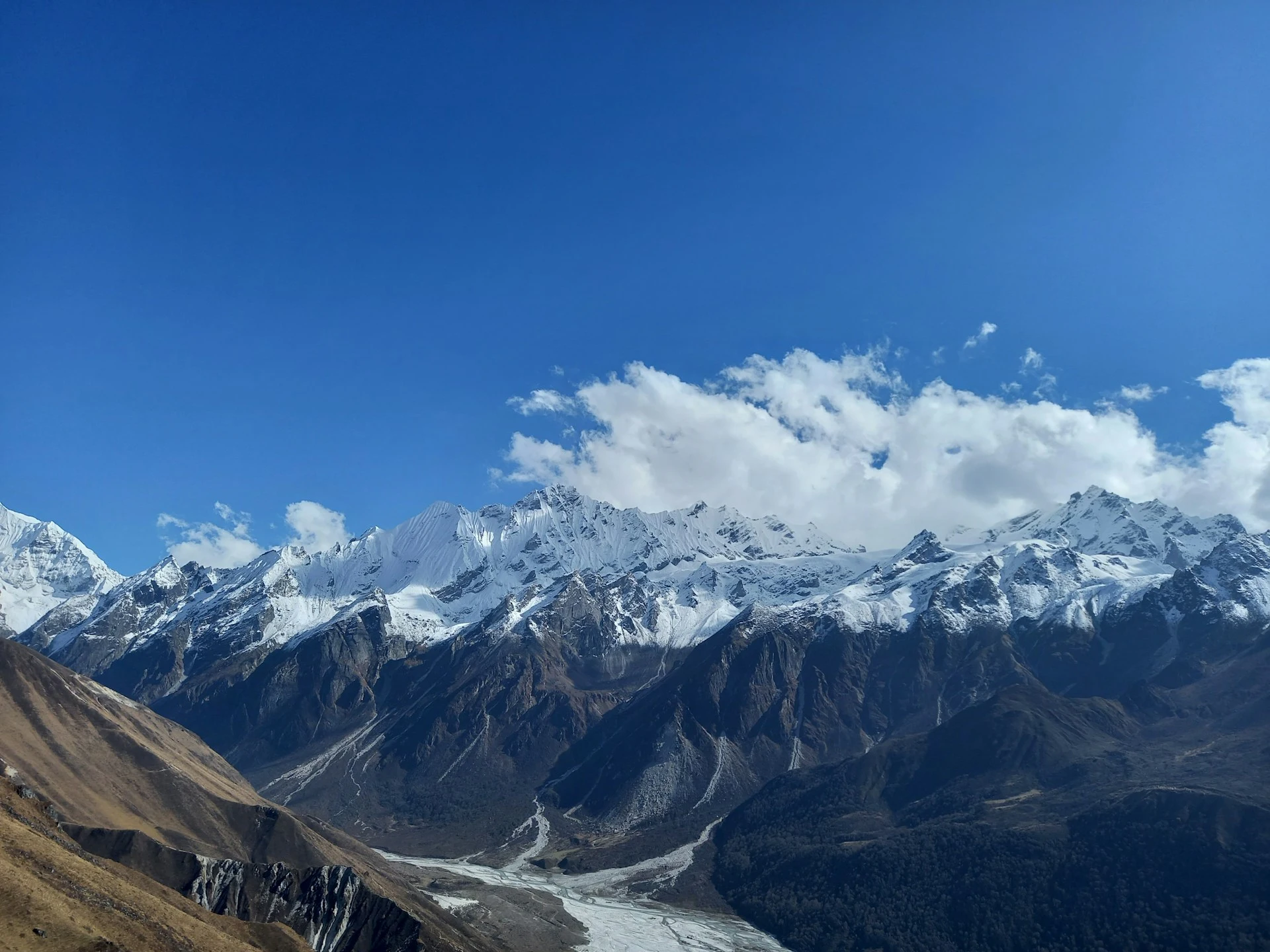
The valley itself runs east from Syabrubesi, climbing through oak and rhododendron forest along the Langtang Khola, then out of the trees into open yak pasture at around 3,400 m. Above that sits Kyanjin Gompa, a small settlement at 3,830 m with a monastery, a cheese factory and a wall of ice at the head of the valley. Langtang Lirung is 7,227 m and stands about 6 km from the lodges. You look almost straight up at it.
Two summits go from Kyanjin. Kyanjin Ri at 4,773 m is the shorter of the two, and Tserko Ri at 4,984 m is the longer. Most operators give you one day and ask you to choose. We give you two nights and you can do both, which is also the safer way to handle the altitude.
The valley was hit hard in 2015. On 25 April an earthquake-triggered avalanche of rock, ice and air destroyed Langtang village and killed roughly 300 people, including a large share of the village’s own residents. It has been rebuilt on a site slightly away from the old one. There is a memorial, and there are people in the lodges who lost family. We cover this properly further down the page, because you should arrive knowing what happened rather than working it out from the stone mounds beside the trail.
Compared with the Khumbu, Langtang is quieter, cheaper and lower. You sleep no higher than 3,830 m. The trek is real work, roughly five to six hours of walking most days with one 950 m climb split across two, but it does not need any technical skill and beginners with reasonable fitness finish it.
Trips Highlights
- No mountain flight. The trailhead at Syabrubesi is 122 km by road from Kathmandu, so there is no Lukla weather delay to plan around
- Two summit days from Kyanjin Gompa instead of one: Kyanjin Ri at 4,773 m, then Tserko Ri at 4,984 m
- Sleep no higher than 3,830 m, which is 1,300 m lower than the highest night on an Everest Base Camp trek
- Langtang Lirung, 7,227 m, stands about 6 km from the Kyanjin lodges and fills the head of the valley
- The 950 m climb from Lama Hotel to Langtang village split across two days, with a night at Thangshyap
- Walk through the rebuilt Langtang village and its earthquake memorial, with time and context to understand what happened here in April 2015
- The yak cheese factory at Kyanjin Gompa, started with Swiss help in the 1950s and rebuilt after the quake, still turning out hard cheese at 3,830 m
- Oak, rhododendron and bamboo forest on the lower trail, with red panda territory and a good chance of langur monkeys around Lama Hotel
- Tamang and Tibetan-descended villages, with mani walls, chortens and a monastery rebuilt in 2018
- Far fewer trekkers than Everest or Annapurna, on a route that costs less and needs no domestic flight
Trips Itinerary
You are met at Tribhuvan International Airport and driven to your hotel in Thamel. Nothing else is scheduled. Most people land tired and the afternoon is best spent asleep or walking the neighbourhood.
Your guide runs the briefing in the evening. We check your kit against the list, confirm your insurance covers evacuation above 4,000 m, hand over your duffel and map, and go through the road journey and the altitude plan. If anything is missing, the gear shops are a few minutes’ walk away and still open.
Duration:
Transfer 30 to 45 min
Accomodation:
3-star hotel, Kathmandu
An early start, usually around 7am, in a private jeep or minibus. The first two hours on the Prithvi Highway are smooth tarmac along the Trishuli. After the turn north at Trishuli Bazaar the road climbs, narrows and gets rougher, and past Dhunche there are stretches of gravel and broken blacktop.
We say seven to eight hours because that is what it usually takes. Operators who advertise five to six hours are quoting a best case that assumes no roadworks and no delay, and it is not what most groups experience. Bring motion sickness tablets if you are prone to it. The switchbacks above Dhunche get people who never normally suffer.
What you get in return is the whole point: no flight, no weather window, no three days lost in an airport. The road climbs to about 2,300 m near Dhunche then drops back down to Syabrubesi, so you sleep low tonight.
You arrive mid to late afternoon. Syabrubesi is a small roadhead town on the Bhote Koshi with lodges, shops and an army permit checkpost.
Duration:
7 to 8 hrs drive, 122 km
Accomodation:
Teahouse lodge, Syabrubesi
Cross the suspension bridge over the Bhote Koshi and turn east into the Langtang valley proper. The trail follows the Langtang Khola upstream through oak, bamboo and rhododendron, with the river loud below you most of the day.
Roughly 1,020 m of ascent, and this is the hardest day of the first half. It comes at you in a series of steps rather than one long climb: up to Doman, then Bamboo at about 1,970 m where most groups stop for lunch, then Rimche at 2,400 m, then a short walk to the cluster of lodges called Lama Hotel.
Langur monkeys are common along this stretch and this is red panda territory, though seeing one would be luck rather than expectation. There is almost no mountain view all day, which surprises people. You are deep in a forested gorge. The mountains arrive on Day 5.
Lama Hotel is not a hotel. It is five or six lodges in a clearing at the bottom of a valley with no phone signal and limited solar power.
Duration:
5 to 6 hrs trek, 11 km
Accomodation:
Teahouse lodge, Lama Hotel
This is where our itinerary parts company with almost every other one online.
The standard version pushes from Lama Hotel to Langtang village in a single day: 950 m of sleeping-altitude gain, finishing above 3,400 m, on the fourth day of the trip. That is well over the 300 to 500 m per night that acclimatisation guidance recommends above 3,000 m, and it is the reason a fair number of people arrive at Langtang village with a bad headache and a rough night ahead of them.
We stop at Thangshyap instead, about 3,140 m, a couple of hours past Ghodatabela. The day is short. You climb steadily out of the forest, and around Ghodatabela at 3,030 m the trees thin and Langtang Lirung finally appears ahead. There is an army checkpost here where permits are recorded.
Your guide starts the daily oxygen saturation and pulse checks this evening. One reading tells you very little. Four days of readings tell you whether you are adapting, which is the point of recording them at all.
Duration:
4 to 5 hrs trek, 7 km
Accomodation:
Teahouse lodge, Thangshyap
A short morning. The valley opens out into yak pasture, the walls pull back, and Langtang Lirung stands 7,227 m above the north side.
Before the new village you pass the site of the old one. On 25 April 2015 an earthquake-triggered avalanche of ice, rock and compressed air came off the slopes below Langtang Lirung and buried it. Around 300 people died there, a large share of them residents of the village itself. Almost nothing was left standing.
What you see now is a memorial: mounds of stones carved with mantras, and boulders the size of houses that the avalanche carried down. The village has been rebuilt slightly to the east on ground judged safer, with new lodges, a school and a health post.
You arrive by early afternoon. Walk the village, and if you want to know more, ask. People here generally will talk about it, and many would rather visitors understood than tiptoed around it. Do not photograph the memorial or people at it without asking first.
Duration:
3 to 4 hrs trek, 6 km
Accomodation:
Teahouse lodge, Langtang Village
Another deliberately short day, 400 m of gain, done by lunchtime. The trail runs through Mundu and Sindum past the longest mani wall in the valley, a stone bank of carved prayers a few hundred metres long. Keep it on your right as you pass, which is the local custom.
Kyanjin Gompa sits in a flat bowl at the head of the inhabited valley with glaciers above it on three sides. The monastery it is named after was rebuilt in 2018 with Japanese support after the earthquake.
The cheese factory is worth the twenty minutes. It was set up with Swiss assistance in the 1950s as a development project, makes hard yak cheese in summer when the herds are up, and has been rebuilt since 2015. You can buy a wedge. It is sharp, salty and travels well.
Spend the afternoon walking gently around the settlement rather than lying down. Light activity at a new altitude helps you sleep and is better preparation for tomorrow than a nap.
Duration:
3 to 4 hrs trek, 7 km
Accomodation:
Teahouse lodge, Kyanjin Gompa
The first of the two summits, and the shorter one. The trail starts directly behind the lodges and climbs the ridge to the north in a steep, relentless zigzag on loose ground.
There are two tops and operator pages routinely confuse them. The lower shoulder at roughly 4,300 m carries prayer flags and takes about ninety minutes. Most people who say they climbed Kyanjin Ri stopped there. The true top is 4,773 m and needs another hour and a half of steeper walking above it. We go for the high top if the group is moving well, and stopping at the lower one is a perfectly good day out.
From the top you get Langtang Lirung directly opposite, Kimshung, Yansa Tsenji, Gangchempo with its distinctive fin, and the Langtang glacier running west. The whole valley you have walked up is laid out below.
Leave around 5.30am. Cloud builds most days from mid-morning. Back at the lodge for a late lunch, then rest, because tomorrow is the long one.
Duration:
4 to 6 hrs, 940 m ascent and descent
Accomodation:
Teahouse lodge, Kyanjin Gompa
The highest point of the trek and a genuinely hard day. Around 1,150 m of ascent, most of it above 4,000 m, on a trail that is more a series of grassy shelves and boulder slopes than a path.
We leave at 4am with headtorches. The gradient eases in stretches, which lets you get a rhythm, then kicks up again near the top. Expect seven hours if the group is strong and closer to nine if it is not.
The summit gives you the full northern wall of the valley: Langtang Lirung at 7,227 m, Langtang Ri, Dorje Lakpa at 6,966 m, Gangchempo, and on a clear day Shishapangma inside Tibet. Below you the Langtang and Lirung glaciers meet.
Honest version: perhaps two thirds of a typical group makes the true summit and the rest turn around somewhere on the upper slopes. That is a normal outcome, not a failure, and it is exactly why we put Kyanjin Ri first. If yesterday’s readings and how you felt on it say no, your guide will tell you so, and you will have a good day walking to the glacier viewpoint instead.
Duration:
7 to 9 hrs, 1,150 m ascent and descent
Accomodation:
Teahouse lodge, Kyanjin Gompa
Long day, all of it downhill: 1,350 m of descent covering in one push what took you three days to climb. You retrace the valley through Langtang village, Thangshyap and Ghodatabela, then drop back into the forest.
The oxygen comes back fast and people usually feel strong. That is the trap. Descending 21 km on rocky trail is what wrecks knees and quads, and almost every injury we see on this trek happens on the way down rather than the way up. Use both poles, shorten your stride, and let the porters go ahead.
The valley looks completely different in this direction, with the light behind you and the peaks at your back rather than ahead.
Duration:
6 to 7 hrs trek, 21 km
Accomodation:
Teahouse lodge, Lama Hotel
Back down through Rimche and Bamboo, then along the river to Syabrubesi. Roughly 1,020 m of descent, on the same forested trail you climbed on Day 3.
It is humid down here after a week in dry mountain air, and the last hour along the Bhote Koshi feels hot in autumn and spring. There is phone signal again in Syabrubesi, hot showers that work properly, and cold beer.
This is the evening the group and the crew usually eat together. If you plan to tip, tonight is when it is done, before the drive back turns everyone into passengers.
Duration:
5 to 6 hrs trek, 11 km
Accomodation:
Teahouse lodge, Syabrubesi
The same road in reverse, leaving around 7am and arriving in Thamel mid to late afternoon. The rough section is the first three hours, then the highway improves.
You are back with a full evening free and no flight risk hanging over it, which is a real difference from a Khumbu trek where the last day is spent hoping the Lukla flight goes. Farewell dinner tonight.
Duration:
7 to 8 hrs drive, 122 km
Accomodation:
3-star hotel, Kathmandu
We drive you to the airport about three hours before your flight. If you have a late departure the hotel will hold your bags, and there is time to get to Patan or Boudhanath and back.
If you are staying on in Nepal, tell us early and we will move things around: Chitwan, Pokhara, or a few days in the Kathmandu valley all work well as an add-on from here.
Duration:
Transfer 30 to 45 min
Accomodation:
Not included
Trips Include
Everything below is inside the trek price. We list quantities because vague inclusions are where trekking budgets quietly break.
- Airport transfers on arrival and departure in Kathmandu, in a private vehicle
- 2 nights in a 3-star Kathmandu hotel on twin-share, with breakfast (single supplement available)
- 9 nights in teahouse lodges on trek, twin-share, with a private room wherever the lodge has one free
- Private jeep or minibus from Kathmandu to Syabrubesi and back, 122 km each way, not a public bus
- All meals on trek: 9 breakfasts, 9 lunches and 9 dinners, ordered from the lodge menu rather than a fixed set menu
- Tea or coffee with every meal on trek
- Purified drinking water on trek, by filter or tablets, so you buy no bottled water and carry no plastic up the valley
- A licensed, English-speaking trekking guide for the whole trek, wilderness first-aid trained
- A second guide on any departure of 7 or more people, so the group can split when walking speeds differ
- One porter for every 2 trekkers, carrying up to 25 kg total, so 12.5 kg of your kit
- All guide and porter wages, food, lodging, transport, insurance and equipment
- Langtang National Park entry permit (NPR 3,000 for foreign nationals) and the TIMS card, both arranged by us
- Daily oxygen saturation and pulse checks from Day 4 onward, recorded so a trend is visible rather than a single reading
- A comprehensive first aid kit carried by your guide, including a pulse oximeter
- Duffel bag on loan for the trek, plus a trekking map of the Langtang valley
- Farewell dinner in Kathmandu on your last night in Nepal
- All government taxes, local levies and company administrative costs
Guide and porter wages, insurance, food, lodging and gear are paid by us and already sit inside the price. You are never asked to top up staff costs on the trail.
Trips Exclude
These sit outside the package. Budget roughly USD 180 to 320 beyond the trek price for twelve days. Langtang runs cheaper than the Khumbu on the trail because supplies come in by road and jeep rather than by porter and plane, so hot showers, charging and drinks cost less than they would above Namche.
- International flights to and from Kathmandu
- Nepal entry visa: USD 30 for 15 days, USD 50 for 30 days, paid in cash on arrival or applied for online in advance
- Travel insurance covering trekking to 5,000 m and helicopter evacuation, which is mandatory on this trek
- Lunch and dinner in Kathmandu, other than the farewell dinner
- Drinks of every kind: bottled water, soft drinks, beer and any bottled or canned beverage
- Hot showers in the lodges, around NPR 300 to 600 depending on altitude
- Charging phones, cameras and power banks in the lodges, around NPR 200 to 400 per device per evening
- Wi-Fi in the lodges, where it exists, roughly NPR 300 to 500 for a day
- Personal trekking gear and clothing, including boots, sleeping bag and down jacket
- Sleeping bag and down jacket rental in Kathmandu if you need it, around USD 2 to 3 per item per day
- Tips for your guide, porter and driver, which are customary but entirely your call
- Extra nights in Kathmandu if you arrive early, leave late or come off the trail ahead of schedule
- Any cost arising from a landslide, road closure, illness or evacuation that changes the itinerary
- Laundry, phone calls, souvenirs and anything else of a personal nature
Travel insurance covering helicopter evacuation and medical treatment to at least 5,000 m is required. Check the altitude limit in the policy wording, not the marketing page. Many standard policies stop at 4,000 m, which is below both summits on this trek and below the level at which you are most likely to need them.
Packaging Lists
The three things that actually matter
Broken-in boots. Mid-weight with ankle support, worn for at least 50 km before you fly. The Langtang trail is rockier and rootier than the Khumbu main trail, and the descent on Days 9 and 10 punishes new boots.
A sleeping bag rated to about -10°C. Lodges at Kyanjin have blankets and most have a heated dining room in the evening, but the bedrooms are unheated and the temperature drops fast after dark. Rentals are available in Kathmandu for a few dollars a day if you would rather not carry one from home.
Trekking poles. Two, not one. There is 2,370 m of descent in this trek and the last two days are almost entirely downhill.
Rest of the list
Layers: two base layers, a fleece or light insulated mid layer, a down jacket for the summit mornings, a waterproof shell. Legs: two pairs of trekking trousers, one thermal bottom. Feet: four pairs of trekking socks, camp shoes. Hands and head: warm hat, sun hat, liner gloves, insulated gloves, buff. Sun: category 4 sunglasses, factor 50, lip balm with SPF. Other: headtorch with spare batteries, 2 litres of water capacity, purification tablets or a filter, a 30 to 40 litre daypack, a power bank of 10,000 mAh or more, basic blister kit, earplugs.
For women. Tampons and pads are hard to find above Syabrubesi, so bring what you need for the full trip plus a few days. A small supply of ziplock bags for used items is worth packing. Lodges have shared toilets and thin walls, which is the same for everybody.
Rented in Kathmandu. Sleeping bags and down jackets are widely available in Thamel. Your guide will take you if you want a second opinion on quality before you pay.
Trips Altitude
Trips FAQs
The questions we actually get asked, including the ones about the earthquake, which most operator pages avoid.
Different treks with different costs and different risks.
Langtang has no flight. You drive to the trailhead, so nothing about your itinerary depends on cloud over an airstrip. It is twelve days rather than fourteen or fifteen, it costs meaningfully less because there is no domestic flight and supplies come in by road, and the highest you sleep is 3,830 m instead of 5,164 m. Far fewer people on the trail. The mountains are closer to you: Langtang Lirung is about 6 km from your lodge at Kyanjin.
Everest Base Camp gives you Everest itself and the name. Nothing here substitutes for that if that is what you want.
Practical version: if this is your first Himalayan trek, if you have a fixed flight home you cannot afford to miss, or if the budget is tight, Langtang is the better trip. If you specifically want Everest, no amount of Langtang will scratch that itch.
On 25 April 2015 a magnitude 7.8 earthquake struck Nepal. In Langtang it triggered an avalanche of ice, rock and debris off the slopes below Langtang Lirung, estimated at tens of millions of tonnes, which came down onto Langtang village along with an air blast that flattened forest on the far side of the valley. Around 300 people died there. A large proportion of them were residents, and there are families in the valley who lost most of their relatives in a few seconds.
The village has been rebuilt on a site to the east that geologists judged safer. There is a school, a health post and new lodges. Kyanjin Gompa monastery was rebuilt in 2018. The cheese factory is running again. Trekking income is the main reason the rebuilding was possible, which is the honest argument for going.
On safety: the trail, the bridges and the lodges have all been rebuilt or repaired and the route has been open and busy for years. Nepal is seismically active and always will be, and no operator can promise you otherwise. That risk is not meaningfully different in Langtang than in Kathmandu.
Normally, mostly. People are running lodges and want your business, not your solemnity.
Two specifics. Ask before photographing the memorial or anyone at it, and do not climb on the stone mounds. And if the subject of the earthquake comes up, follow the lead of whoever raised it rather than pressing for the story. Some people talk about it readily, some do not, and both are fine.
Beyond that, spend money in the valley. Eat where you sleep, buy the cheese, buy the tea. That is what actually helps.
Moderate. Five to six hours of walking on most days, one long descent day of 21 km, and two optional summit days that are much harder than the rest of the trek.
There is no technical ground, no rope, no crampons and no pass to cross. If you can walk six hours on a hilly trail carrying a daypack, on consecutive days, you can do this trek.
Worth pointing out: Ace the Himalaya grade this one Demanding, level 3, in their facts block and then describe it in their own FAQ as one of the most beginner friendly treks in Nepal. Both statements cannot be doing any work. Our grade is moderate for the valley walk. Tserko Ri on its own is challenging, and you can decline it on the morning without affecting anything else.
Two documents for Langtang: the Langtang National Park entry permit, NPR 3,000 for foreign nationals and NPR 1,500 for SAARC nationals, and a TIMS card. Both are included in your trek price and we arrange them in Kathmandu before you leave.
The TIMS question causes confusion because the answer differs by region and has changed more than once. TIMS was scrapped in the Khumbu, where a separate local municipality fee replaced it, and various sources have wrongly generalised that to the whole country. For Langtang, carry both. We confirm the current position with the Nepal Tourism Board in the week before every departure rather than trusting a blog post.
Since February 2025 a licensed guide has been mandatory for trekking inside Langtang National Park, for foreign and Nepali trekkers alike. Solo unguided trekking is not permitted here.
You need two passport photos and your passport. Permits are checked at Dhunche, Syabrubesi and Ghodatabela.
Yes. Mild altitude sickness starts around 2,500 m and Kyanjin Gompa is well above that. Tserko Ri at 4,984 m is high enough for serious symptoms in someone who is not adapted.
The risk on this trek is concentrated in one place: the climb from Lama Hotel at 2,480 m to Langtang village at 3,430 m. Most itineraries do that in one day, which is roughly double the recommended sleeping gain above 3,000 m. We split it with a night at Thangshyap, and we give Kyanjin two nights so you climb high and sleep low twice before Tserko Ri.
Your guide records oxygen saturation and pulse every evening from Day 4. Descent is quick here if it is needed, which is one advantage of a valley where you are never more than a day from 2,500 m.
Both start from the Kyanjin lodges and both are out-and-back climbs. You do them on separate days on this itinerary, which is the main thing that separates it from the standard ten-day version where you get one day and have to choose.
Kyanjin Ri, 4,773 m. Four to six hours return, about 940 m of ascent, steep and loose but short. There is a lower shoulder at roughly 4,300 m with prayer flags that many people mistake for the summit, and stopping there is a fine outcome. Best view of Langtang Lirung, which is almost directly opposite.
Tserko Ri, 4,984 m. Seven to nine hours return, about 1,150 m of ascent, mostly above 4,000 m. Wider panorama including Dorje Lakpa and, on a clear day, Shishapangma over the Tibetan border.
If you only have the energy for one, do Kyanjin Ri. The view of Lirung is better and the day is far kinder.
Long and bumpy. Seven to eight hours for 122 km, which tells you most of what you need to know about the average speed.
The first stretch on the Prithvi Highway is fine. After the turn north the road narrows into mountain switchbacks, and between Dhunche and Syabrubesi there are sections of gravel, potholes and repairs where progress is slow. In monsoon it can be muddy and landslide debris sometimes needs clearing.
We use a private jeep or minibus rather than a public bus, which makes a real difference to how you feel at the other end. Take motion sickness tablets an hour before departure if you are at all prone. Sit in the front if the winding roads get to you.
Set against a Lukla flight, it is still the better deal. Eight uncomfortable hours you can plan for beats two or three days of uncertainty in an airport.
Yes, and plenty of solo travellers book it. Nepal is a low-risk country for solo travel by international standards, and the Langtang trail is busy enough in season that you are rarely out of sight of other trekkers.
On our trips you are with a licensed, English-speaking trekking guide throughout, and since February 2025 a guide has been compulsory in Langtang National Park in any case. Lodge rooms are twin-share and lockable, and if you are travelling alone we pair you with another solo traveller of the same sex or arrange a single room where the lodge has one.
Ordinary sense applies as anywhere: keep valuables with you, dress in a way that does not stand out in village settings, and tell your guide if anything feels off. If you would prefer a female guide we will do our best to arrange one, though availability varies by date.
Basic and generally decent. Twin rooms with plywood walls, a foam mattress and a blanket, shared squat or Western toilets down the corridor, and a communal dining room with a stove lit in the evening.
The lower valley is better than you expect and Kyanjin is better than the rest, because the road at Syabrubesi means supplies do not have to be flown or portered from a long way off. Lama Hotel is the weakest link: it is a handful of lodges in a forest clearing with limited solar power, and in peak season one of the larger ones may put you in a shared room.
Hot showers exist most of the way up, gas heated below Langtang village and often bucket water above it. Wi-Fi is patchy and slow. Phone signal is absent from Lama Hotel to Ghodatabela and reasonable at Kyanjin.
Rooms are unheated. The dining room is the warm place and everybody sits in it.
October and November are the most reliable: clear air after the monsoon, cold nights, busy trails by Langtang standards, which still means quiet by Everest standards.
March to May is the other main season. Rhododendron in flower on the lower trail through late March and April, warmer, with more afternoon haze and cloud than autumn.
December to February works if you accept the cold. Night temperatures at Kyanjin drop to -15°C or lower, some lodges close, and snow can make Tserko Ri impassable without microspikes. Very few people about.
June to mid-September is monsoon. Rain most days, leeches on the forest section, views often shut down for days, and road landslides are a genuine risk. We run it if you ask, but we do not recommend it.
Budget USD 15 to 25 a day beyond the trek price, so roughly USD 180 to 320 for the trip. That covers hot showers, device charging, Wi-Fi, drinks, snacks and the odd bar of chocolate at altitude prices.
Add tips on top if you plan to tip. Around USD 10 to 12 per day for a guide and USD 7 to 9 for a porter, shared across the group, is the range most people land on. It is voluntary.
Bring it in Nepalese rupees, in cash, in small notes. There are ATMs in Dhunche and sometimes in Syabrubesi, and nothing dependable above that. No lodge in the valley takes cards.
Anyone who cannot walk five to six hours on rough ground for several days running. Fitness matters more than experience here.
Anyone with a heart or lung condition, uncontrolled high blood pressure, or a previous episode of high altitude pulmonary or cerebral oedema, without a doctor signing off on 5,000 m first.
Anyone who gets badly carsick and cannot manage eight hours on a mountain road, twice. It is the honest deal-breaker on this particular trek.
Anyone who specifically wants Everest. Langtang is a fine trek and it is not a cheaper version of the Khumbu, it is a different valley.
And anyone hoping to do it unguided. That has not been permitted inside Langtang National Park since February 2025.
Yes, and it is a separate trek rather than a bolt-on. From Kyanjin you come back down the valley to Thulo Syabru, then climb to the Gosaikunda lakes at 4,380 m and cross the Laurebina La at 4,610 m into Helambu. Add five to six days.
It is a substantially harder trip: a genuine high pass, more remote sections, and lodges that close in winter. We run it as its own itinerary. Ask us and we will send that one instead.
Ganja La, the direct pass south from Kyanjin to Helambu, is a different matter. It needs rope, an ice axe and a climbing guide, and it is not a trekking route.
Your guide is wilderness first-aid trained and carries a kit with a pulse oximeter. The first response to altitude illness is always descent, and on this route descent is straightforward because you are walking down a single valley with lodges every couple of hours.
There is a health post at Langtang village and a clinic at Dhunche. For anything serious we organise a helicopter, which is why the insurance requirement is not negotiable. Helicopters can land at Kyanjin Gompa and Langtang village in reasonable weather.
If one person in a group has to go down, they go down with a guide or an assistant guide, not alone, and the rest of the group carries on. That is what the second guide on larger departures is for.
Lodge menus across the valley are similar: dal bhat, fried rice, noodles, momo, soups, pasta, potatoes, porridge, eggs and Tibetan bread. Dal bhat comes with free refills and is the best value on any menu in Nepal.
Vegetarian is easy and we recommend it above Lama Hotel, since meat has come up the valley without much refrigeration. Vegan is workable with some repetition. Gluten free is harder but manageable on rice and potato dishes if you tell us at booking so your guide can brief the lodges ahead.
Bring your own snacks from Kathmandu. Chocolate and energy bars at Kyanjin cost three or four times Thamel prices, for obvious reasons.
Good to Know
The questions we actually get asked, including the ones about the earthquake, which most operator pages avoid.
The earthquake struck at 11.56am on 25 April 2015, magnitude 7.8, epicentre at Barpak in Gorkha. In Langtang the shaking brought down an enormous mass of ice and rock from the slopes below Langtang Lirung. It fell roughly 1,500 m onto the valley floor, and the air blast it pushed ahead of it flattened forest on the opposite side.
Langtang village was directly in its path. Around 300 people were killed, among them villagers, trekkers, guides and porters. Because it happened at midday in high season, many of the dead were people who lived there and were working in their own lodges. Almost nothing of the old village survived.
Rebuilding started in 2016 on a site slightly east, chosen after geological assessment. The new lodges are concrete framed and better insulated than what they replaced. Kyanjin Gompa monastery was rebuilt in 2018 with support from Japan. The cheese factory is producing again. There is a school and a health post.
What you will see. Boulders the size of small buildings sitting in open ground where the village used to be, and mounds of stones carved with mantras as a memorial. Your guide will point out where the old settlement stood.
How to be a decent visitor. Ask before you photograph the memorial or people at it. Do not climb on the stone mounds. Let people raise the subject themselves and follow their lead. Spend your money in the valley: eat at the lodge you sleep in rather than carrying all your own food, buy the cheese, buy the tea, tip the local crew. Trekking revenue paid for a large part of the rebuilding, and it is still what the valley runs on.
Syabrubesi is 122 km north of Kathmandu on the Pasang Lhamu Highway, which runs on towards the Tibetan border at Rasuwagadhi. We use a private jeep or minibus, seven to eight hours each way.
The first 60 km or so on the Prithvi Highway is decent sealed road. After the turn north the road climbs through Kalikasthan and Dhunche, narrowing into switchbacks with gravel and broken sections, and it is slow. The high point is around 2,300 m near Dhunche, then it drops about 850 m to Syabrubesi.
Why this matters. Everest treks start and end with a flight to Lukla that is cancelled for weather regularly, sometimes for two or three days in a row, and every operator quietly tells you to keep buffer days. Langtang has no such dependency. The road can be slowed by a landslide in monsoon, but that is measured in hours, not days.
Local buses run the same route for a few dollars and take nine to eleven hours, packed. They are not part of this trip and we do not recommend them after a trek.
Langtang National Park entry permit. NPR 3,000 including VAT for foreign nationals, NPR 1,500 for SAARC nationals. Issued in Kathmandu at the Nepal Tourism Board or at the park entrance in Dhunche.
TIMS card. Required for Langtang. The Khumbu dropped TIMS in favour of a local municipality fee and plenty of websites have wrongly extended that to the whole country. It has not been dropped here.
Both are included in your trek price. We need your passport and two passport photos.
Guides are compulsory. Since 17 February 2025, trekking inside Langtang National Park requires a licensed guide, with no exception for individuals or unguided groups. Permits are checked at Dhunche, at Syabrubesi and again at the Ghodatabela post.
Rules in Nepal change with little notice and mid-season. We reconfirm the current requirements before every departure rather than working from what was true last year.
Highest sleeping altitude on this trek is 3,830 m at Kyanjin Gompa, for three nights. Highest point walked is Tserko Ri at 4,984 m. That combination is a good deal safer than an Everest trek, where you sleep at 5,164 m at Gorak Shep.
The one weak spot in the standard itinerary. Lama Hotel at 2,480 m to Langtang village at 3,430 m is 950 m of sleeping gain in one day. Above 3,000 m the accepted guidance is 300 to 500 m per night. Nearly every ten-day itinerary you will find online does it in one push, and it is the main reason people feel rough on the fourth and fifth nights.
We break it with a night at Thangshyap, around 3,140 m, then a short day to Langtang village, then a short day to Kyanjin. Three nights at Kyanjin gives two climb-high-sleep-low cycles before the highest day.
Monitoring. Oxygen saturation and pulse are taken each evening from Day 4 and written down. A single reading is close to meaningless. A falling trend over three evenings is information you can act on.
Symptoms to report. Headache that does not clear with water and paracetamol, nausea, dizziness, unusual breathlessness at rest, and any loss of coordination. Tell your guide, not your friend. Descending here is easy and quick, which is the advantage of a single valley with lodges every couple of hours.
Kyanjin sits at 3,830 m in a flat bowl at the top of the inhabited valley. Twenty or so lodges, a monastery, a small army post, and glaciers on three sides.
The cheese factory is the local curiosity worth twenty minutes. It dates from a Swiss development project in the 1950s that brought alpine dairy techniques to Nepal, and it makes hard yak cheese from summer milk when the herds are up on the high pasture. It was destroyed in 2015 and rebuilt. Buy a wedge. It is sharp and salty and keeps for weeks.
The monastery was rebuilt in 2018 with Japanese funding. It is small and usually open. Shoes off, walk clockwise, ask before photographing inside.
The glacier walk is the third option if you would rather not climb. Two to three hours east along the valley floor to the terminus of the Langtang glacier, almost flat, and a good day for anyone sitting out Tserko Ri.
There is a bakery. At 3,830 m the apple pie is better than it has any right to be.
Rooms. Twin share, plywood partitions, foam mattress, pillow and a blanket. Unheated. Bring a sleeping bag rated to about -10°C, or rent one in Kathmandu for two or three dollars a day.
Toilets. Shared, mixed squat and Western, down the corridor. Cleaner below Langtang village than above it. Carry your own paper and a small bottle of hand sanitiser.
Showers. Gas heated in the lower valley, often a bucket of hot water higher up. NPR 300 to 600. Do it in the afternoon while there is still sun and you can dry your hair before the temperature drops.
Charging. NPR 200 to 400 per device per evening at most lodges. A 10,000 mAh power bank saves you money and an argument over sockets. Cold flattens batteries fast, so keep phone and camera inside your jacket on the summit mornings.
Wi-Fi. Exists in Syabrubesi, Langtang village and Kyanjin, costs NPR 300 to 500, and is slow. Nothing between Lama Hotel and Ghodatabela. NCell and Ntc signal is patchy in the forest section and reasonable in the upper valley.
Food. Dal bhat with free refills is the best value anywhere on the menu. Prices climb with altitude in the usual way: a plate at Kyanjin runs roughly double the Syabrubesi price.
Autumn, October and November. The most settled window. Daytime 10°C to 18°C in the lower valley, 5°C to 12°C at Kyanjin, nights at Kyanjin around -5°C to -10°C. Clearest air of the year.
Spring, March to May. Warmer days, hazier afternoons. Rhododendron in flower on the forest section from late March. Kyanjin nights around -2°C to -8°C. Cloud tends to build from midday, which is why the summit starts are early.
Winter, December to February. Cold and very quiet. Kyanjin nights down to -15°C or lower. Some lodges shut, and snow on the upper slopes can make Tserko Ri impassable without microspikes. Clear skies when it is not snowing.
Monsoon, June to mid-September. Rain most afternoons and often all day, leeches through the forest, cloud that can hide the mountains for a week, and landslide risk on the road. Green, cheap and empty. The trade is real and most people should not take it.
Whatever the season, the temperature at Kyanjin falls off a cliff about twenty minutes after the sun leaves the valley. That is when the dining room fills up.
Bring Nepalese rupees in cash, in small notes. ATMs exist in Dhunche and unreliably in Syabrubesi, and nothing above that works. No lodge in the valley takes a card.
Typical trail prices. Hot shower NPR 300 to 600. Device charging NPR 200 to 400. Wi-Fi NPR 300 to 500 per day. Large bottle of water NPR 100 to 300, though your purified water is included so you should not need to buy any. Beer NPR 600 to 900, best kept for Syabrubesi on the way down.
Budget USD 15 to 25 a day, so USD 180 to 320 for twelve days, plus tips.
Tipping is voluntary and customary. The range most groups settle on is USD 10 to 12 per day for the guide and USD 7 to 9 per day for a porter, pooled across the group and handed over on the last night in Syabrubesi. Give it directly and give it in rupees.
Change is a genuine problem in the upper valley. Break your NPR 1,000 notes in Kathmandu or Syabrubesi before you go up.
Book six to eight weeks ahead for October, November, March and April. Langtang has fewer lodges than the Khumbu, and in Kyanjin Gompa the good ones fill first.
A 20% deposit holds your place, with the balance due in Kathmandu before you leave for Syabrubesi. We can hold a provisional booking for seven days at no cost while you sort flights and insurance.
Departures run on any date you choose. Solo travellers are joined to an existing group where one is running, or can trek privately at a small supplement. Groups of seven or more get a second guide so the party can split when one person is going slower than the rest.
You do not need spare days for a flight. This is the practical advantage of Langtang over Everest. The trek starts and ends with a road journey, so the usual advice about keeping two buffer days before your international flight does not apply with the same force. One spare day is still sensible in monsoon, when a landslide can close the Pasang Lhamu Highway for a few hours.
Visa. Visa on arrival at Kathmandu airport, USD 30 for 15 days or USD 50 for 30 days, payable in cash. Apply online in advance to skip one of the two queues.
Insurance. Must cover trekking to 5,000 m and helicopter evacuation. Send us the policy number and the emergency phone line before you fly.
Cancellation. The deposit is non-refundable inside 21 days of departure, because permits, transport and staff are booked by then. Outside 21 days we transfer it to any other departure within 12 months at no charge.