Trip Facts
Country:
Annapurna Region, Nepal
Duration:
13 Days
Max Altitude:
4,130 m / 13,550 ft (Annapurna Base Camp)
Activities:
Trekking
Region:
Annapurna Conservation Area, Gandaki
Grade:
Moderate to strenuous
Group Size:
1–12 people
Accomodation:
3-star hotel in Kathmandu (2 nights) and Pokhara (2 nights), teahouse lodges on trek (8 nights)
Trips Overview
Most Himalayan trekking is looking at mountains from a distance. The Annapurna Sanctuary is different. You walk up a river gorge that narrows to a slot barely 100 m wide, and then it opens.
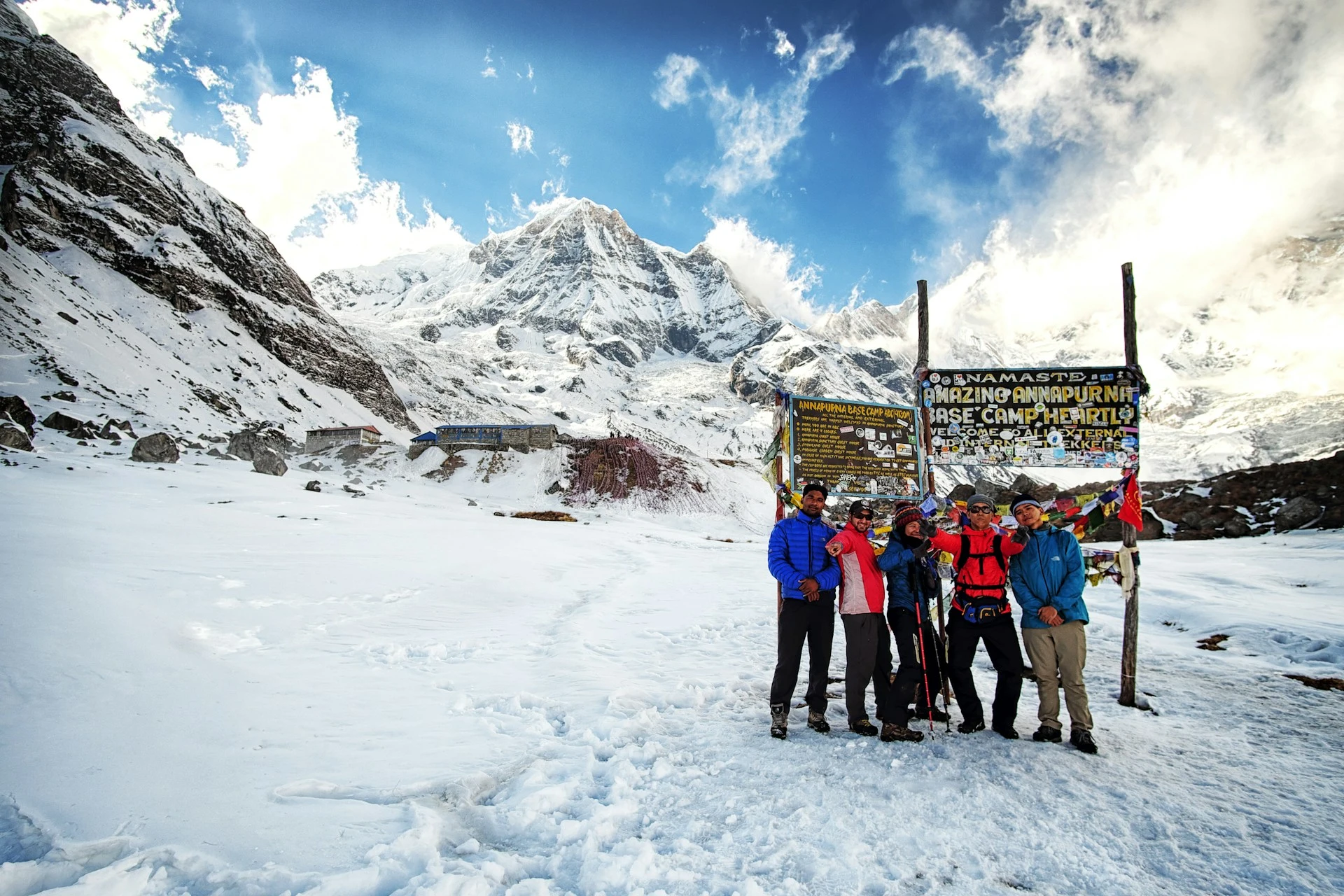
Annapurna Base Camp sits at 4,130 m on the floor of a glacial bowl. Annapurna I, the tenth highest mountain on earth, is directly in front of you. Annapurna South, Hiunchuli, Gangapurna, Tent Peak and Machhapuchhre stand around the rim. There is no ridge to look across from and no valley leading away. You are inside a ring of mountains, and it feels like it.
The walk in takes six days from Pokhara through Gurung villages, rhododendron forest and then bamboo and moss where the gorge closes over. The altitude is modest by Everest standards. Nobody sleeps above 4,130 m and the whole trek stays below 4,200 m. What catches people out is the rate of climb: the standard itinerary gains 900 m of sleeping altitude in a single day near the top.
Ours does not. We break that climb with a night at Machhapuchhre Base Camp, 3,700 m, so the last three sleeping gains are 630 m, 470 m and 430 m. It costs nothing in trek days and it is the difference between arriving at ABC with a headache and arriving able to enjoy it.
Two honest warnings before you read further. The hard part of this trek is stone steps, not thin air: the descent from Chhomrong to the Chhomrong Khola is roughly 2,500 of them and you climb back up on the way out. And the gorge between Deurali and Machhapuchhre Base Camp is avalanche terrain that has killed trekkers, most recently in 2025. We cover both properly further down this page.
Trips Highlights
- Stand inside the Annapurna Sanctuary at 4,130 m, a glacial bowl ringed by peaks on every side rather than a viewpoint you look out from
- Sleep at Annapurna Base Camp for sunset and sunrise on Annapurna I, the tenth highest mountain on earth
- A night at Machhapuchhre Base Camp, 3,700 m, which splits the standard 900 m climb into 470 m and 430 m
- Machhapuchhre from a few kilometres away: unclimbed, closed to climbing permanently, and the only peak of its size in Nepal nobody has stood on
- Cross the avalanche terrain above Deurali early in the morning with a guide who checks conditions first, and knows when to turn around
- Daily oxygen saturation and pulse checks from Day 5, recorded so we can see a trend rather than guess
- Gurung stone villages at Ghandruk and Chhomrong, with Annapurna South filling the skyline above the terraces
- Rhododendron forest between Ghandruk and Chhomrong, in flower through late March and April
- Hot springs on the Modi Khola at Jhinu Danda on the way out, three stone pools beside the river
- A second guide on any departure of seven or more, so the group can split when walking speeds differ
Trips Itinerary
You are met at Tribhuvan International Airport and driven to your hotel in Thamel. Traffic decides whether that takes twenty minutes or an hour.
Nothing is scheduled. Sleep if you have come off a long flight. If you land early enough we will do the trip briefing this evening, otherwise tomorrow morning before the bus.
At the briefing we go through the route, the current snow and gorge conditions, your insurance policy and your kit. If something important is missing, Thamel sells it and we will point you at a shop that is not fleecing you.
Duration:
Transfer 30 to 45 min
Accomodation:
3-star hotel, Kathmandu
A long day sitting down. The tourist bus follows the Trishuli river west through terraced hills and roadside towns. It is a decent road by Nepali standards and a slow one by any other.
Delays happen. Landslides in the monsoon months and roadworks in the dry season can add two hours, so we leave early rather than late.
If you would rather fly, the Kathmandu to Pokhara flight takes 25 minutes and costs around USD 110 to 130. Say so when you book and we will arrange it. It is weather-dependent and cancels more often than people expect, which is the reason it is not the default.
Pokhara sits on a lake at 820 m with Machhapuchhre visible at the end of the street on a clear evening. Afternoon free. Last chance to rent a sleeping bag, buy microspikes or find anything you forgot.
Duration:
6 to 7 hrs by road, 200 km
Accomodation:
3-star hotel, Pokhara
A short drive on a rough road to Kimche, then a genuinely easy first day on foot. Stone steps up through terraced fields, and you are in Ghandruk by mid-afternoon.
We keep the first walking day short on purpose. It lets us see how everyone moves, how the boots are behaving and whether the porter loads are packed sensibly, while we are still two hours from a road.
Ghandruk is a Gurung village of slate-roofed stone houses stacked up the hillside. Annapurna South and Hiunchuli sit directly above it and Machhapuchhre is off to the right. It is one of the best village views in Nepal and you get it from the lodge terrace with a cup of tea.
There is a small Gurung museum in the upper village if the light goes early.
Duration:
2 hrs drive, then 2 to 3 hrs trek, 4 km
Accomodation:
Teahouse lodge, Ghandruk
The day that teaches you what this trek is. You gain only 230 m of sleeping altitude and you will climb and descend well over 1,200 m to do it.
The trail drops steeply to the Kimrong Khola at about 1,780 m, crosses the river, and then climbs relentlessly through forest to Kimrong Danda and on to Chhomrong. Most of it is stone steps, laid by hand generations ago and worn smooth.
Chhomrong is the last real village on the route and the gateway to the Sanctuary. It is built down a steep spur in three tiers, so getting from the upper lodges to the lower ones is itself a ten-minute descent. There are bakeries, a couple of gear shops and the last reliable ATM-free chance to buy anything cheaply.
Look up the valley from the terrace here. That notch in the ridge to the north is where you are going, and the gorge is already visibly narrower than anything you have walked so far.
Duration:
5 to 6 hrs trek, 10 km
Accomodation:
Teahouse lodge, Chhomrong
The famous one. Chhomrong begins with roughly 2,500 stone steps down to the Chhomrong Khola at about 1,900 m, then an unbroken climb of 460 m up the other side to Sinuwa at 2,360 m. You will be doing that staircase in reverse on Day 10, and everyone remembers it.
From Sinuwa the trail levels into deep forest and traverses to Bamboo at 2,310 m, actually losing a little height, then climbs again through bamboo thickets and moss-hung rhododendron to Dovan at 2,600 m.
The valley closes in here. You lose the big mountain views for a day and a half and walk in green shade with the river roaring somewhere below. People find this section either the most atmospheric part of the trek or the most claustrophobic, and there is no middle ground.
Watch your footing on wet stone. This is where twisted ankles happen, not up at ABC.
Oxygen saturation and pulse checks start this evening and continue every evening from now on.
Duration:
6 to 7 hrs trek, 12 km
Accomodation:
Teahouse lodge, Dovan
A deliberately short day. You gain 630 m of sleeping altitude and we would rather you did it by lunchtime and then rested than pushed on to a bigger gain.
The trail climbs steadily through thinning forest to the lodges at Himalaya, 2,920 m, then past Hinku Cave, a huge rock overhang that sheltered trekkers before there were lodges here. Above the cave the trees give out and the walls of the gorge stand up sheer on both sides.
Deurali sits at 3,230 m where the valley is at its narrowest. It is cold, it is loud with the river, and the lodges are basic.
Your guide will talk to the lodge owners and any group coming down about the state of the ground above, and will check the forecast. From here on, the plan for tomorrow morning depends on conditions rather than on the schedule printed on this page. That is not a caveat we are adding for legal cover. It is the actual decision point of this trek.
Duration:
3 to 4 hrs trek, 6 km
Accomodation:
Teahouse lodge, Deurali
Early start, usually between 5.30am and 6.30am. Not for the view. The 2 km above Deurali runs under steep, snow-loaded slopes on the west side of the Modi Khola, and the safest time to be in it is while the snowpack is still frozen hard from the night. By late morning the sun has been on those slopes for hours and the risk climbs.
Your guide crosses the exposed sections one at a time, with spacing, and does not let the group bunch up. If the guide judges conditions unsafe, we wait at Deurali. If they do not improve, we turn around. That has happened and it will happen again.
Once through, the gorge opens and the ground changes completely. Moraine, boulders, low scrub, and suddenly sky. Machhapuchhre Base Camp is a handful of lodges on a shelf at 3,700 m at the mouth of the Sanctuary, with Machhapuchhre directly overhead. No one has ever climbed it and no one is allowed to.
You arrive by late morning with the afternoon free. After lunch and a rest we walk 30 to 45 minutes up towards ABC to around 3,900 m and come back down. Climb high, sleep low. That walk is the single reason our profile is safer than the standard one.
Sunset here is often better than at ABC, because you are looking straight up at Machhapuchhre with the light coming off the fluted ridge.
Duration:
2 to 3 hrs trek, 4 km, plus an afternoon acclimatisation walk
Accomodation:
Teahouse lodge, Machhapuchhre Base Camp
Two hours, 430 m, and one of the shortest days you will ever walk to reach somewhere this good.
The trail climbs the moraine on the east side of the glacier, gently at first and then in a series of short rises. Turn around every so often. Machhapuchhre gets steadily more absurd behind you as you gain height on it.
Then the bowl opens out. Annapurna I at 8,091 m is straight ahead, a two and a half kilometre wall of ice above the glacier. Annapurna South and Hiunchuli close the west side, Gangapurna and Annapurna III the far end, Tent Peak and Machhapuchhre the east. It is a full 360 degrees of mountains and nothing at all leads out of it except the way you came in.
We arrive by late morning, which leaves the whole afternoon. Walk out onto the moraine towards the glacier. Visit the memorials on the ridge above the lodges, including the one to Anatoli Boukreev, killed by an avalanche on Annapurna in 1997. They are a reminder of what this place is when the weather is bad.
Cloud usually fills the bowl during the afternoon and clears again around sunset. Sunset light on the Annapurna face turns it orange for about ten minutes. Sunrise is better still and colder, so lay your clothes out the night before.
Lodges here are unheated except for the dining room stove. Bring your bag inside from the porter load, and expect a shared or dormitory room in October and November.
Duration:
2 hrs trek, 4 km
Accomodation:
Teahouse lodge, Annapurna Base Camp
Sunrise on Annapurna I, breakfast, then 1,820 m of descent in one day. This is the longest and hardest day of the trek and almost nobody expects that, because it is all downhill.
We leave early again for the same reason we came up early. The gorge section between MBC and Deurali is crossed in the cold of the morning, not at midday.
Below Deurali the trail loses height fast through Himalaya and Dovan and back into the forest. Knees complain. Use both poles from the top and take the ten-minute stops rather than pushing through.
Bamboo at 2,310 m is warm and green after two nights on rock and ice, and the air feels thick. Most people sleep extremely well here.
If the group is tired we stop at Dovan instead and make up the distance tomorrow. That call is the guide’s, made on the day.
Duration:
6 to 7 hrs trek, 15 km
Accomodation:
Teahouse lodge, Bamboo
The staircase, in reverse. Down to Sinuwa, down to the Chhomrong Khola, and then those 2,500 steps back up into Chhomrong. It is around 45 minutes to an hour of steady climbing and there is no way around it.
Lunch in Chhomrong, then a long descent southwest to Jhinu Danda at 1,780 m.
From the lodges it is a 15 to 20 minute walk down to the hot springs on the bank of the Modi Khola. Three stone pools, hot water piped from the source, and the river running past cold and grey a metre away. Small local entry fee, a few hundred rupees, paid at the gate.
It is public and it is busy in the late afternoon. Bring swimwear, because stripping off is not acceptable here. After eight days of bucket washes, twenty minutes in hot water is the best thing on this itinerary that is not a mountain.
Duration:
5 to 6 hrs trek, 11 km
Accomodation:
Teahouse lodge, Jhinu Danda
A short, easy walk down the Modi Khola on a wide trail to the road head at Syauli Bazaar, then a private jeep to Pokhara on a road that is rough for the first hour and paved after that.
You are in Pokhara by mid-afternoon. Hot shower, laundry that someone else does, and a proper bed.
Pokhara is a good place to have an evening. The lakeside strip has real coffee, cold beer and restaurants that are not serving dal bhat from a solar-heated kitchen. Sit somewhere with a view north and look at where you have been.
This is also the day to settle up with your porters if you are tipping in cash, since they head home from here.
Duration:
2 to 3 hrs trek, 6 km, then 2 hrs drive
Accomodation:
3-star hotel, Pokhara
Back the way you came, by tourist bus. If you would rather fly, tell us at least a week ahead and we will book the 25-minute flight instead, at extra cost.
Afternoon free in Kathmandu. Most people spend it in Thamel buying things they refused to carry.
Farewell dinner in the evening at a restaurant in town, with the guide and any office staff who worked on your trip.
Duration:
6 to 7 hrs by road, or 25 min by air
Accomodation:
3-star hotel, Kathmandu
We drive you to the airport about three hours before your flight. Kathmandu departures are slow and the queues outside the terminal are real.
If you are staying on in Nepal, tell us and we will hold your bags at the office, book onward transport or put together a few days in Chitwan or Bandipur.
Duration:
Transfer 30 to 45 min
Accomodation:
Not included
Trips Include
Everything listed below is already paid for in the trek price. We give quantities and names rather than vague phrases, because vague inclusions are where a cheap quote turns expensive on the trail.
- Airport transfers in Kathmandu on arrival and departure, in a private vehicle
- 2 nights in a 3-star hotel in Kathmandu, twin share, breakfast included
- 2 nights in a 3-star hotel in Pokhara, twin share, breakfast included
- 8 nights in teahouse lodges on trek, twin share where rooms allow. At MBC and ABC in peak season rooms are shared or dormitory, because there are only a few buildings.
- All meals on trek: 8 breakfasts, 9 lunches and 8 dinners, ordered from the lodge menu with no cap on what you choose
- One hot drink with every meal on trek
- Annapurna Conservation Area Permit (ACAP), arranged by us using your passport details
- TIMS card, obtained on your behalf even though checkpoint enforcement is currently inconsistent
- Licensed, English-speaking trekking guide for the full trek, with wilderness first aid training
- A second licensed guide on any departure of seven trekkers or more
- One porter shared between two trekkers, carrying up to 12 kg of your kit each
- All guide and porter wages, food, lodging, insurance and equipment
- Kathmandu to Pokhara and Pokhara to Kathmandu by tourist bus, or by 25-minute flight on request at extra cost
- Private vehicle Pokhara to Kimche at the start and Syauli Bazaar to Pokhara at the end
- Daily oxygen saturation and pulse checks from Day 5 upward, using a pulse oximeter, with readings written down
- Group first aid kit carried by the guide, including a pulse oximeter and basic altitude medication
- Water purification tablets or filter use for the whole trek, so you do not buy bottled water
- Duffel bag on loan for the porter load, and a trekking map for the group
- Pre-departure briefing in Kathmandu covering route, weather, gorge conditions and kit check
- All government taxes, VAT and company administrative costs
Guide and porter wages, their insurance, their food, their lodging and their kit are inside the price. You will not be asked to top anyone up mid-trek. Tips at the end are separate and entirely yours to decide.
Both permits are bought by us before you leave Kathmandu or Pokhara, using your passport details. You do not queue at the Nepal Tourism Board.
Trips Exclude
These sit outside the package. For thirteen days, budget roughly USD 250 to 450 on top of the trek price. Lodge charges climb as you go up the gorge, because everything above Chhomrong arrives on somebody’s back or a mule.
- International flights to and from Kathmandu
- Nepal visa on arrival, currently USD 30 for 15 days, USD 50 for 30 days, USD 125 for 90 days
- Travel insurance with helicopter evacuation and medical cover to at least 4,500 m, which is compulsory on this trek
- Lunches and dinners in Kathmandu and Pokhara, roughly USD 6 to 20 a meal depending on where you eat
- Hot showers in lodges, USD 2 to 5, and none at all at ABC
- Device charging in lodges, USD 2 to 5 per charge above Chhomrong
- Wifi in lodges, USD 2 to 5 a day, patchy above Deurali and absent at ABC
- Bottled and canned drinks, beer, and boiled water bought by the flask
- Snacks, chocolate and anything from the lodge shelf outside your meals
- Personal trekking equipment and clothing
- Sleeping bag and down jacket rental in Pokhara, roughly USD 2 to 3 per item per day
- Microspikes, needed November to March, USD 15 to 25 to buy in Pokhara
- Flights between Kathmandu and Pokhara if you prefer them to the bus, roughly USD 110 to 130 each way
- Extra nights in Kathmandu or Pokhara caused by weather, road closures or an early return
- Jhinu Danda hot springs entry fee, a small local charge of a few hundred rupees
- Tips for the guide, second guide and porters, entirely at your discretion
- Emergency helicopter evacuation, which your insurer pays, not us
- Anything not written in the inclusions list above
Travel insurance covering helicopter evacuation and medical treatment to at least 4,500 m is required, and we will ask to see the policy before departure. Cover to 6,000 m costs very little more and we would take it.
The Sanctuary has one way in and one way out. If the weather closes the gorge, evacuation by air can be impossible for a day or two, and a policy that also covers trip delay is worth having.
Packaging Lists
The four things that actually matter
Boots you have already walked in. Mid-weight, ankle support, waterproof, and worn for at least 80 km before you fly. This trek is stone steps for days. Blisters and black toenails are the most common reason someone has a miserable week, well ahead of altitude.
Trekking poles. Two, not one. The descent from ABC to Bamboo drops 1,820 m in a single day, most of it on stone. Poles take a real load off your knees.
A four-season sleeping bag. Lodges at MBC and ABC are unheated stone or plywood rooms and the blankets are not enough in December or January. Rated to minus 10C is right for October to April. We can arrange a rental in Pokhara.
Microspikes, November to March. Light, cheap, and they turn the frozen morning traverse above Deurali from unpleasant to routine. Buy or rent in Pokhara.
Clothing
- Base layers, two sets, merino or synthetic. No cotton.
- Fleece or light insulated mid layer
- Down jacket, 600 fill or better, for ABC and MBC evenings
- Waterproof shell jacket and trousers. The gorge holds rain and the forest drips even when it is not raining.
- Two pairs of trekking trousers, one pair of shorts for the low warm days
- Sun hat, warm hat, buff, glove liners and warm outer gloves
- Four to five pairs of wool socks, plus liners if you are blister-prone
- Swimwear and a quick-dry towel for the Jhinu Danda hot springs. The pools are public.
For women
Bring what you would normally need for a two-week trip and enough sanitary products for the whole trek. Above Chhomrong there are no shops of any kind. Disposal is your own bag out, since lodge bins do not get emptied down the valley.
Everything else
- 30 to 40 litre daypack with a rain cover
- Headtorch and spare batteries. Lodge power cuts are normal.
- Sunglasses, category 3 or 4. Snow glare in the Sanctuary is severe.
- Sunscreen 50 plus, lip balm with SPF
- Two one-litre water bottles or a bladder plus a bottle
- Personal first aid: blister plasters, ibuprofen, rehydration salts, any prescription medicines, plus your own diamox if your doctor has prescribed it
- Power bank, 10,000 mAh or larger. Charging costs money and cold flattens batteries.
- Earplugs. Lodge walls at Deurali and MBC are plywood.
- Toilet paper and hand sanitiser
Trips Altitude
Trips FAQs
The questions we actually get asked about this trek, starting with the one everybody asks: how it compares to the other Annapurna options and to Everest Base Camp.
They are three different trips and people book the wrong one all the time.
Ghorepani and Poon Hill is the short one. Five days on the trail, a top height of 3,210 m, and a sunrise viewpoint that looks across at Dhaulagiri and the Annapurnas from a distance. Good for a first trek, good with children, no altitude worry. You are outside the mountains looking in.
Mardi Himal climbs a forested ridge to 4,500 m at Mardi Himal Base Camp with Machhapuchhre almost close enough to touch. It is quieter than ABC, the walking is on a narrow ridge rather than in a gorge, and the exposure to weather up high is greater. Ten days.
Annapurna Base Camp is the only one that puts you inside a ring of 7,000 m and 8,000 m peaks with no view out. It is the biggest day-to-day workload of the three because of the stone steps, and the only one with real avalanche terrain on the route.
If you have thirteen days and reasonable fitness, ABC. If you have a week, Poon Hill. If you want a ridge and fewer people, Mardi.
Different mountains and a very different experience.
Altitude. Everest Base Camp reaches 5,364 m and Kala Patthar 5,545 m. ABC tops out at 4,130 m. Altitude sickness is a genuine planning problem on Everest and a manageable one here. Roughly one trekker in ten turns back on the Everest route. On ABC it is far fewer, and usually a knee or a stomach rather than altitude.
Getting there. Everest needs the Lukla flight, which is weather-dependent and can strand you for days at either end. ABC starts with a bus and a jeep. Nothing cancels.
The view. Everest Base Camp itself has no view of Everest, which surprises people. You climb Kala Patthar for that. ABC has Annapurna I filling the sky from where you eat breakfast.
Hardship. Everest is colder, drier, higher and more tiring. ABC is steeper day to day, wetter, and harder on knees.
ABC is the better first Himalayan trek. Everest is the bigger one.
Yes, and it is the one honest warning this route needs.
The section between Deurali (3,230 m) and Machhapuchhre Base Camp (3,700 m) runs along the floor of a narrow gorge with steep slopes rising on both sides. Snow that builds up on those slopes has nowhere to go but down into the trail. It is classic terrain-trap ground.
People have died there. An avalanche between Hinku Cave and Deurali in March 2001 killed dozens. In January 2020 an avalanche in the same stretch killed four South Korean trekkers and three Nepali guides. In late March 2025 a solo trekker was killed between Deurali and MBC. The trail is re-routed most years because of avalanche debris.
What that means in practice: the risk is real, concentrated in a couple of kilometres, and highly dependent on recent snowfall. In a settled autumn week with no fresh snow it is close to zero. In the 24 to 72 hours after a heavy snowfall, particularly in January, February and March, it is serious.
What we do about it is in the Good to Know section below. The short version: we ask before we go, we cross early and spaced out, and we are willing to turn around.
We arrange them before you start walking, using a scan of your passport. You do not queue anywhere.
ACAP, the Annapurna Conservation Area Permit, is compulsory and it is genuinely checked. There are posts at Birethanti, Ghandruk and Chhomrong and they will stop you. It currently costs NPR 3,000 for foreign nationals, less for SAARC citizens, free for children under ten.
TIMS is the disputed one. It has not been formally abolished in the Annapurna region the way it was in Khumbu, but since 2025 checkpoints here have reportedly been inspecting ACAP only. Different sources will tell you different things and they are all partly right.
We buy it anyway. The fee is small and being sent back down from a checkpoint on Day 4 would cost you far more than the card does. Both permits are in the price.
Note also that independent trekking without a licensed guide is not permitted inside the Annapurna Conservation Area, so a guide is a legal requirement here, not an upsell.
Fit enough to walk five to seven hours on steep, uneven stone steps, on eight consecutive days, carrying a daypack of four to six kilos.
The useful test is not distance, it is repeated stairs. If you can do 45 minutes of continuous stair climbing at a steady pace without stopping, three times a week, you are ready. If you train only on flat ground you will find Day 4 and Day 5 a shock.
Start eight to ten weeks out. Hills with a loaded pack beat gym cardio. Include downhill, because the descent from ABC to Bamboo is what actually hurts people, and downhill loading is the one thing nobody trains.
Age is not the barrier people think it is. We have had trekkers in their seventies finish comfortably and fit thirty-year-olds struggle because they trained on a treadmill.
Mild symptoms are possible, serious altitude sickness is uncommon on this route, and the risk is not zero just because the numbers look modest.
The problem on ABC is not the height, it is the rate. Most itineraries sold online go from Sinuwa or Bamboo to Deurali and then straight to ABC, gaining close to 900 m of sleeping altitude on the final day. That is well above the 300 to 500 m per night guideline once you are over 3,000 m.
Our profile gains 630 m to Deurali, 470 m to MBC and 430 m to ABC, with an afternoon walk to about 3,900 m from MBC before sleeping at 3,700 m. Same number of trek days as the standard version. Better acclimatisation.
From Day 5 your guide records oxygen saturation and pulse every evening. One reading tells you almost nothing. A trend across four evenings tells you a lot, which is why we write them down.
Headache, poor sleep and loss of appetite at MBC and ABC are normal. Vomiting, an unsteady walk or breathlessness at rest are not, and the response to those is to go down immediately. Losing height is easy here: two hours of descent from ABC puts you 430 m lower and four more hours puts you at 2,600 m.
Yes, and solo travellers make up a good share of our bookings on this route.
The Annapurna trails are among the busiest in Nepal, the lodges are family-run, and you are with a licensed guide the whole way, which is a legal requirement inside the conservation area in any case.
Practical points. Rooms at MBC and ABC in peak season can be shared or dormitory because there are only a handful of buildings, so tell us at booking if you want a single room wherever one exists and we will try, though at 4,130 m we cannot promise it. Lodge toilets are shared and above Chhomrong many are squat toilets. There are no shops above Chhomrong, so carry what you need for the full eight days.
If anything about a lodge or a fellow trekker makes you uncomfortable, tell the guide. Moving you to a different lodge is straightforward and we would rather do it than have you put up with something.
Good and cheerful as far as Chhomrong. Basic from Sinuwa upward. Spartan at MBC and ABC.
Down low you get a private twin room, a proper mattress, an attached or nearby bathroom, wifi you pay for, and a menu with real variety. Chhomrong even has bakeries.
Above Chhomrong the lodges are wood and stone with plywood partitions between rooms. Bring earplugs. Rooms are unheated. The dining room has a stove and that is where everybody sits after 5pm.
At MBC and ABC there are only a few buildings serving the entire route. In late October you may be in a shared room, a dormitory or occasionally a dining room floor if the weather has bunched everyone up. Nobody is left outside, but the room you get is whatever exists.
Toilets above Deurali are squat, shared and cold. There are no showers at ABC. This is normal and it lasts two nights.
Vegetarian is easy. Dal bhat, the rice, lentil and vegetable plate, is the staple and it comes with free refills at almost every lodge. It is also the freshest thing on any menu, because it is what the family is cooking anyway.
Beyond that expect fried rice, noodles, potatoes, soup, pasta, eggs, porridge, chapati and Tibetan bread. Menus get shorter and prices rise as you go up, because everything above Chhomrong walked in on somebody’s back.
Gluten-free is workable with care: rice, dal, potatoes, eggs and vegetables cover you, but cross-contamination in a lodge kitchen cannot be ruled out. Tell us at booking and the guide will speak to each lodge.
Vegan is possible but repetitive above Chhomrong. Bring your own snacks and protein.
We suggest skipping meat from Chhomrong upward. It is carried unrefrigerated for a day or more, and a stomach bug at 3,700 m ruins the part of the trek you came for.
October and November are the best months. Clear air, stable weather, cold but not brutal nights, and the busiest trails of the year.
March to April is the second season. Warmer, hazier, rhododendron in flower below Chhomrong, and more snow on the ground up high. Avalanche risk in the gorge is higher in early spring than in autumn.
December to February is genuinely cold and quiet, with clear skies and short days. Some lodges above Deurali close. Snow can shut the route entirely for days at a time and this is the period when the gorge is at its most dangerous after a storm. We run it, but only with microspikes, a flexible schedule and an acceptance that ABC is not guaranteed.
June to mid-September is monsoon. Cloud most days, leeches in the forest between Chhomrong and Deurali, landslides on the access roads, and views that come and go. It is the wrong time to see the Sanctuary. If it is the only time you have, go somewhere in the rain shadow like Upper Mustang instead.
Budget USD 250 to 450 for thirteen days on top of the trek price, plus tips.
That covers hot showers at USD 2 to 5, device charging at USD 2 to 5 above Chhomrong, wifi at USD 2 to 5 a day, drinks, snacks, the hot springs fee and your meals in Kathmandu and Pokhara.
Bring Nepali rupees in cash from Pokhara. There is no ATM on the trail and no card machine above Chhomrong. Notes in small denominations are much more useful than a stack of 1,000s.
On tipping: it is customary and it is not compulsory. A common range is USD 10 to 15 per trekking day for the guide and USD 7 to 10 per day per porter, split across the group. Cash, at the end, handed over directly.
You can day-trip it from MBC and some operators do, because it saves them a night in the most expensive and most limited lodges on the route.
We do not. The Sanctuary is usually clouded in from late morning until around sunset. A day trip that arrives at 10am and leaves at noon gets you a photograph of white fog and a memory of having been somewhere.
Sleeping at ABC gives you the clearing around sunset and the whole of sunrise on the Annapurna face. That is the trek. Two nights of cold and a shared room is a fair price for it.
Because it is closed to climbing, permanently.
The mountain is sacred to the people of this valley and is associated with Shiva. A British expedition in 1957 reached about 50 m below the top and stopped there, honouring an agreement not to set foot on the summit. Nepal has issued no climbing permit for it since.
So Machhapuchhre, 6,993 m, is almost certainly the highest mountain of its size in Nepal that nobody has ever stood on. You walk directly beneath it for two days and camp at its base camp. Look at the fluted ice on the north face from MBC and it is not hard to see why nobody has pushed for permission.
Descent is quick and cheap on this trek, which is one of its quiet advantages.
If someone is unwell, the guide walks them down and the group carries on with the second guide when we have one. From ABC you can be at 2,600 m in half a day, which resolves almost every altitude problem by itself.
If the gorge is unsafe or the weather closes in, we wait at Deurali or turn back to Chhomrong. In that case we use the spare days for Ghandruk, the Jhinu hot springs or extra time in Pokhara, at no extra charge for the guide and porters. We do not charge you for a decision made on safety grounds.
Helicopter evacuation is available and expensive and your insurer pays for it, which is why we ask to see the policy. Note that the Sanctuary is a bowl with a single exit and cloud fills it most afternoons, so an air evacuation may not be possible until the following morning. Walking down remains the primary plan.
Group departures run at 1 to 12 people. Above six trekkers we add a second licensed guide, so the group can split when one half wants to walk faster than the other.
Private departures run on any date with any number, including one person. The route, inclusions and pacing are identical. A private trip gives you control over rest days and start times, which is worth having in winter when the gorge decides your schedule.
Bear in mind that lodges at MBC and ABC cannot hold a large group in twin rooms during October and November whatever we do. That is a building constraint, not a booking one.
Poon Hill can be added, and we would rather you did it as its own trek. Bolting it on to the front of ABC adds two days, the 3,300-step Ulleri staircase and a long traverse day, before you have even started the climb that matters. Plenty of operators sell the combined version. It is more days on the invoice and a tired group by Chhomrong.
Helicopter return from ABC or MBC is possible in clear weather and costs several hundred US dollars per person depending on how the seats fill. It saves three walking days. It is also the least reliable part of any itinerary, because the Sanctuary clouds over by mid-morning and a helicopter that cannot land will not land. Book it as a nice-if-it-happens, never as the plan.
Good to Know
The questions we actually get asked about this trek, starting with the one everybody asks: how it compares to the other Annapurna options and to Everest Base Camp.
This is the part of the Annapurna Base Camp trek that operator pages leave out, and it is the part you should read.
Why the ground is dangerous
Above Deurali, at 3,230 m, the Modi Khola runs through a gorge only a few hundred metres wide with slopes rising steeply on both sides. Snow accumulates on those slopes through the winter and after every storm. When it releases, there is nowhere for it to go except onto the valley floor, which is where the trail is. The debris also piles up and does not clear, so the trail is re-cut in a new line most years.
Mountain rescuers call this a terrain trap: ground where an avalanche that would be survivable on an open slope becomes lethal because the debris is funnelled and deep. The exposed stretch is roughly 2 km between Deurali and Machhapuchhre Base Camp, with the section near Hinku Cave historically the worst.
It has killed people
- March 2001: an avalanche between Hinku Cave and Deurali killed dozens of people, one of the worst trekking disasters in the Annapurna region.
- January 2020: an avalanche in the same stretch killed four South Korean trekkers and three Nepali guides.
- Late March 2025: a solo trekker was killed between Deurali and MBC.
We are not listing these to frighten you off. We are listing them because a page that tells you the trek is safe and easy has not told you what the guides actually think about on Day 7.
When it is a real risk and when it is not
The hazard is almost entirely about recent snowfall, not about the season on its own.
- Low risk: a settled autumn or late spring week with no fresh snow in the past week. Most October and November departures never see conditions that give a guide pause.
- Elevated: 24 to 72 hours after any significant snowfall, at any time of year. Fresh snow on a hard old layer is the classic problem.
- Highest: January through March, particularly after a storm, and again in early spring when daytime warming starts loosening the winter snowpack.
What your guide actually does
- Asks before going. At Deurali the guide talks to lodge owners, to porters coming down and to any group that crossed that morning. Local knowledge here is better than any forecast.
- Times the crossing. We leave Deurali between 5.30am and 6.30am. The snowpack is at its most stable when it is frozen hard overnight, and least stable in the afternoon after hours of sun. Groups that leave at 9am are in the gorge at the wrong time.
- Spaces the group out. Across the exposed sections we go one at a time with clear gaps, so an event cannot take everybody. Nobody stops to take photographs in that stretch.
- Waits. If conditions are poor, we sit at Deurali for a day. Lodges there are grim but they are not in the runout.
- Turns around. If a day’s wait does not change things, we go down. That decision belongs to the guide and it is not open to a group vote. We use the spare days at Ghandruk, Jhinu or Pokhara and we do not charge you for it.
What you should do
Carry microspikes from November to March. Do not walk this section unguided, which is not permitted anyway. If you are told to move fast and not stop through a stretch, move fast and do not stop. And be genuinely willing to not reach ABC, because a group that has decided it must get there is the one that gets hurt.
The Annapurna Sanctuary is a glacial basin about 5 km across, closed on every side by mountains, with one narrow gorge as the only entrance. It is not a marketing word. It is a description of the shape of the ground.
The rim, going round from the entrance: Machhapuchhre (6,993 m), Tent Peak (5,663 m), Gangapurna (7,455 m), Annapurna III (7,555 m), Annapurna I (8,091 m), Annapurna South (7,219 m) and Hiunchuli (6,441 m). The South Annapurna Glacier fills the floor.
Standing at ABC you turn a full circle and you never see out. There is no horizon, no distant plain, no valley leading away. The sky is a rough disc directly overhead. People go quiet when they arrive, and it is not the altitude.
Compare that with the alternatives. Poon Hill at 3,210 m is a lookout: the mountains are 30 km away across a valley and they are beautiful and they are elsewhere. Mardi Himal puts you on a ridge with Machhapuchhre close, but the ground still falls away on both sides. Everest Base Camp sits on a glacier in a valley with the view running off down the Khumbu.
ABC is the only trek of this length in Nepal where you end up inside the mountains rather than in front of them. That is the reason to come, and it is why we insist on sleeping there.
One practical consequence of the shape: cloud pours in over the rim through the middle of the day and sits in the bowl. Mornings are usually clear, afternoons usually are not, and it often opens up again for half an hour at sunset.
The highest point is 4,130 m and the highest place you sleep is the same. By Himalayan standards that is not much. Everest Base Camp trekkers sleep at 5,140 m at Gorak Shep.
The catch is the profile. Above Chhomrong the valley climbs steeply and there are no logical intermediate stops, so most itineraries make one very large jump. The version sold by many operators sleeps at Deurali (3,230 m) and then goes straight to ABC (4,130 m), a gain of 900 m in a single night. The generally accepted guideline above 3,000 m is 300 to 500 m per night.
Our profile, night by night
- Chhomrong 2,170 m
- Dovan 2,600 m, plus 430 m
- Deurali 3,230 m, plus 630 m
- Machhapuchhre Base Camp 3,700 m, plus 470 m, with an afternoon walk to about 3,900 m
- Annapurna Base Camp 4,130 m, plus 430 m
Same thirteen days. No jump over 630 m once past 2,500 m, and a climb-high-sleep-low walk built into the MBC afternoon.
Monitoring
From Day 5 the guide takes oxygen saturation and pulse each evening with a fingertip oximeter and writes the numbers down. A single reading is close to useless: people vary, cold fingers give bad readings, and a fit trekker can read low and feel fine. A downward trend over three or four evenings alongside symptoms is the thing worth acting on.
Symptoms and the response
Headache, disturbed sleep and a poor appetite at MBC and ABC are common and usually fine. Persistent vomiting, an unsteady gait, confusion, or breathlessness while sitting still are not, and the answer is immediate descent, at night if necessary.
Descent is easy here, which is worth remembering. Two hours below ABC you are at 3,700 m. Half a day and you are at 2,600 m in the trees. Very few altitude problems on this route become serious, because losing height is quick.
On diamox: talk to your own doctor before you travel. We do not prescribe, and we do not think anyone should be taking it as a routine measure at these heights.
Ask anyone who has done this trek what the hardest part was and they will not say the altitude.
The Annapurna foothills are steep, wet and farmed, and the trails have been paved with stone steps by hand over generations. Some flights are hundreds of steps long. They are uneven, they are polished smooth in places, and they are slippery when wet.
The two that matter:
- Chhomrong. Roughly 2,500 steps down from the village to the Chhomrong Khola at about 1,900 m, then 460 m of climbing up to Sinuwa. You do it on the way in on Day 5 and again in reverse on Day 10, when the up and the down are swapped.
- The Ghandruk to Chhomrong day. Only 230 m of net gain, well over 1,200 m of combined ascent and descent. It is the day that surprises people most.
Add the descent from ABC to Bamboo on Day 9: 1,820 m of height loss, much of it on stone. Downhill loading on stone steps is what wrecks knees, and it is the single most common reason someone finishes this trek limping.
What actually helps
- Two trekking poles, used from the top of every descent, not from the point where it starts hurting.
- Training that includes downhill. Almost nobody does this and it is the most useful thing on the list.
- Boots half a size up, laced tight over the instep on descents, so your toes are not slamming forward.
- Short steps and a high cadence downhill rather than long drops from step to step.
- Telling us in advance if you have knee trouble. We will plan shorter descent days and, if it helps, break Day 9 at Dovan.
Machhapuchhre means fish tail, from the twin-summit shape you see from Pokhara. From the trail above Chhomrong it looks like a single perfect spire, because you are looking at it end-on.
It is 6,993 m and it has never been summited. In 1957 a British expedition led by Jimmy Roberts reached roughly 50 m below the top and turned around, honouring an undertaking to the Nepali authorities that the summit would not be trodden on. The mountain is sacred, associated with Shiva, and Nepal has issued no climbing permit for it since.
So you spend two days walking directly beneath one of the very few mountains of its size on earth that no human has stood on top of. There is no route, no fixed rope, no base camp queue. Machhapuchhre Base Camp is named for the mountain, not for expeditions, because there are none.
Best views of it are from the trail between Chhomrong and Sinuwa in the early morning, from MBC at sunset when the fluted north face goes gold, and looking back over your shoulder on the climb from MBC to ABC. Take that last one seriously. It is the best view on the trek and it is behind you.
October to November
The best months, and everyone knows it. Air scrubbed clean by the monsoon, stable weather, clear mornings almost every day. Nights at ABC drop to about minus 5C to minus 10C. Lodges at MBC and ABC are full and rooms are shared. Book two to three months ahead.
December to February
Cold, quiet, often startlingly clear. Nights at ABC can hit minus 15C or lower. Some lodges above Deurali close for the season. Snow can close the route for days and this is the period of highest avalanche risk in the gorge after a storm. Microspikes are not optional. Come in winter for the emptiness, not for a guaranteed summit-day photograph.
March to April
The second season. Warmer, hazier as the pre-monsoon dust builds, and the rhododendron forest between Ghandruk and Chhomrong is in flower through late March and April, which is genuinely worth planning around. More snow underfoot up high than in autumn and a higher avalanche risk in the gorge.
May
Hot in the low valleys, cloudy by mid-morning up high, and thinning crowds. Workable, not ideal.
June to mid-September
Monsoon. Cloud most days, leeches in the forest between Chhomrong and Deurali, landslides on the roads at both ends, and views that appear for ten minutes and vanish. We will run it if you insist, and we would rather send you to Upper Mustang or Dolpo, which sit in the rain shadow.
Daily pattern, any season
Clear at dawn, cloud building from mid-morning, socked in through the afternoon, often clearing again around sunset. This is why we start early every day and why we sleep at ABC rather than day-tripping it.
Where you sleep
Ghandruk and Chhomrong: proper lodges, private twin rooms, decent bathrooms, bakeries and menus with range. Sinuwa to Deurali: plain wooden rooms, plywood walls, shared squat toilets, dining room stove. MBC and ABC: a handful of buildings serving the whole route, unheated rooms, shared or dormitory accommodation in peak season, no shower at ABC.
Water
Do not buy bottled water. It is expensive above Chhomrong, the plastic has to be carried out by someone, and several villages have banned it. We provide purification for the whole trek, either tablets or a filter, and you refill from lodge taps and springs. Two one-litre bottles is the right carrying capacity. Boiled water is sold by the flask if you want it hot, at USD 2 to 5 a litre.
Power
Solar panels and small hydro units. Charging is free at the lower lodges and costs USD 2 to 5 a device above Chhomrong. Cold flattens batteries fast, so sleep with your phone and camera batteries inside your sleeping bag. A 10,000 mAh power bank removes the problem entirely.
Connectivity
Ncell and NTC cover most of the route up to Deurali, patchily. Signal at MBC and ABC is unreliable and often absent. Lodge wifi is sold for USD 2 to 5 a day below Deurali and is slow. Assume you are offline for the last two days and tell people at home so before you leave Pokhara. The guide carries a phone and we have a satellite phone available for emergencies.
Money
No ATM on the trail. Draw enough rupees in Pokhara for the whole trek and carry small notes.
Toilets and washing
Western flush toilets down low, squat toilets from Sinuwa upward, shared everywhere above Chhomrong. Hot showers cost USD 2 to 5 and are gas or solar heated, so a cloudy day means a cold one. At MBC it is a bucket. At ABC it is wet wipes and patience.
Booking
A 20 percent deposit confirms your place and the balance is due on arrival in Kathmandu, in cash or by card with the card fee added. We need a passport scan, your insurance policy details and any dietary or medical notes at least three weeks out, because the permits are issued against your passport.
Insurance
Compulsory. It must cover trekking to at least 4,500 m, helicopter evacuation and medical repatriation. We will ask to see it and we will not start a trek without it. Cover to 6,000 m costs very little more and gives you room if you add another trek later.
Cancellation
Cancel more than 30 days out and the deposit is refunded less the cost of permits already issued and any hotel already paid. Between 30 and 15 days, the deposit is retained. Inside 15 days the trip is non-refundable, because staff have been booked, hotels are paid and the porters have turned down other work. This is why you want a policy with cancellation cover.
If we change the itinerary
Weather, snow, road closures and gorge conditions can all force a change. If we shorten or re-route the trek on safety grounds, there is no extra charge for the guide, the porters or the days you still spend with us. If you choose to leave early for personal reasons, unused lodge nights and meals are not refundable, because they are paid to the families who kept the rooms.
Spare days
Keep one day between the end of this trip and your international flight. Not for the trek itself, which does not depend on a mountain airstrip, but because the Pokhara road and the Pokhara flight both fail occasionally.
October and November are the clearest months and the lodges above Chhomrong fill up. There are only a handful of buildings at MBC and ABC, so a bed at 4,130 m in late October is genuinely scarce. Book two to three months ahead for autumn, six weeks for spring.
March to April gives you rhododendron forest in flower between Ghandruk and Chhomrong, which is the best thing about the spring season on this route. It also carries more avalanche risk in the gorge, so read that section before you pick your dates.
Keep one spare day at the end. Snow or a landslide on the Pokhara road can cost a day, and the Pokhara to Kathmandu flight cancels in bad weather. A spare day before your international flight removes the whole problem.
Tell us about knees before you book, not on Day 5. This trek has more descent on stone steps than any other popular route in Nepal. If you have had knee surgery or you know steps are a problem, say so and we will plan shorter descent days.
Solo travellers are welcome. Independent trekking without a guide is not permitted inside the Annapurna Conservation Area, so everyone walks with a licensed guide here regardless. Join a fixed departure or run the trek privately, the route is the same.